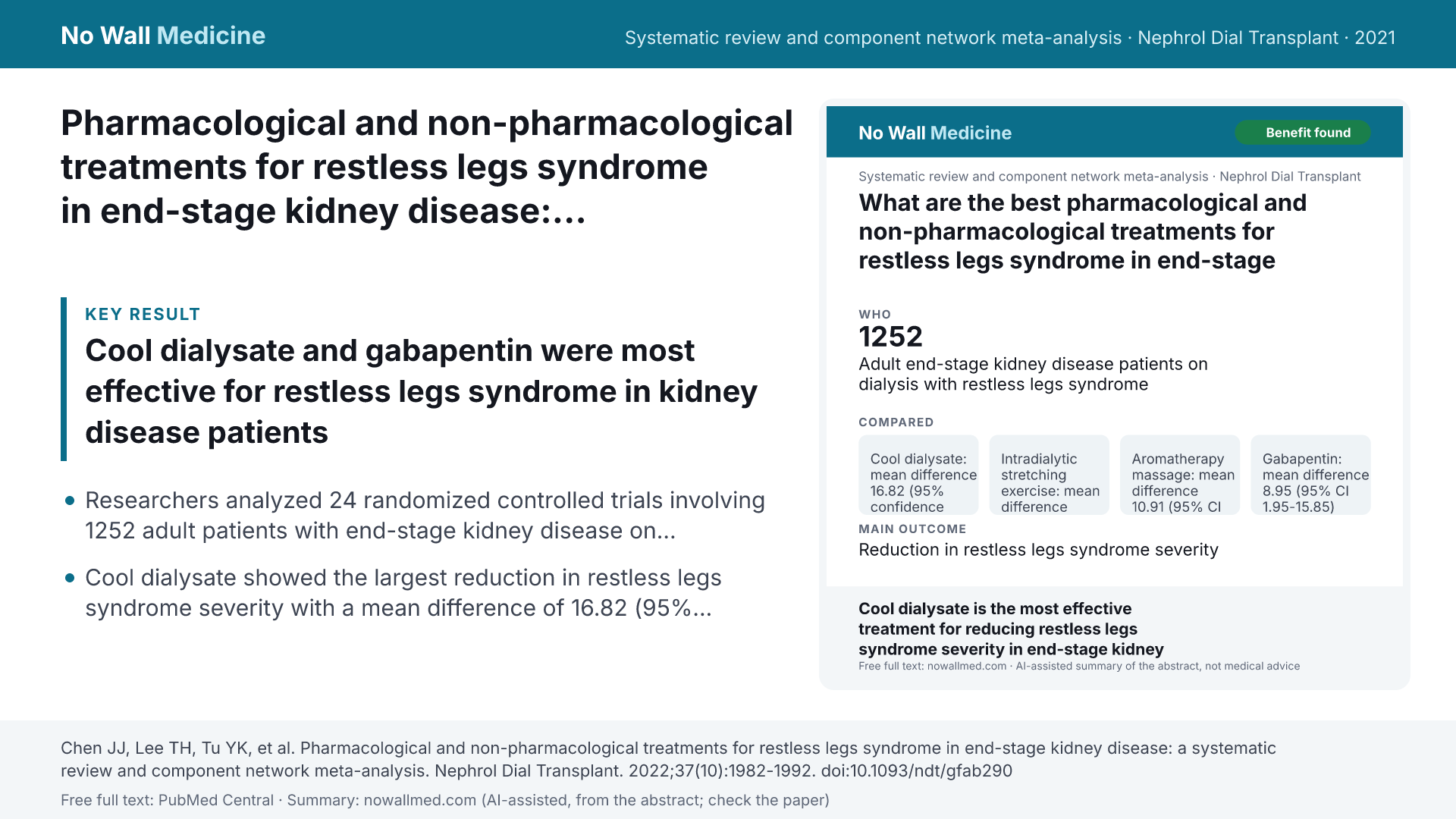
Cool dialysate and gabapentin were most effective for restless legs syndrome in kidney disease patients
Pharmacological and non-pharmacological treatments for restless legs syndrome in end-stage kidney disease: a systematic review and component network meta-analysis
Systematic review and component network meta-analysisBenefit found
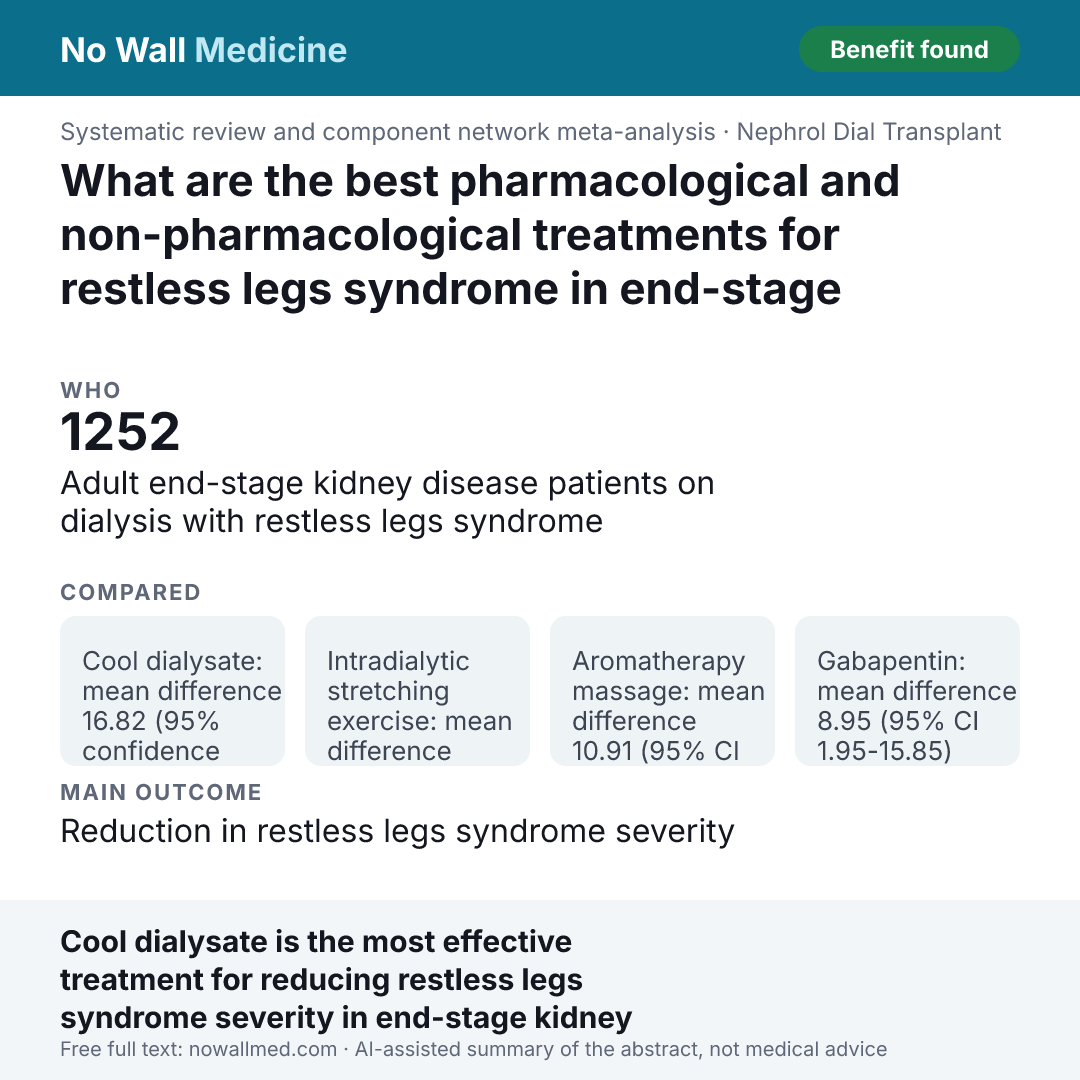
What are the best pharmacological and non-pharmacological treatments for restless legs syndrome in end-stage kidney disease?
Who
1252
Adult end-stage kidney disease patients on dialysis with restless legs syndrome
Compared
Cool dialysate: mean difference 16.82 (95% confidence interval 10.635-23.02)
Intradialytic stretching exercise: mean difference 12.00 (95% CI 7.04-16.97)
Aromatherapy massage: mean difference 10.91 (95% CI 6.96-14.85)
Gabapentin: mean difference 8.95 (95% CI 1.95-15.85)
Main outcome
Reduction in restless legs syndrome severity
Bottom line: Cool dialysate is the most effective treatment for reducing restless legs syndrome severity in end-stage kidney disease patients.
Limitation: Further parallel randomized controlled trials with sufficient sample sizes are required to evaluate long-term effects.
Nephrol Dial Transplant · 2021-10-07 · Save PNG
Clinical question: What are the best pharmacological and non-pharmacological treatments for restless legs syndrome in end-stage kidney disease?
Why it matters: An updated meta-analysis was needed to compare various pharmacological and non-pharmacological treatments for restless legs syndrome in patients with end-stage kidney disease.
Key points
- Researchers analyzed 24 randomized controlled trials involving 1252 adult patients with end-stage kidney disease on dialysis who had restless legs syndrome.
- Cool dialysate showed the largest reduction in restless legs syndrome severity with a mean difference of 16.82 (95% CI 10.635-23.02).
- Among medications, gabapentin was the most effective with a mean difference of 8.95 (95% CI 1.95-15.85) and improved sleep quality.
Limitation the authors note: Further parallel randomized controlled trials with sufficient sample sizes are required to evaluate these potential interventions and long-term effects.
Headline and key points written with AI from the paper’s abstract, with every number checked against it. Read the paper before relying on them.
Was this summary helpful?
Subject terms
Headline, design, result, key points, caveat and citation as plain text.
Cite this article
Chen JJ, Lee TH, Tu YK, et al. Pharmacological and non-pharmacological treatments for restless legs syndrome in end-stage kidney disease: a systematic review and component network meta-analysis. Nephrol Dial Transplant. 2022;37(10):1982-1992. doi:10.1093/ndt/gfab290
Spotted a mistake? Suggest a correction