Oral azacitidine increased red blood cell transfusion independence in patients with lower-risk myelodysplastic syndromes
Phase III, Randomized, Placebo-Controlled Trial of CC-486 (Oral Azacitidine) in Patients With Lower-Risk Myelodysplastic Syndromes
Why it matters: Treatment options are limited for patients with lower-risk myelodysplastic syndromes who depend on red blood cell transfusions and have low platelet counts.
Key points
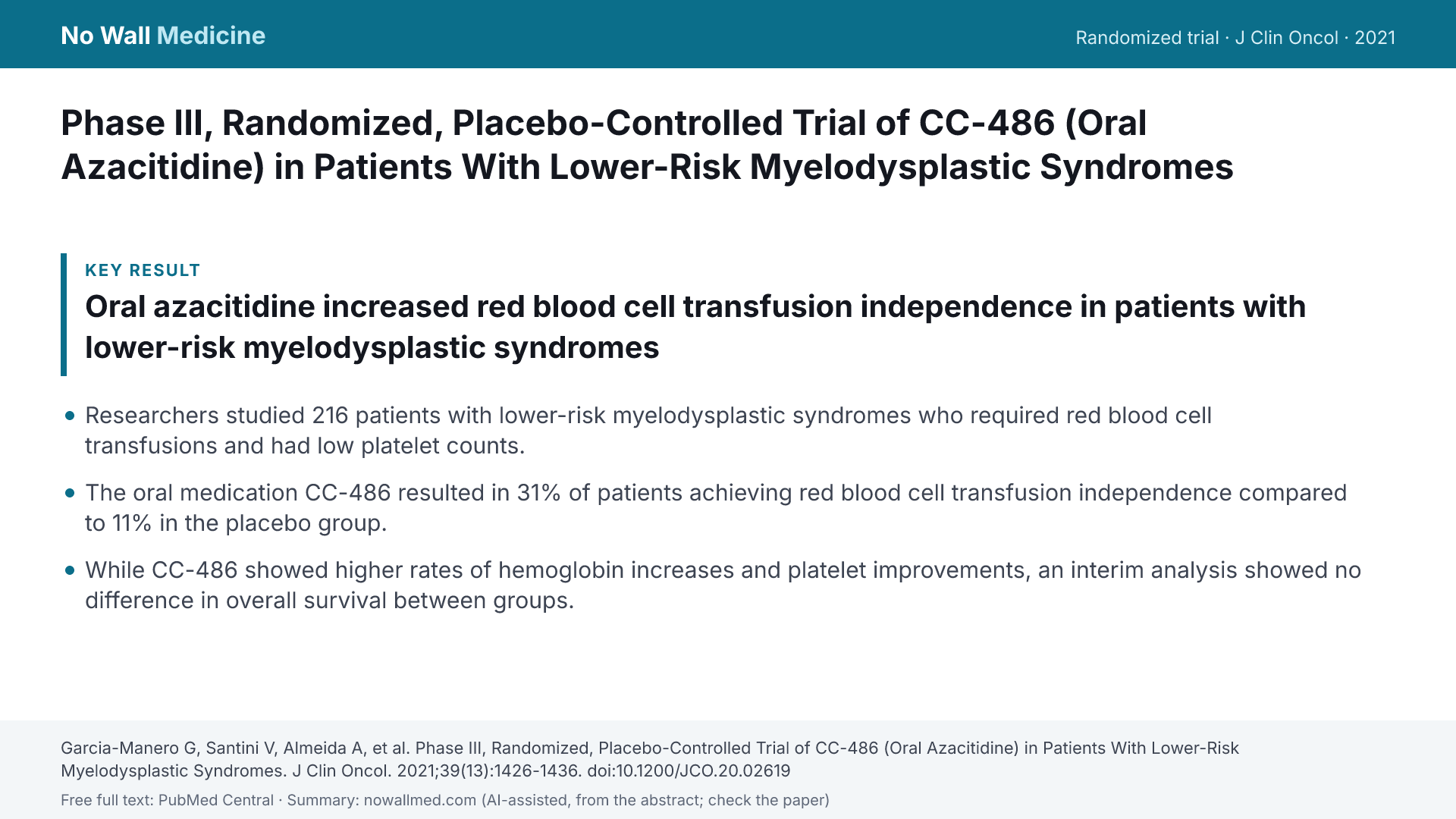
- Researchers studied 216 patients with lower-risk myelodysplastic syndromes who required red blood cell transfusions and had low platelet counts.
- The oral medication CC-486 resulted in 31% of patients achieving red blood cell transfusion independence compared to 11% in the placebo group.
- While CC-486 showed higher rates of hemoglobin increases and platelet improvements, an interim analysis showed no difference in overall survival between groups.
Limitation the authors note: The interim overall survival analysis was underpowered.
Headline and key points written with AI from the paper’s abstract, with every number checked against it. Read the paper before relying on them.
Was this summary helpful?
Subject terms
Headline, design, result, key points, caveat and citation as plain text.
Cite this article
Garcia-Manero G, Santini V, Almeida A, et al. Phase III, Randomized, Placebo-Controlled Trial of CC-486 (Oral Azacitidine) in Patients With Lower-Risk Myelodysplastic Syndromes. J Clin Oncol. 2021. doi:10.1200/JCO.20.02619
Spotted a mistake? Suggest a correction