Phase III, Randomized, Placebo-Controlled Trial of CC-486 (Oral Azacitidine) in Patients With Lower-Risk Myelodysplastic Syndromes
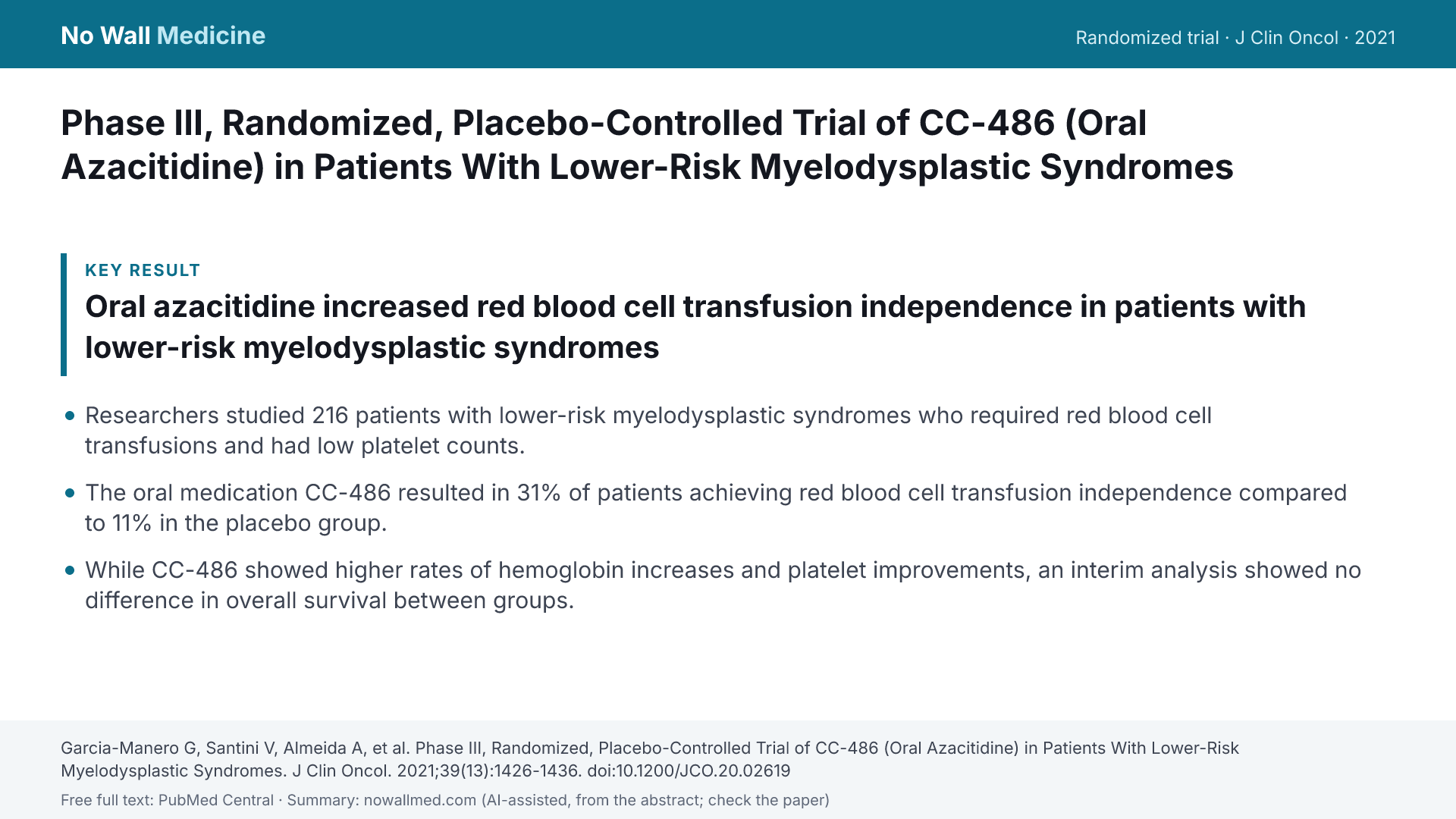
Key result: Oral azacitidine increased red blood cell transfusion independence in patients with lower-risk myelodysplastic syndromes
Key points
- Researchers studied 216 patients with lower-risk myelodysplastic syndromes who required red blood cell transfusions and had low platelet counts.
- The oral medication CC-486 resulted in 31% of patients achieving red blood cell transfusion independence compared to 11% in the placebo group.
- While CC-486 showed higher rates of hemoglobin increases and platelet improvements, an interim analysis showed no difference in overall survival between groups.
Why it matters: Treatment options are limited for patients with lower-risk myelodysplastic syndromes who depend on red blood cell transfusions and have low platelet counts.
Limitation the authors note: The interim overall survival analysis was underpowered.
Discussion prompts
- Would these patients look like yours? Who was left out?
- Is the main outcome one that matters to patients?
- Is the difference large enough to change what you do?
Cite: Garcia-Manero G, Santini V, Almeida A, et al. Phase III, Randomized, Placebo-Controlled Trial of CC-486 (Oral Azacitidine) in Patients With Lower-Risk Myelodysplastic Syndromes. J Clin Oncol. 2021;39(13):1426-1436. doi:10.1200/JCO.20.02619
Free full text: PubMed Central · Summary and visual abstract: nowallmed.com/a/phase-iii-randomized-placebo-controlled-trial-of-cc-486-oral-16ut916/ (AI-assisted from the abstract; check the paper before relying on it).