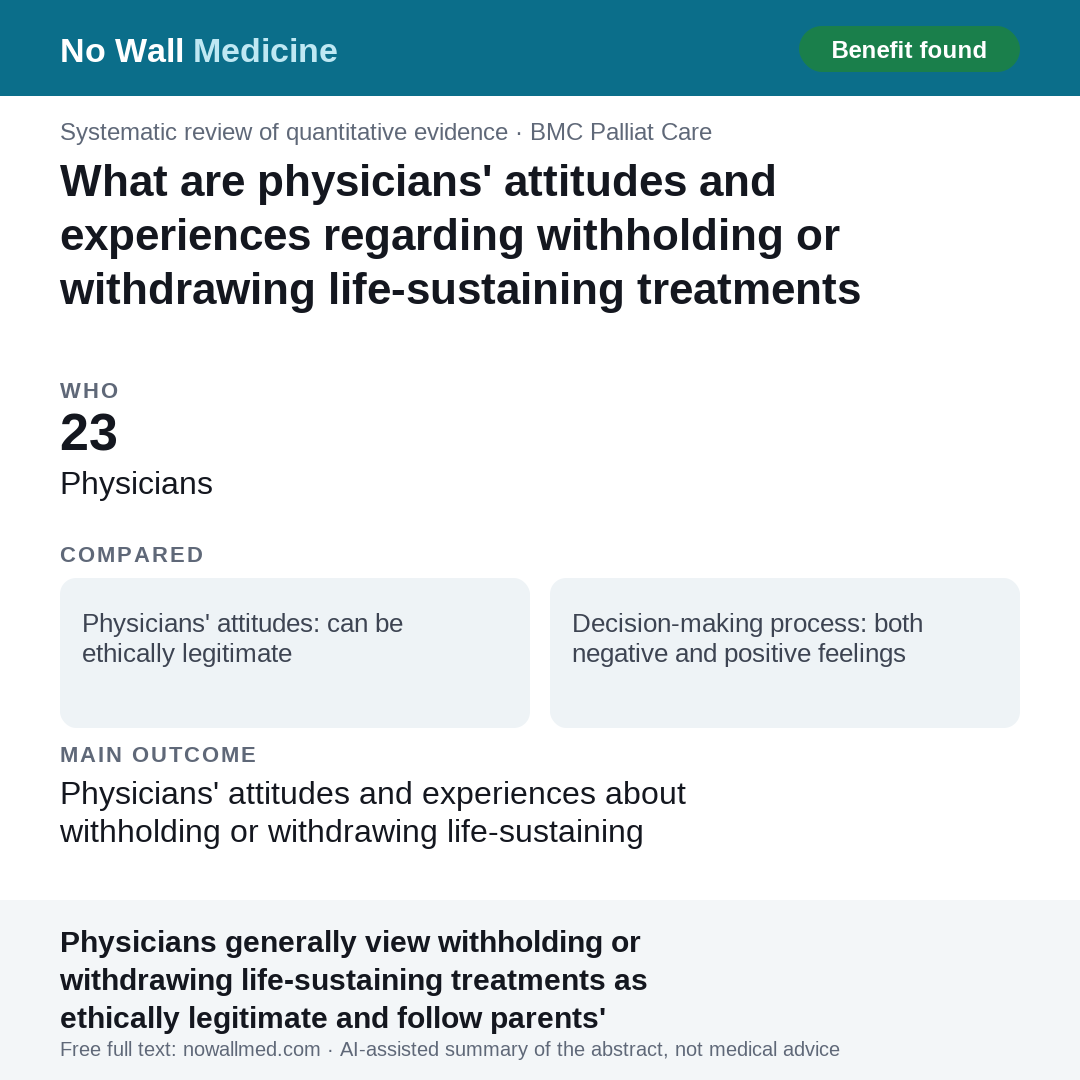
Physicians generally view withholding or withdrawing life-sustaining treatments for children as ethically legitimate
Physicians' attitudes and experiences about withholding/withdrawing life-sustaining treatments in pediatrics: a systematic review of quantitative evidence
Systematic review of quantitative evidenceBenefit found
What are physicians' attitudes and experiences regarding withholding or withdrawing life-sustaining treatments in pediatrics?
Who
23
Physicians
Compared
Physicians' attitudes: can be ethically legitimate
Decision-making process: both negative and positive feelings
Main outcome
Physicians' attitudes and experiences about withholding or withdrawing life-sustaining treatments
Bottom line: Physicians generally view withholding or withdrawing life-sustaining treatments as ethically legitimate and follow parents' wishes.
Limitation: Limited number of quantitative studies to support factors influencing physicians' attitudes and experiences.
BMC Palliat Care · 2023-09-29Download image
Clinical question: What are physicians' attitudes and experiences regarding withholding or withdrawing life-sustaining treatments in pediatrics?
Why it matters: The diverse nature of existing research makes it difficult to understand the specific attitudes and influencing factors regarding physicians' decisions to withhold or withdraw life-sustaining treatments in pediatrics.
Key points
- Researchers systematically reviewed 23 quantitative articles regarding physicians' attitudes and experiences with withholding or withdrawing life-sustaining treatments in pediatric patients.
- Physicians tended to follow the wishes of parents and patients when treatment preferences were specified and agreed to share decision-making with them.
- Physicians reported experiencing both positive and negative feelings during the decision-making process for children with life-limiting conditions.
Limitation the authors note: There was only a limited number of quantitative studies to support the hypothesis that specific factors can influence physicians' attitudes and experiences toward life-sustaining treatments.
Headline and key points written with AI from the paper’s abstract, with every number checked against it. Read the paper before relying on them.
Was this summary helpful?
Subject terms
Cite this article
Zhong Y, Cavolo A, Labarque V, Gastmans C. Physicians' attitudes and experiences about withholding/withdrawing life-sustaining treatments in pediatrics: a systematic review of quantitative evidence. BMC Palliat Care. 2023. doi:10.1186/s12904-023-01260-y
Spotted a mistake? Suggest a correction
Top studies every Monday
The week’s key trials and guidelines in your specialties, plus any topics you follow. By email, free.
Get the weekly digest