Noninvasive respiratory support strategies have distinct physiological effects in adults with acute hypoxemic respiratory failure
Physiological effects of noninvasive respiratory support strategies in adults with acute hypoxemic respiratory failure: a systematic review and network meta-analysis
Systematic review and network meta-analysisMixed results
How do noninvasive respiratory strategies affect lung injury determinants in hypoxemic adults?
Who
312
Adults with acute hypoxemic respiratory failure
Compared
Standard oxygen
High-flow nasal oxygen: -95 cmH2O*bpm [-140; -49] effort per minute
Noninvasive ventilation: -240 cmH2O*bpm [-284; -196] effort per minute
Continuous positive airway pressure: no effect on effort per minute
Main outcome
transpulmonary driving pressure and inspiratory effort
Bottom line: Noninvasive strategies have distinct effects: NIV reduces effort per breath but increases driving pressure, while CPAP and NIV improve oxygenation more than high-flow nasal oxygen.
Crit Care · 2025-10-28 · Save PNG
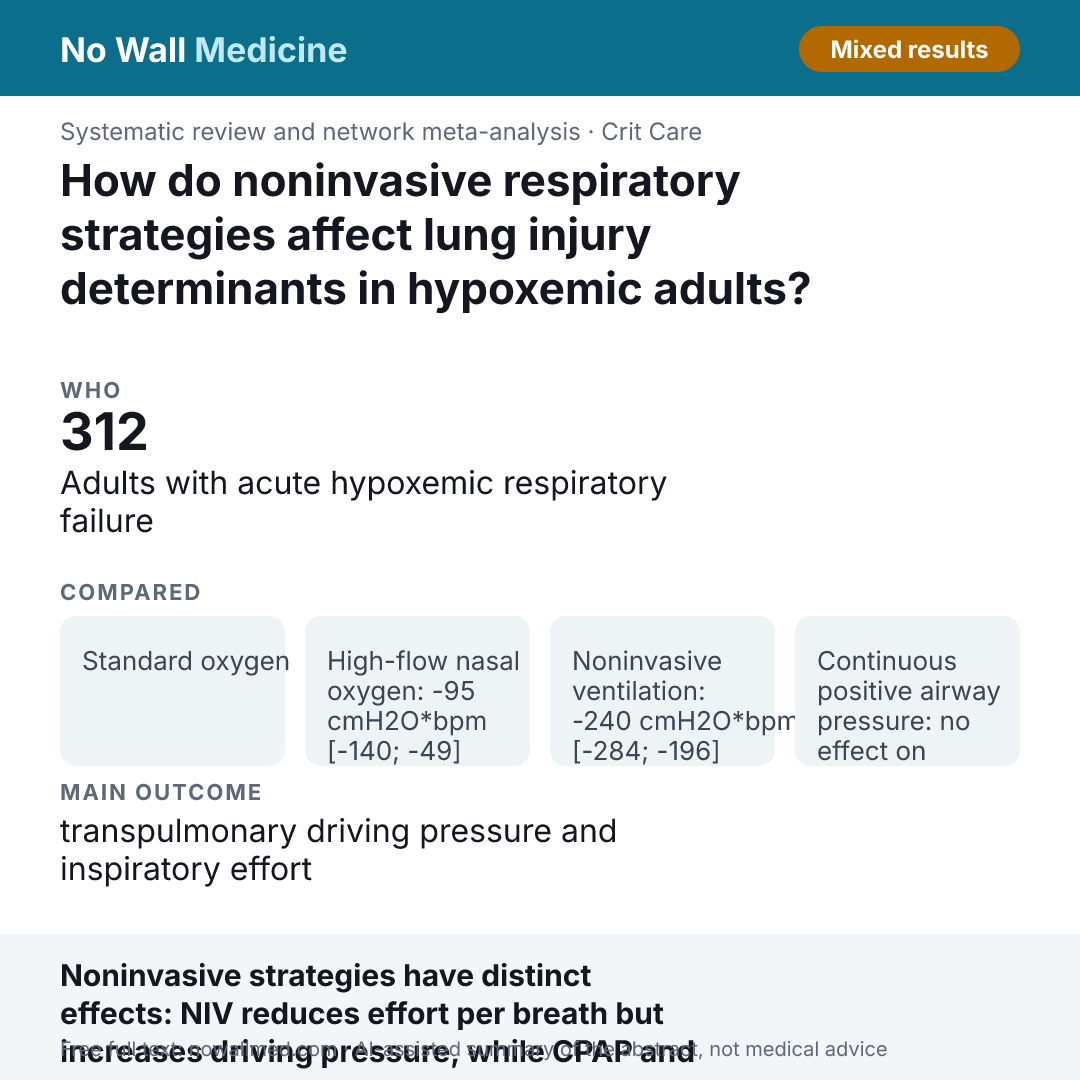
Clinical question: How do noninvasive respiratory strategies affect lung injury determinants in hypoxemic adults?
Key points
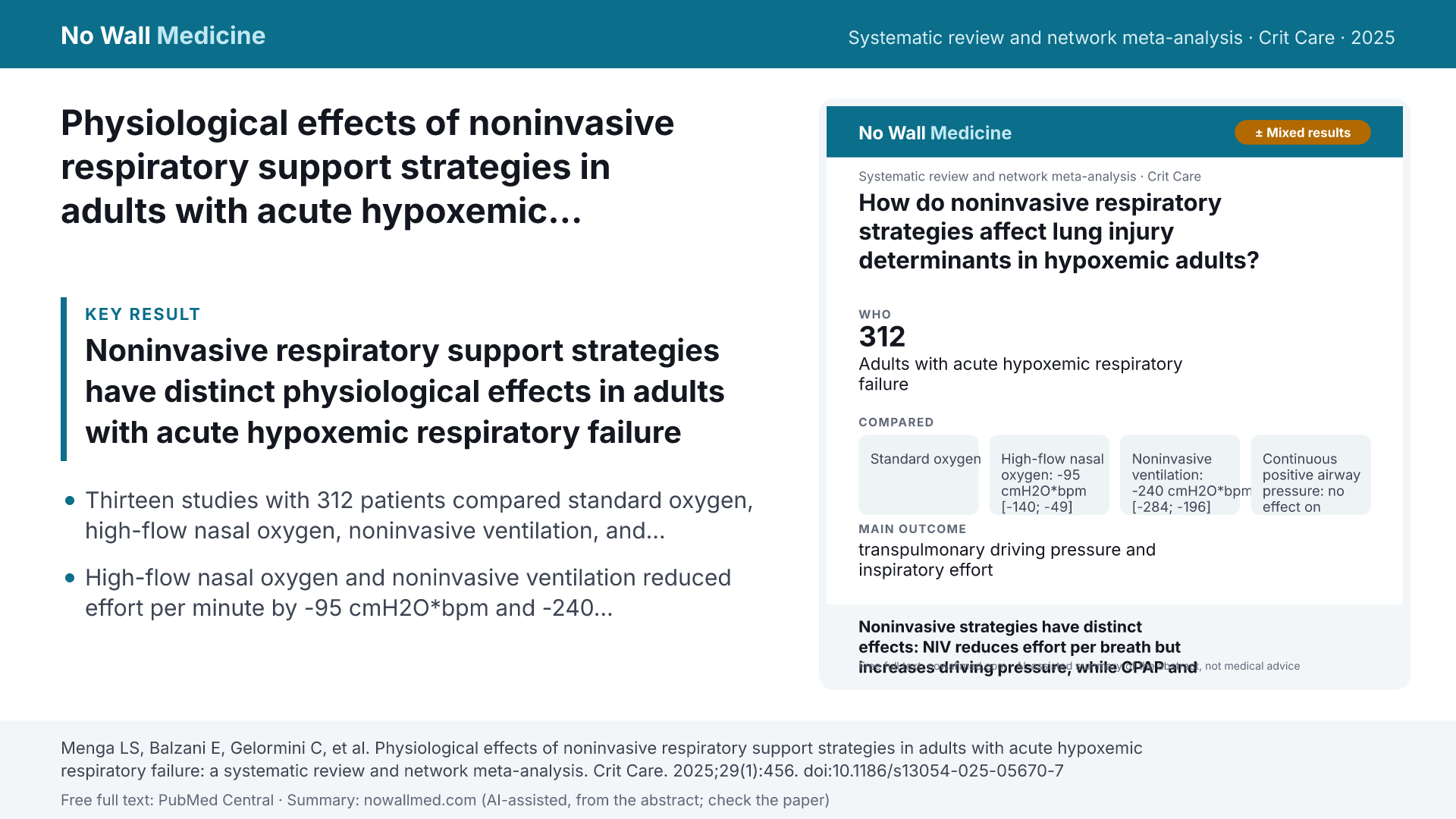
- Thirteen studies with 312 patients compared standard oxygen, high-flow nasal oxygen, noninvasive ventilation, and continuous positive airway pressure.
- High-flow nasal oxygen and noninvasive ventilation reduced effort per minute by -95 cmH2O*bpm and -240 cmH2O*bpm, respectively.
- Noninvasive ventilation lowered effort per breath but increased driving pressure by 3.4 cmH₂O.
Headline and key points written with AI from the paper’s abstract, with every number checked against it. Read the paper before relying on them.
Was this summary helpful?
Subject terms
Headline, design, result, key points, caveat and citation as plain text.
Cite this article
Menga LS, Balzani E, Gelormini C, et al. Physiological effects of noninvasive respiratory support strategies in adults with acute hypoxemic respiratory failure: a systematic review and network meta-analysis. Crit Care. 2025;29(1):456. doi:10.1186/s13054-025-05670-7
Spotted a mistake? Suggest a correction