Helmet noninvasive ventilation reduces breathing effort compared to CPAP and high-flow nasal oxygen
Respective Effects of Helmet Pressure Support, Continuous Positive Airway Pressure, and Nasal High-Flow in Hypoxemic Respiratory Failure: A Randomized Crossover Clinical Trial
Randomized crossover clinical trialMixed results
How do helmet NIV, CPAP, and high-flow nasal oxygen affect hypoxemic patients?
Who
15
Patients with hypoxemia (PaO2/FiO2 ⩽ 200)
Compared
Helmet noninvasive ventilation: 5 [3-9] cm H2O
Continuous positive airway pressure: 13 [10-19] cm H2O
High-flow nasal oxygen: 10 [8-13] cm H2O
Main outcome
Inspiratory esophageal and transpulmonary pressure swings
Bottom line: Helmet noninvasive ventilation reduced breathing effort more than CPAP or high-flow nasal oxygen, while both NIV and CPAP improved oxygenation.
AJRCCM · 2022-11-16Download image
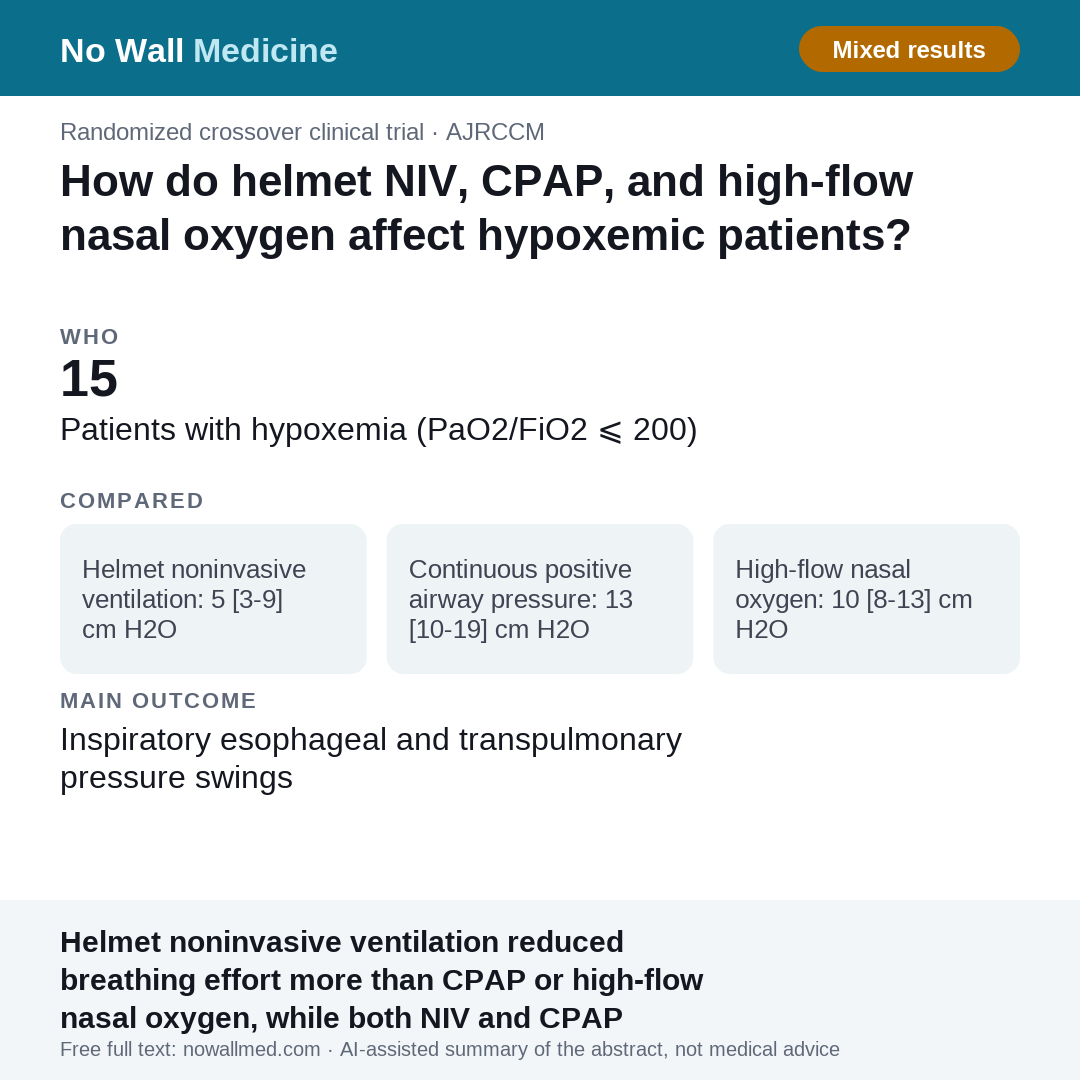
Clinical question: How do helmet NIV, CPAP, and high-flow nasal oxygen affect hypoxemic patients?
Why it matters: The respective effects of pressure support and continuous positive airway pressure delivered through a helmet versus high-flow nasal oxygen on breathing effort and lung inflation are unknown.
Key points
- Fifteen patients with low blood oxygen levels were compared using high-flow nasal oxygen, continuous positive airway pressure, and helmet noninvasive ventilation.
- Helmet noninvasive ventilation resulted in lower inspiratory esophageal pressure swings, a measure of breathing effort, compared to continuous positive airway pressure and high-flow nasal oxygen.
- Continuous positive airway pressure and helmet noninvasive ventilation were associated with higher oxygenation and tidal volume compared to high-flow nasal oxygen.
Headline and key points written with AI from the paper’s abstract, with every number checked against it. Read the paper before relying on them.
Was this summary helpful?
Subject terms
Cite this article
Menga LS, Delle Cese L, Rosà T, Cesarano M, Scarascia R, Michi T. Respective Effects of Helmet Pressure Support, Continuous Positive Airway Pressure, and Nasal High-Flow in Hypoxemic Respiratory Failure: A Randomized Crossover Clinical Trial. AJRCCM. 2022. doi:10.1164/rccm.202204-0629OC
Spotted a mistake? Suggest a correction
Top studies every Monday
The week’s key trials and guidelines in your specialties, plus any topics you follow. By email, free.
Get the weekly digest