Room temperature stored platelets reversed platelet inhibition better than cold stored platelets in healthy volunteers
Platelet dysfunction reversal with cold-stored vs room temperature-stored platelet transfusions
Randomized crossover studyMixed results
How do cold-stored versus room temperature-stored platelets affect posttransfusion platelet function?
Who
10
10 healthy humans on acetylsalicylic acid
Compared
room temperature-stored platelets: reversed platelet inhibition significantly better in αIIbβ3 integrin activation-dependent assays
cold-stored platelets: led to significantly more thrombin generation
Main outcome
posttransfusion platelet function and lipid mediators
Bottom line: Room temperature-stored platelets reversed inhibition better, while cold-stored platelets led to more thrombin generation.
Limitation: Small sample size of 10 healthy humans
Blood · 2024-03-01Download image
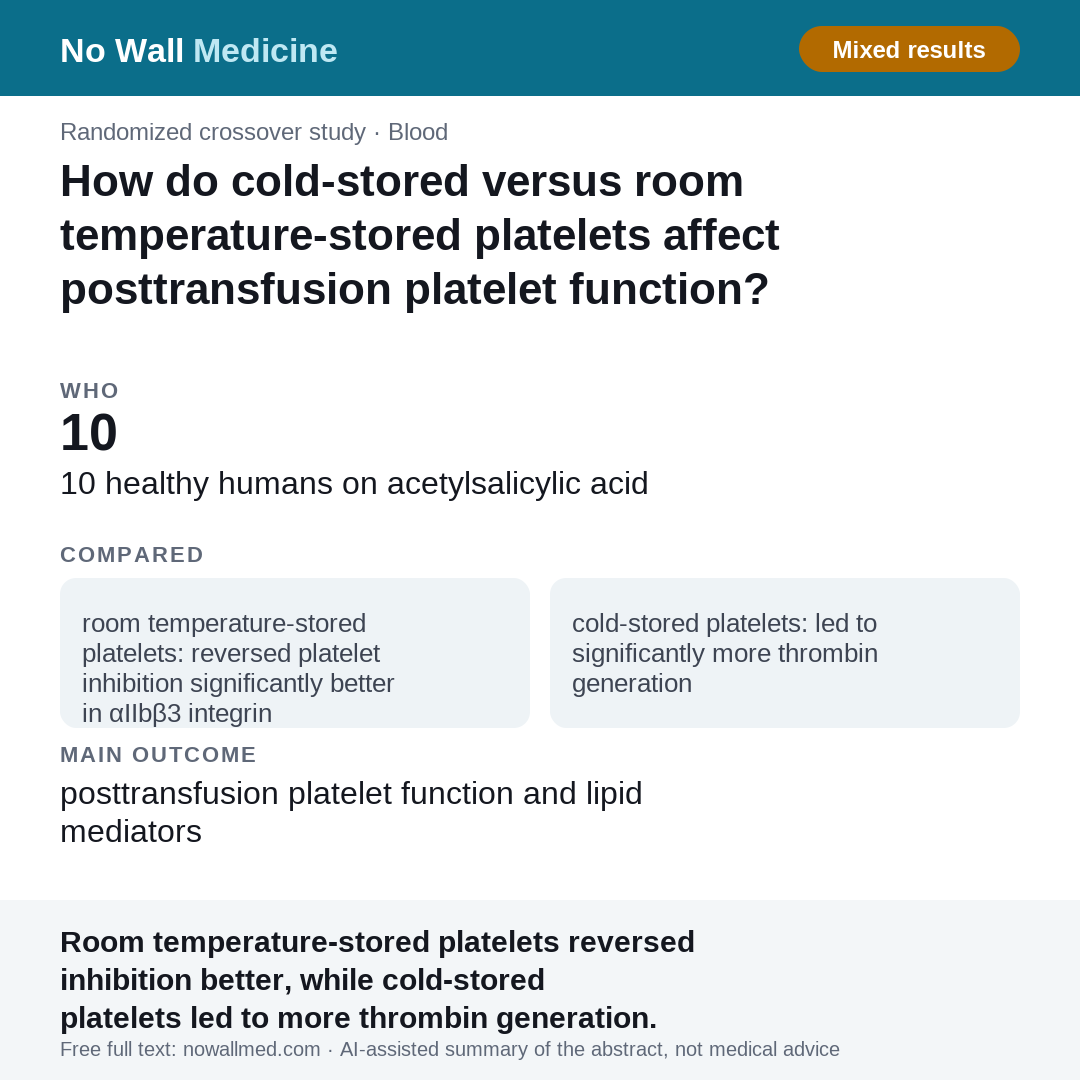
Clinical question: How do cold-stored versus room temperature-stored platelets affect posttransfusion platelet function?
Why it matters: It is unknown how the function of platelets changes after transfusion when they are stored at cold temperatures for up to 14 days.
Key points
- Researchers conducted a randomized crossover study in 10 healthy volunteers who took acetylsalicylic acid, a blood-thinning medication, to inhibit their own platelets.
- Room temperature-stored platelets reversed platelet inhibition significantly better in assays measuring αIIbβ3 integrin activation, which is a protein used to assess platelet function.
- Cold-stored platelets led to significantly more thrombin generation, a protein involved in blood clotting, compared to room temperature-stored platelets.
Headline and key points written with AI from the paper’s abstract, with every number checked against it. Read the paper before relying on them.
Was this summary helpful?
Subject terms
Cite this article
Kogler VJ, Miles JA, Özpolat T, Bailey SL, Byrne DA, Bawcom-Randall M. Platelet dysfunction reversal with cold-stored vs room temperature-stored platelet transfusions. Blood. 2024. doi:10.1182/blood.2023022593
Spotted a mistake? Suggest a correction
Top studies every Monday
The week’s key trials and guidelines in your specialties, plus any topics you follow. By email, free.
Get the weekly digest