Surgery and casting show similar wrist function results for older patients after two years
Plating vs Closed Reduction for Fractures in the Distal Radius in Older Patients: A Secondary Analysis of a Randomized Clinical Trial
Secondary analysis of a randomized clinical trialNo clear difference
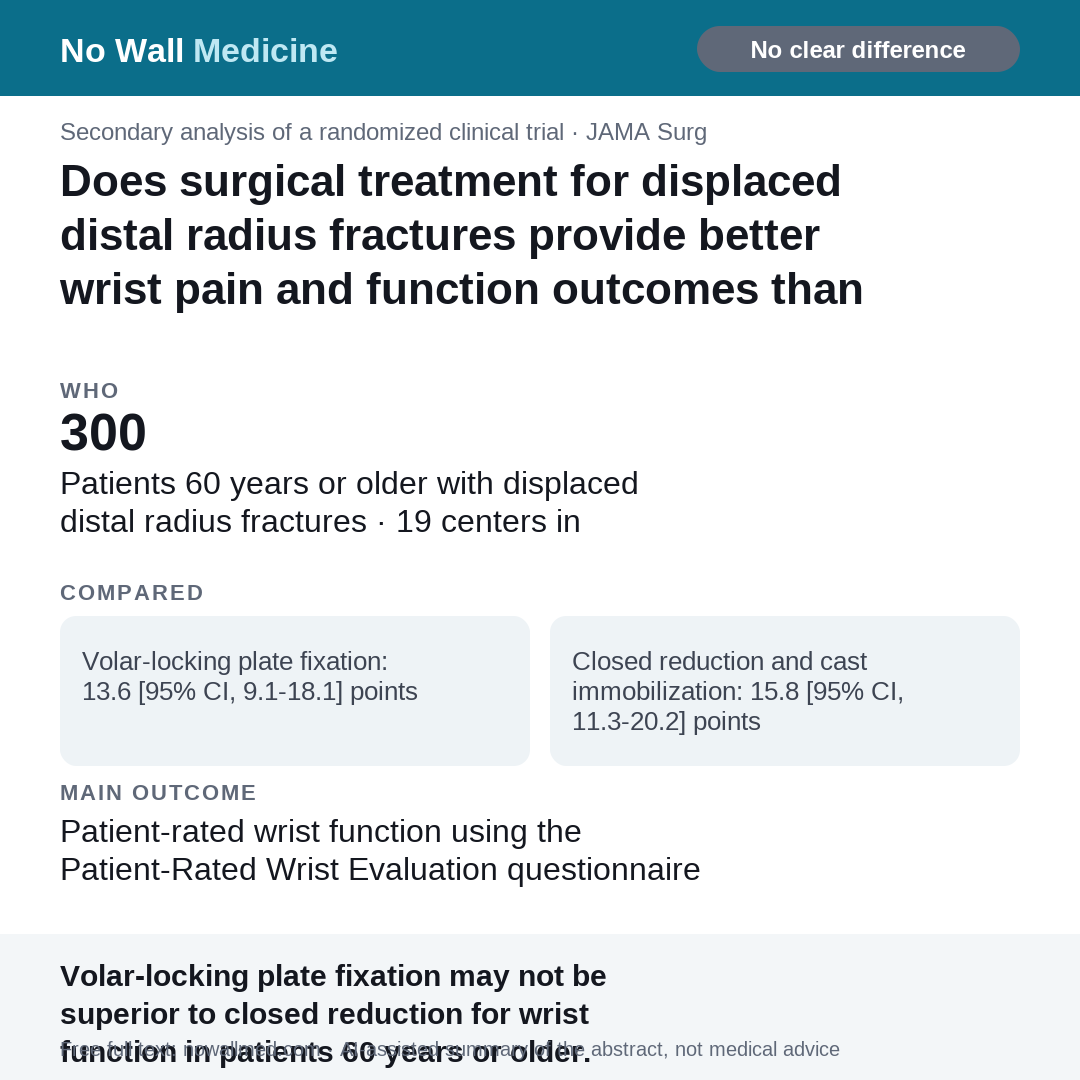
Does surgical treatment for displaced distal radius fractures provide better wrist pain and function outcomes than nonsurgical treatment?
Who
300
Patients 60 years or older with displaced distal radius fractures · 19 centers in Australia and New Zealand
Compared
Volar-locking plate fixation: 13.6 [95% CI, 9.1-18.1] points
Closed reduction and cast immobilization: 15.8 [95% CI, 11.3-20.2] points
Main outcome
Patient-rated wrist function using the Patient-Rated Wrist Evaluation questionnaire
Result: mean difference, 2.1 [95% CI, -4.2 to 8.5]
Bottom line: Volar-locking plate fixation may not be superior to closed reduction for wrist function in patients 60 years or older.
JAMA Surg · 2022-04-28Download image
Clinical question: Does surgical treatment for displaced distal radius fractures provide better wrist pain and function outcomes than nonsurgical treatment?
Why it matters: It is unknown if surgical treatment for displaced wrist fractures provides better patient-reported pain and function outcomes than nonsurgical treatment at 24 months for people aged 60 or older.
Key points
- Researchers studied 300 patients with an average age of 71.2 years to compare surgical plate fixation with casting for wrist fractures.
- At 24 months, there was no clinically important difference in wrist function scores between the surgical group (13.6 points) and the casting group (15.8 points).
- While function was similar, 75.0% of the surgical group reported very successful treatment compared to 44.6% in the casting group.
Headline and key points written with AI from the paper’s abstract, with every number checked against it. Read the paper before relying on them.
Was this summary helpful?
Subject terms
Cite this article
Combined Randomised and Observational Study of Surgery for Fractures in the Distal Radius in the Elderly (CROSSFIRE) Study Group, Lawson A, Naylor J, Buchbinder R, Ivers R, Balogh ZJ. Plating vs Closed Reduction for Fractures in the Distal Radius in Older Patients: A Secondary Analysis of a Randomized Clinical Trial. JAMA Surg. 2022. doi:10.1001/jamasurg.2022.0809
Spotted a mistake? Suggest a correction
Top studies every Monday
The week’s key trials and guidelines in your specialties, plus any topics you follow. By email, free.
Get the weekly digest