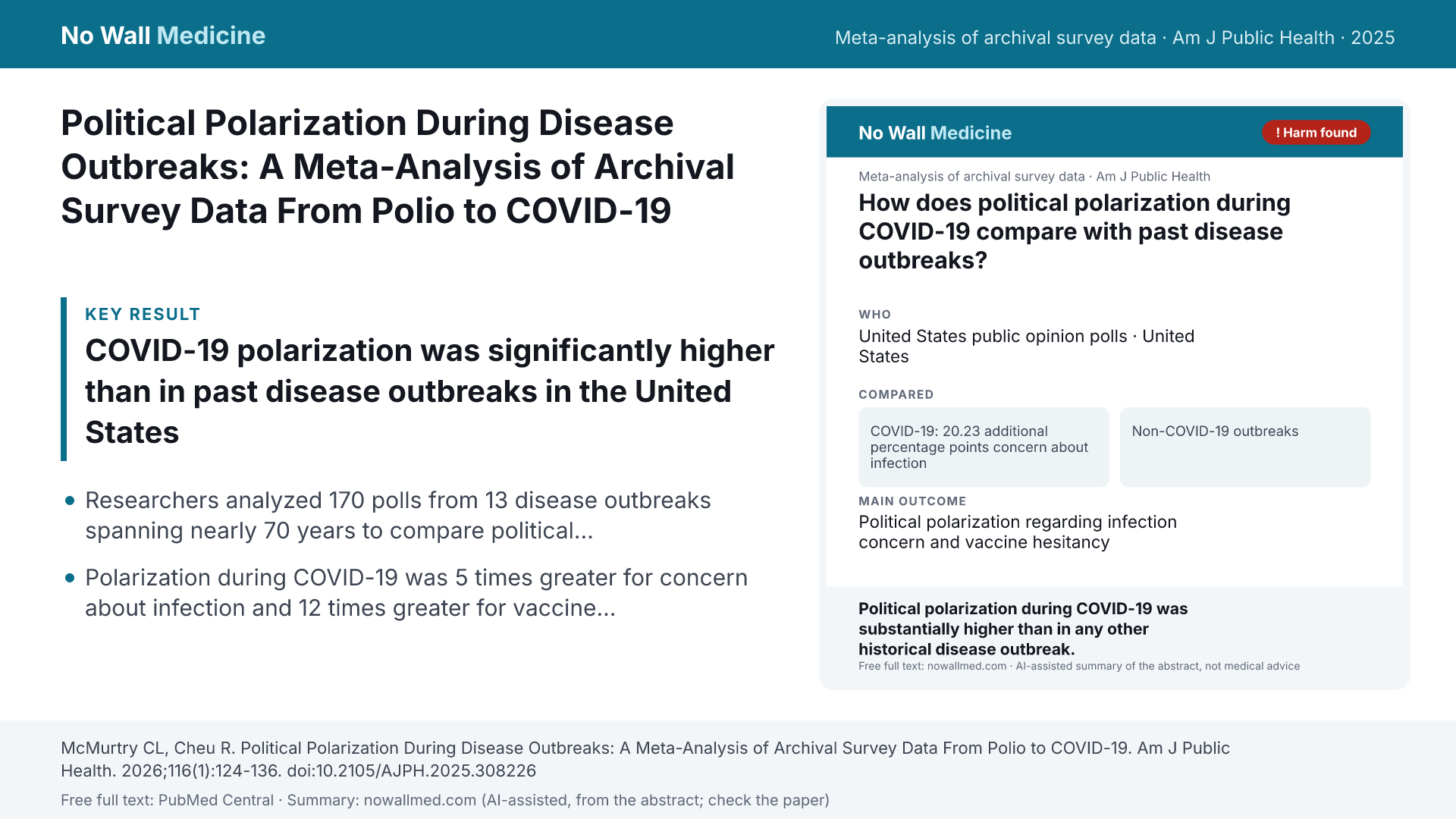
COVID-19 polarization was significantly higher than in past disease outbreaks in the United States
Political Polarization During Disease Outbreaks: A Meta-Analysis of Archival Survey Data From Polio to COVID-19
Meta-analysis of archival survey dataHarm found
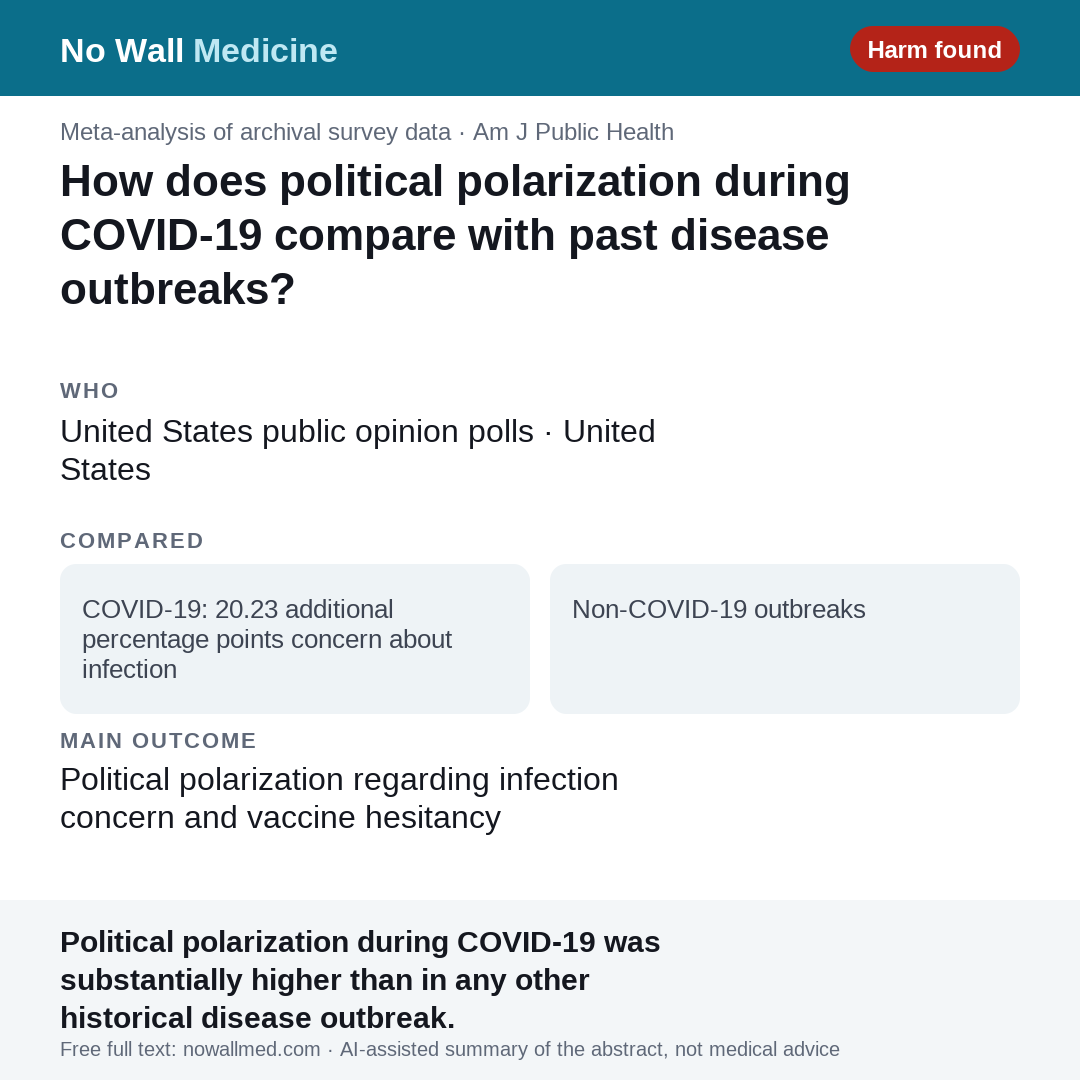
How does political polarization during COVID-19 compare with past disease outbreaks?
Who
United States public opinion polls · United States
Compared
COVID-19: 20.23 additional percentage points concern about infection
Non-COVID-19 outbreaks
Main outcome
Political polarization regarding infection concern and vaccine hesitancy
Result: 20.23 (95% CI 12.30, 28.17) and 25.89 (95% CI 6.63, 45.16) additional percentage points
Bottom line: Political polarization during COVID-19 was substantially higher than in any other historical disease outbreak.
Am J Public Health · 2025-08-28Download image
Clinical question: How does political polarization during COVID-19 compare with past disease outbreaks?
Key points
- Researchers analyzed 170 polls from 13 disease outbreaks spanning nearly 70 years to compare political polarization levels.
- Polarization during COVID-19 was 5 times greater for concern about infection and 12 times greater for vaccine hesitancy compared to past outbreaks.
- After controlling for survey characteristics, COVID-19 was associated with 20.23 additional percentage points of polarization for infection concern and 25.89 for vaccine hesitancy.
Headline and key points written with AI from the paper’s abstract, with every number checked against it. Read the paper before relying on them.
Was this summary helpful?
Subject terms
Headline, design, result, key points, caveat and citation as plain text.
Cite this article
McMurtry CL, Cheu R. Political Polarization During Disease Outbreaks: A Meta-Analysis of Archival Survey Data From Polio to COVID-19. Am J Public Health. 2025. doi:10.2105/AJPH.2025.308226
Spotted a mistake? Suggest a correction