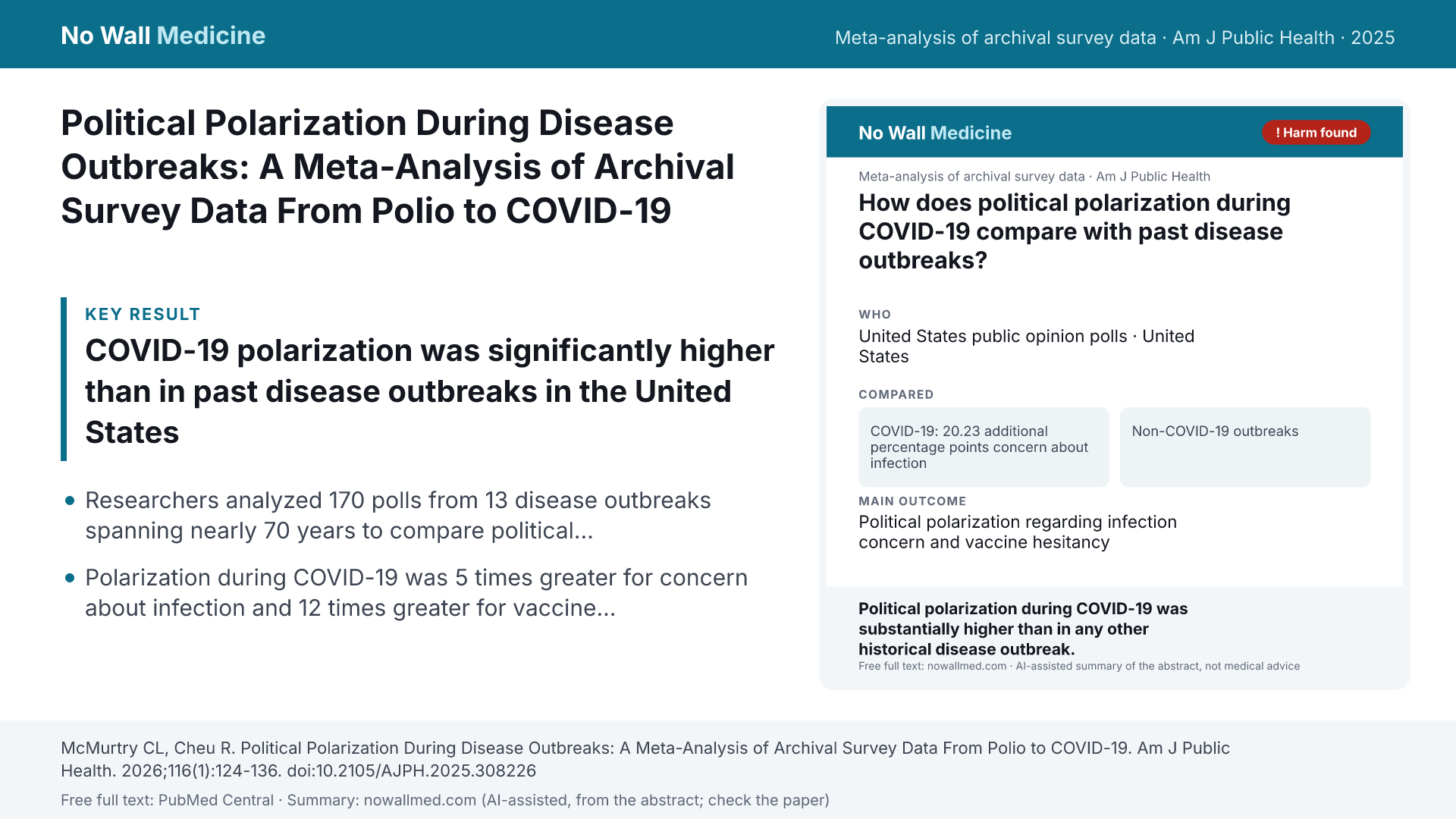
Political Polarization During Disease Outbreaks: A Meta-Analysis of Archival Survey Data From Polio to COVID-19
Key result: COVID-19 polarization was significantly higher than in past disease outbreaks in the United States
Meta-analysis of archival survey dataHarm found
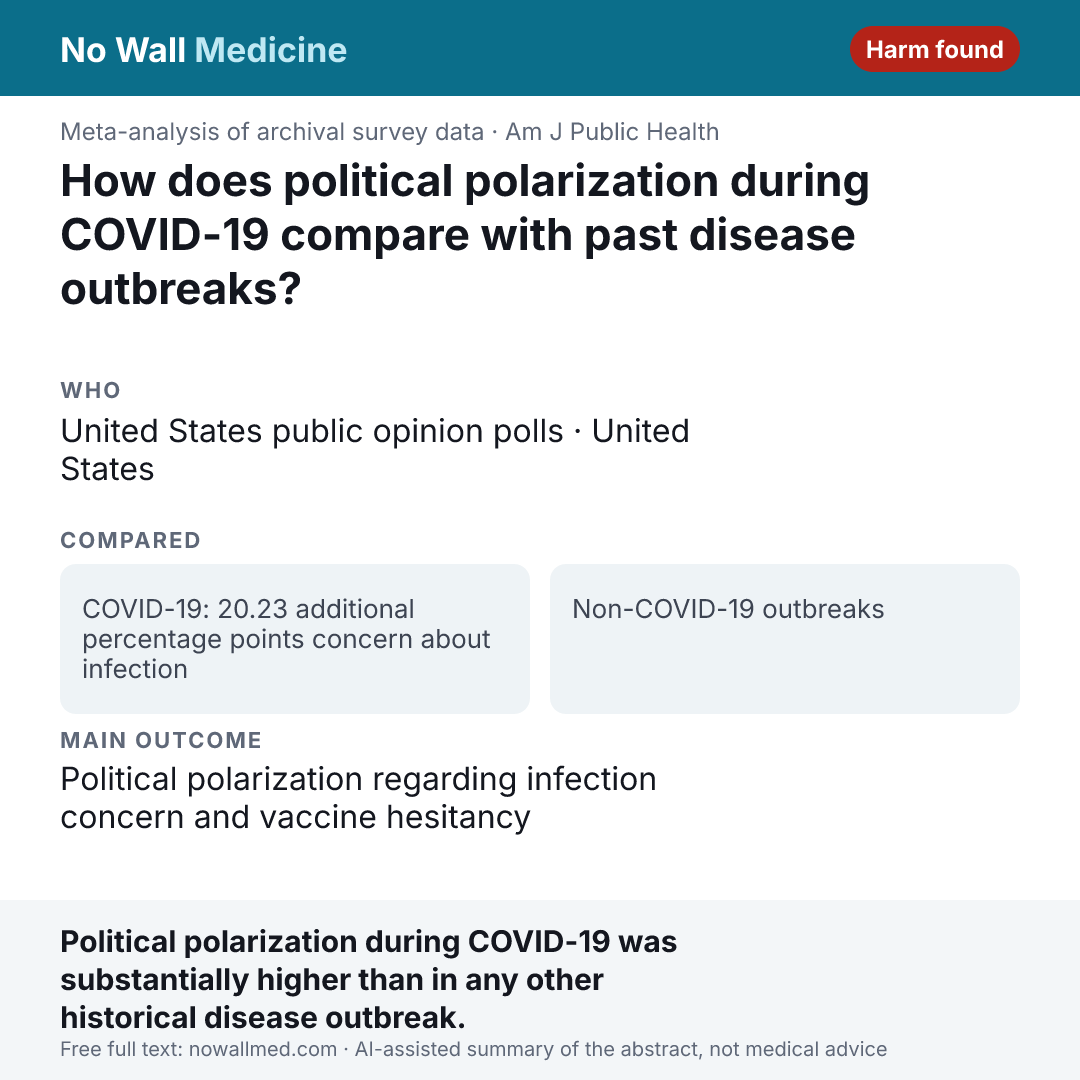
How does political polarization during COVID-19 compare with past disease outbreaks?
Who
United States public opinion polls · United States
Compared
COVID-19: 20.23 additional percentage points concern about infection
Non-COVID-19 outbreaks
Main outcome
Political polarization regarding infection concern and vaccine hesitancy
Result: 20.23 (95% CI 12.30, 28.17) and 25.89 (95% CI 6.63, 45.16) additional percentage points
Bottom line: Political polarization during COVID-19 was substantially higher than in any other historical disease outbreak.
Am J Public Health · 2025-08-28 · Save PNG
Key points
- Researchers analyzed 170 polls from 13 disease outbreaks spanning nearly 70 years to compare political polarization levels.
- Polarization during COVID-19 was 5 times greater for concern about infection and 12 times greater for vaccine hesitancy compared to past outbreaks.
- After controlling for survey characteristics, COVID-19 was associated with 20.23 additional percentage points of polarization for infection concern and 25.89 for vaccine hesitancy.
Discussion prompts
- Would these patients look like yours? Who was left out?
- Is the main outcome one that matters to patients?
- Is the difference large enough to change what you do?
Cite: McMurtry CL, Cheu R. Political Polarization During Disease Outbreaks: A Meta-Analysis of Archival Survey Data From Polio to COVID-19. Am J Public Health. 2026;116(1):124-136. doi:10.2105/AJPH.2025.308226
Free full text: PubMed Central · Summary and visual abstract: nowallmed.com/a/political-polarization-during-disease-outbreaks-a-meta-analysis-of-12ech76/ (AI-assisted from the abstract; check the paper before relying on it).