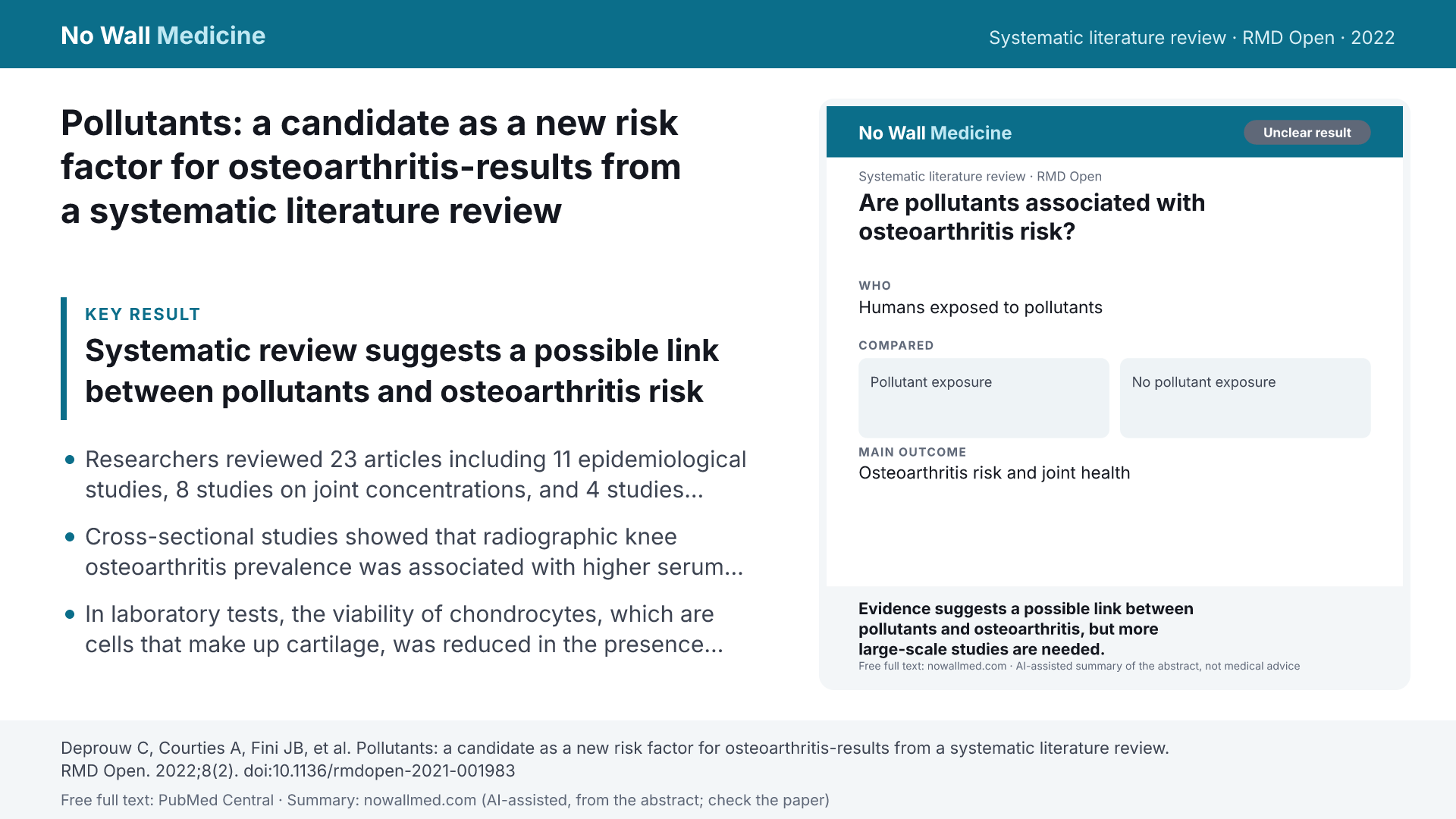
Systematic review suggests a possible link between pollutants and osteoarthritis risk
Pollutants: a candidate as a new risk factor for osteoarthritis-results from a systematic literature review
Systematic literature reviewUnclear result
Are pollutants associated with osteoarthritis risk?
Who
Humans exposed to pollutants
Compared
Pollutant exposure
No pollutant exposure
Main outcome
Osteoarthritis risk and joint health
Bottom line: Evidence suggests a possible link between pollutants and osteoarthritis, but more large-scale studies are needed.
Limitation: The level of knowledge currently remains low.
RMD Open · 2022-06-14 · Save PNG

Clinical question: Are pollutants associated with osteoarthritis risk?
Key points
- Researchers reviewed 23 articles including 11 epidemiological studies, 8 studies on joint concentrations, and 4 studies on cell effects.
- Cross-sectional studies showed that radiographic knee osteoarthritis prevalence was associated with higher serum lead levels.
- In laboratory tests, the viability of chondrocytes, which are cells that make up cartilage, was reduced in the presence of some pollutants.
Headline and key points written with AI from the paper’s abstract, with every number checked against it. Read the paper before relying on them.
Was this summary helpful?
Abstract
Background
Considering non-classical environmental risk factors for osteoarthritis (OA), a systematic literature review (SLR) was performed to summarise existing knowledge on associations between OA and pollutants. Methods
PubMed was used to identify studies reporting data on OA and pollutants in humans (examples of MeSH terms: "Pesticides" or "Polychlorinated Biphenyls" or 'Lead'). Reports included epidemiological clinical studies, pollutant assessments in ex vivo OA joint, and in vitro effects of pollutants on chondrocytes. Results
Among the 193 potentially relevant articles, 14 were selected and combined with 9 articles obtained by manual search. Among these 23 articles there were: (1) 11 epidemiological studies on the relationship between OA and pollutants exposure, (2) 8 on pollutant concentrations in ex vivo OA joint, (3) 4 on the in vitro effects of pollutants on human chondrocytes. Epidemiological studies investigating mainly chlorinated and fluorinated pollutants suggested a possible link with OA. In cross-sectional studies, radiographic knee OA prevalence increased with higher serum lead levels. There was also a relationship between serum lead levels and serum/urine joint biomarkers. A high concentration of heavy metals in the cartilage tidemark was found in ex vivo joints. In vitro, the viability of chondrocytes was reduced in presence of some pollutants. However, the level of knowledge currently remains low, justifying the need for new methodologically sound studies. Conclusions
This SLR supports the hypothesis of a possible involvement of pollutants in OA disease risk. Large-scale epidemiological and biological studies and ideally big-data analysis are needed to confirm that pollutants could be risk factors for OA.
Abstract reproduced under the article’s CC BY NC licence.
Subject terms
Headline, design, result, key points, caveat and citation as plain text.
Cite this article
Deprouw C, Courties A, Fini JB, et al. Pollutants: a candidate as a new risk factor for osteoarthritis-results from a systematic literature review. RMD Open. 2022. doi:10.1136/rmdopen-2021-001983
Spotted a mistake? Suggest a correction