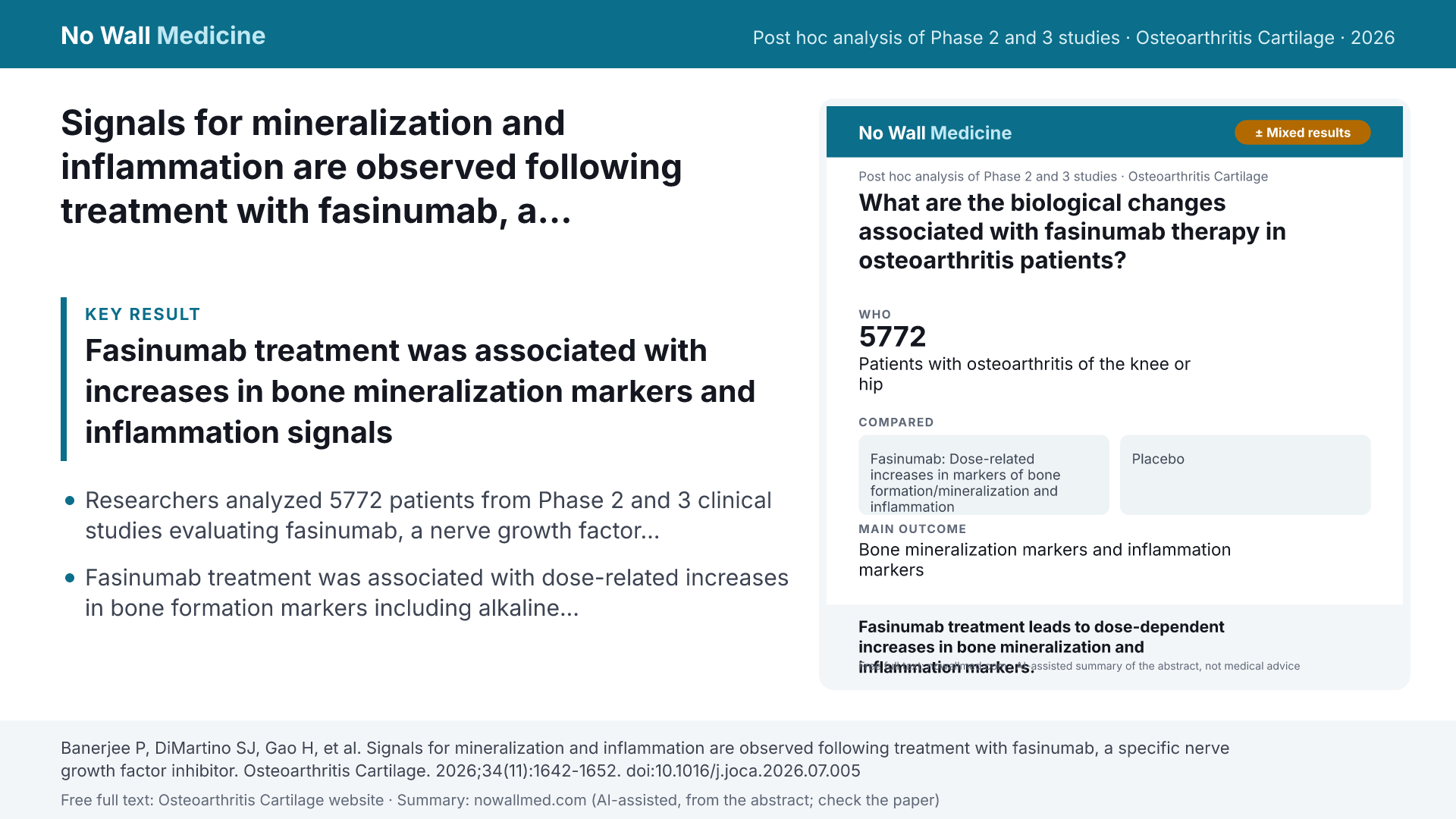
Fasinumab treatment was associated with increases in bone mineralization markers and inflammation signals
Signals for mineralization and inflammation are observed following treatment with fasinumab, a specific nerve growth factor inhibitor
Post hoc analysis of Phase 2 and 3 studiesMixed results
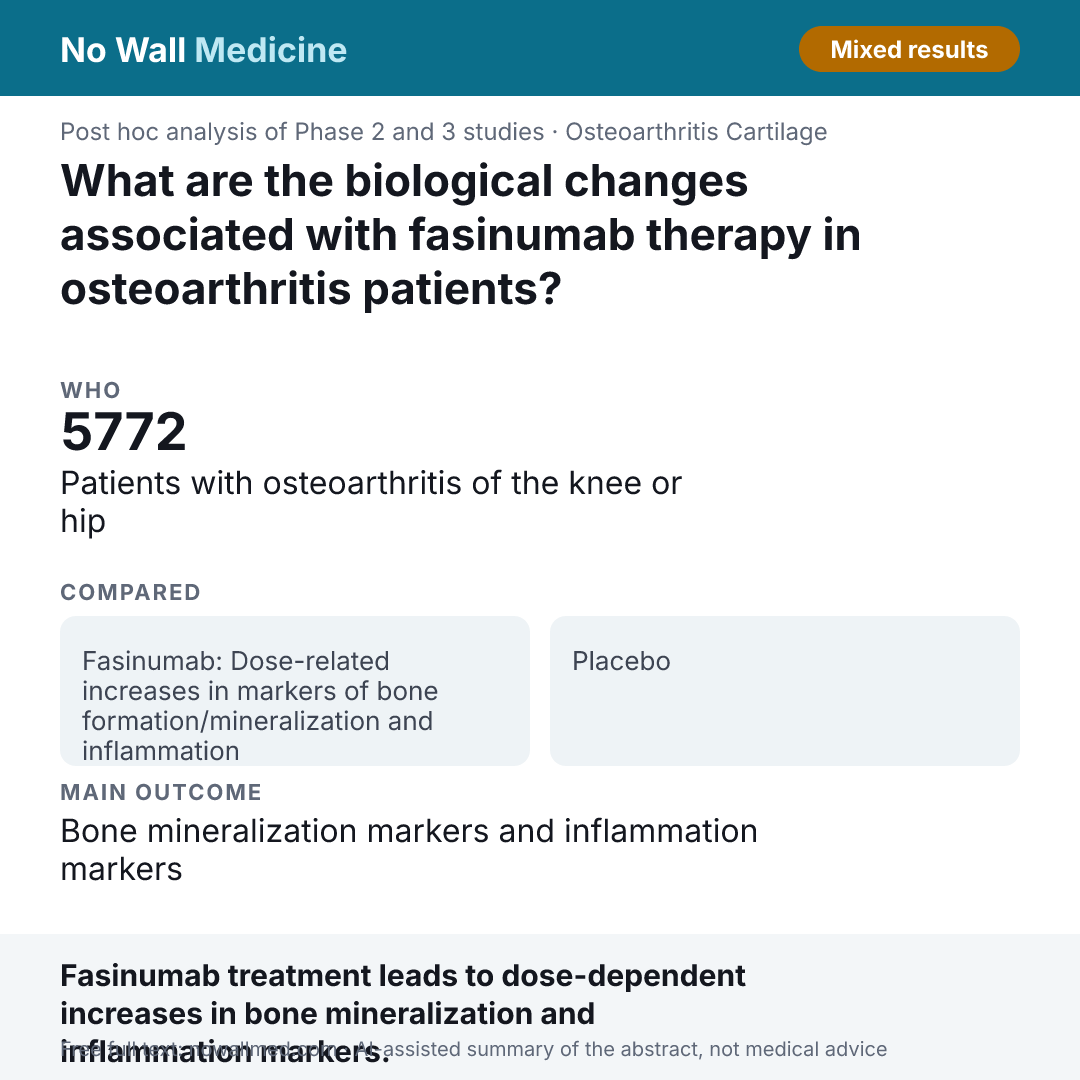
What are the biological changes associated with fasinumab therapy in osteoarthritis patients?
Who
5772
Patients with osteoarthritis of the knee or hip
Compared
Fasinumab: Dose-related increases in markers of bone formation/mineralization and inflammation
Placebo
Main outcome
Bone mineralization markers and inflammation markers
Bottom line: Fasinumab treatment leads to dose-dependent increases in bone mineralization and inflammation markers.
Osteoarthritis Cartilage · 2026-07-11 · Save PNG
Clinical question: What are the biological changes associated with fasinumab therapy in osteoarthritis patients?
Why it matters: The biological changes associated with fasinumab therapy, specifically regarding bone mineralization and inflammation, were not previously explored.
Key points
- Researchers analyzed 5772 patients from Phase 2 and 3 clinical studies evaluating fasinumab, a nerve growth factor inhibitor, for osteoarthritis of the knee or hip.
- Fasinumab treatment was associated with dose-related increases in bone formation markers including alkaline phosphatase, bone-specific alkaline phosphatase, osteocalcin, and procollagen type 1 N-terminal propeptide.
- Patients with arthropathies showed larger increases in alkaline phosphatase and C-reactive protein, an inflammation marker, compared to those without arthropathies at Week 16.
Headline and key points written with AI from the paper’s abstract, with every number checked against it. Read the paper before relying on them.
Was this summary helpful?
Subject terms
Headline, design, result, key points, caveat and citation as plain text.
Cite this article
Banerjee P, DiMartino SJ, Gao H, et al. Signals for mineralization and inflammation are observed following treatment with fasinumab, a specific nerve growth factor inhibitor. Osteoarthritis Cartilage. 2026;34(11):1642-1652. doi:10.1016/j.joca.2026.07.005
Spotted a mistake? Suggest a correction