Oral enzyme combination therapy was associated with lower pain and inflammation in knee osteoarthritis patients
Oral enzyme combination therapy reduces systemic inflammation, urinary CTXII and pain in knee osteoarthritis: a proof-of-mechanism, randomised, crossover, double-blind, placebo-controlled trial
Randomized, crossover, double-blind, placebo-controlled trialBenefit found
Does oral enzyme combination therapy reduce inflammation and pain in knee osteoarthritis?
Who
43
Patients aged 40 years or older with symptomatic knee osteoarthritis
Compared
Oral enzyme combination: increased interleukin-10 (p<0.0001)
Placebo
Main outcome
Innate immunity, systemic inflammation, and cartilage turnover markers
Bottom line: Oral enzyme combination therapy modulates interleukin-10 and reduces pain and symptoms in knee osteoarthritis patients.
RMD Open · 2025-08-12Download image
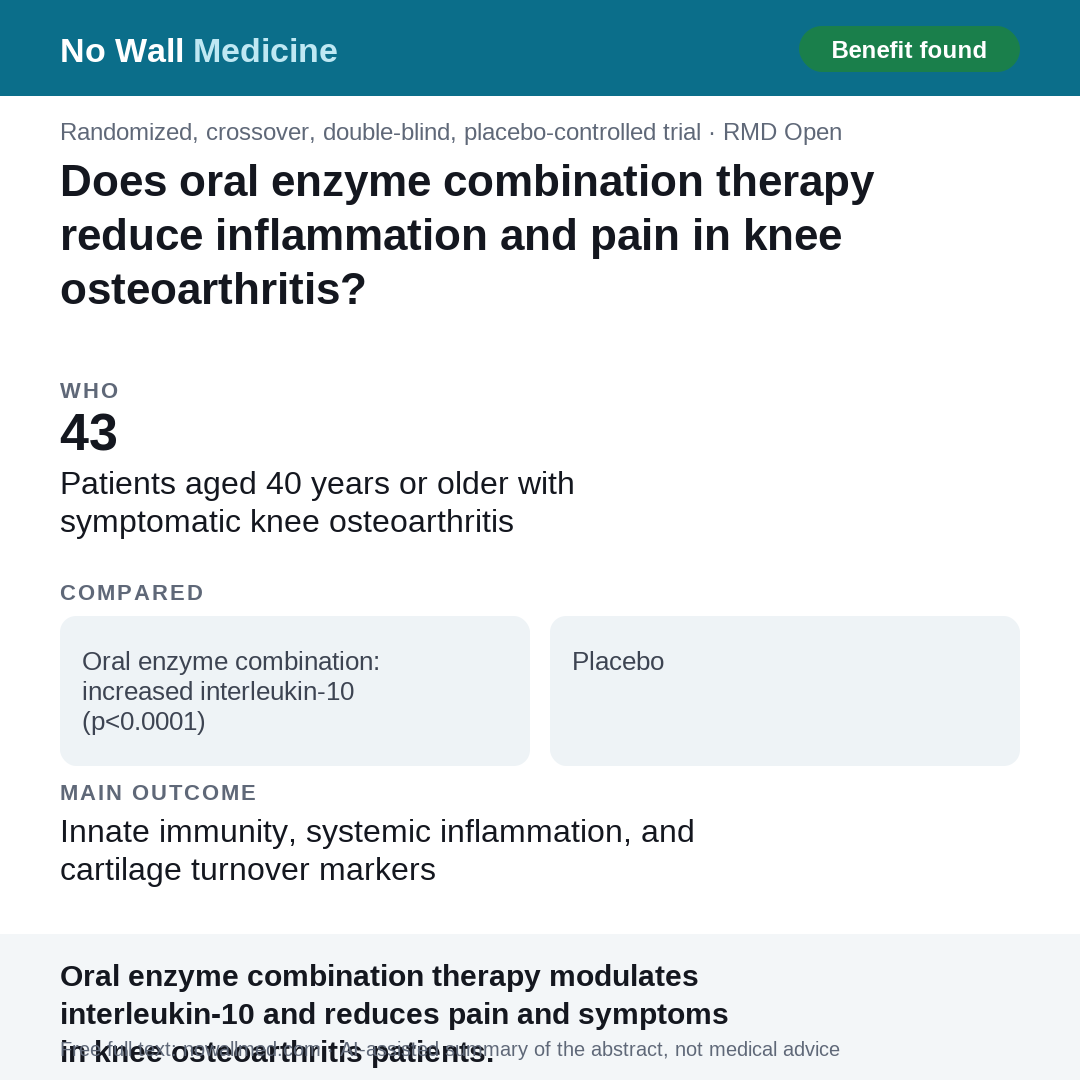
Clinical question: Does oral enzyme combination therapy reduce inflammation and pain in knee osteoarthritis?
Key points
- The study randomized 45 patients with symptomatic knee osteoarthritis to receive either a placebo or an oral enzyme combination of bromelain, trypsin, and rutoside for 8 weeks.
- The enzyme combination was associated with increased levels of interleukin-10 and α2-macroglobulin, decreased urinary carboxyl-terminal cross-linked telopeptide of type II collagen, and improved pain and symptom scores.
- The treatment was well tolerated with no serious related adverse events reported in either group.
Limitation the authors note: No correction for multiple comparisons was made due to the exploratory nature of the study.
Headline and key points written with AI from the paper’s abstract, with every number checked against it. Read the paper before relying on them.
Abstract
Objectives
Oral enzyme combination (OEC) therapy with bromelain, trypsin and rutoside reduces pain and improves function in patients with knee osteoarthritis (OA). Here, we investigated several potential biological mechanisms underlying the clinical effects of OEC therapy in patients with established knee OA with respect to innate immunity, systemic inflammation and cartilage turnover (EudraCT 2020-003154-80, NCT05038410). Methods
Patients (age ≥40 years, body mass index (BMI) ≤35 kg/m2) with symptomatic knee OA were randomised to either placebo or OEC, administered 2×3 tablets/day, for 8 weeks before crossing over after a 4-week washout period. Different markers exploring innate immunity, inflammation and cartilage matrix degradation have been measured in the blood using immunoassays or cytometric methods. Data from the modified intention-to-treat population (mITT) were analysed using a generalised linear mixed model. No correction for multiple comparisons was made due to the exploratory nature of the study. Results
Altogether, 45 patients were randomised; 43 completed both treatment sequences (mITT; mean age: 63.3 years; mean BMI: 27.4 kg/m2; mean global Knee injury and Osteoarthritis Outcome Score (KOOS): 48.7). OEC significantly increased levels of α2-macroglobulin (p=0.038) and interleukin-10 (p<0.0001) while decreasing urinary carboxyl-terminal cross-linked telopeptide of type II collagen (p=0.038). Patients administered OEC exhibited significant improvements in KOOS Pain (p=0.0464) and Symptoms (p=0.026) subdomains but not globally. OEC was well tolerated, with no serious related adverse events reported in either group. Conclusions
One of the key findings of this proof-of-mechanism study is that OEC modulates IL-10 production, suggesting an anti-inflammatory effect in patients with knee OA. This main finding contributes to explaining the effects of OEC on pain and function in these patients. Trial registration number
NCT05038410.
Abstract reproduced under the article’s CC BY NC licence.
Topics
Cite this article
Henrotin Y, Pap T, Lieten S, Badot V, Dubuc JE, Urbin-Choffray D. Oral enzyme combination therapy reduces systemic inflammation, urinary CTXII and pain in knee osteoarthritis: a proof-of-mechanism, randomised, crossover, double-blind, placebo-controlled trial. RMD Open. 2025. doi:10.1136/rmdopen-2025-005433
Spotted a mistake? Suggest a correction
Top studies every Monday
The week’s key trials and guidelines in your specialties, by email. Free.
Get the weekly digest