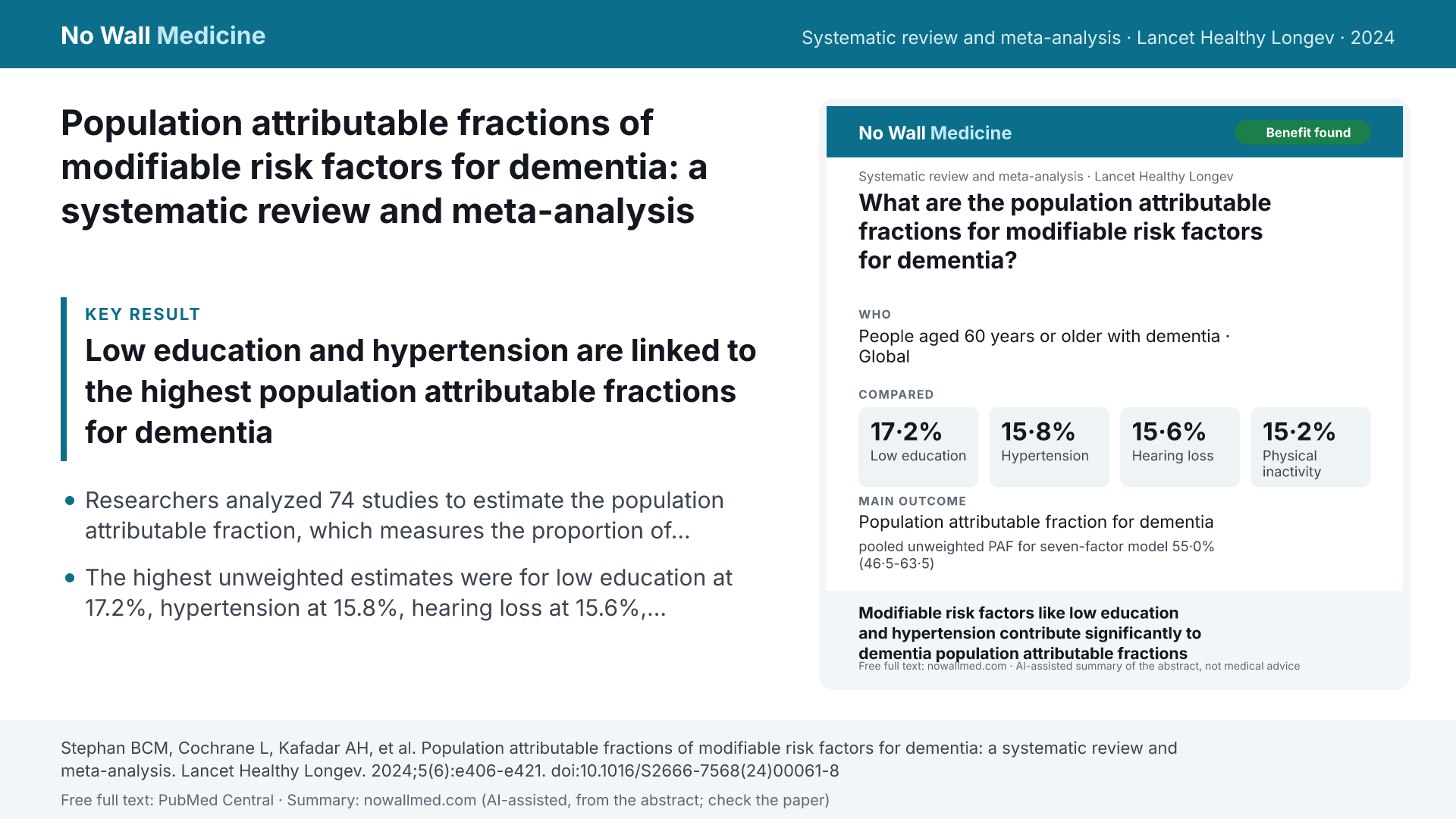
Population attributable fractions of modifiable risk factors for dementia: a systematic review and meta-analysis
Key result: Low education and hypertension are linked to the highest population attributable fractions for dementia
Systematic review and meta-analysisBenefit found
What are the population attributable fractions for modifiable risk factors for dementia?
Who
People aged 60 years or older with dementia · Global
Compared
17·2%Low education (unweighted)
15·8%Hypertension (unweighted)
15·6%Hearing loss (unweighted)
15·2%Physical inactivity (unweighted)
Main outcome
Population attributable fraction for dementia
Result: pooled unweighted PAF for seven-factor model 55·0% (46·5-63·5)
Bottom line: Modifiable risk factors like low education and hypertension contribute significantly to dementia population attributable fractions worldwide.
Funded by: UK Research and Innovation (Medical Research Council)
Lancet Healthy Longev · 2024-06-03 · Save PNG

Key points
- Researchers analyzed 74 studies to estimate the population attributable fraction, which measures the proportion of disease in a population that could be prevented by addressing a specific risk factor.
- The highest unweighted estimates were for low education at 17.2%, hypertension at 15.8%, hearing loss at 15.6%, physical inactivity at 15.2%, and obesity at 9.4%.
- Combining seven factors including midlife hypertension, obesity, and smoking resulted in a pooled unweighted population attributable fraction of 55.0%.
Why it matters: The specific proportion of dementia cases in a population that can be attributed to various modifiable risk factors was not clearly quantified.
Discussion prompts
- Would these patients look like yours? Who was left out?
- Is the main outcome one that matters to patients?
- Is the difference large enough to change what you do?
Cite: Stephan BCM, Cochrane L, Kafadar AH, et al. Population attributable fractions of modifiable risk factors for dementia: a systematic review and meta-analysis. Lancet Healthy Longev. 2024;5(6):e406-e421. doi:10.1016/S2666-7568(24)00061-8
Free full text: PubMed Central · Summary and visual abstract: nowallmed.com/a/population-attributable-fractions-of-modifiable-risk-factors-for-emm7xu/ (AI-assisted from the abstract; check the paper before relying on it).