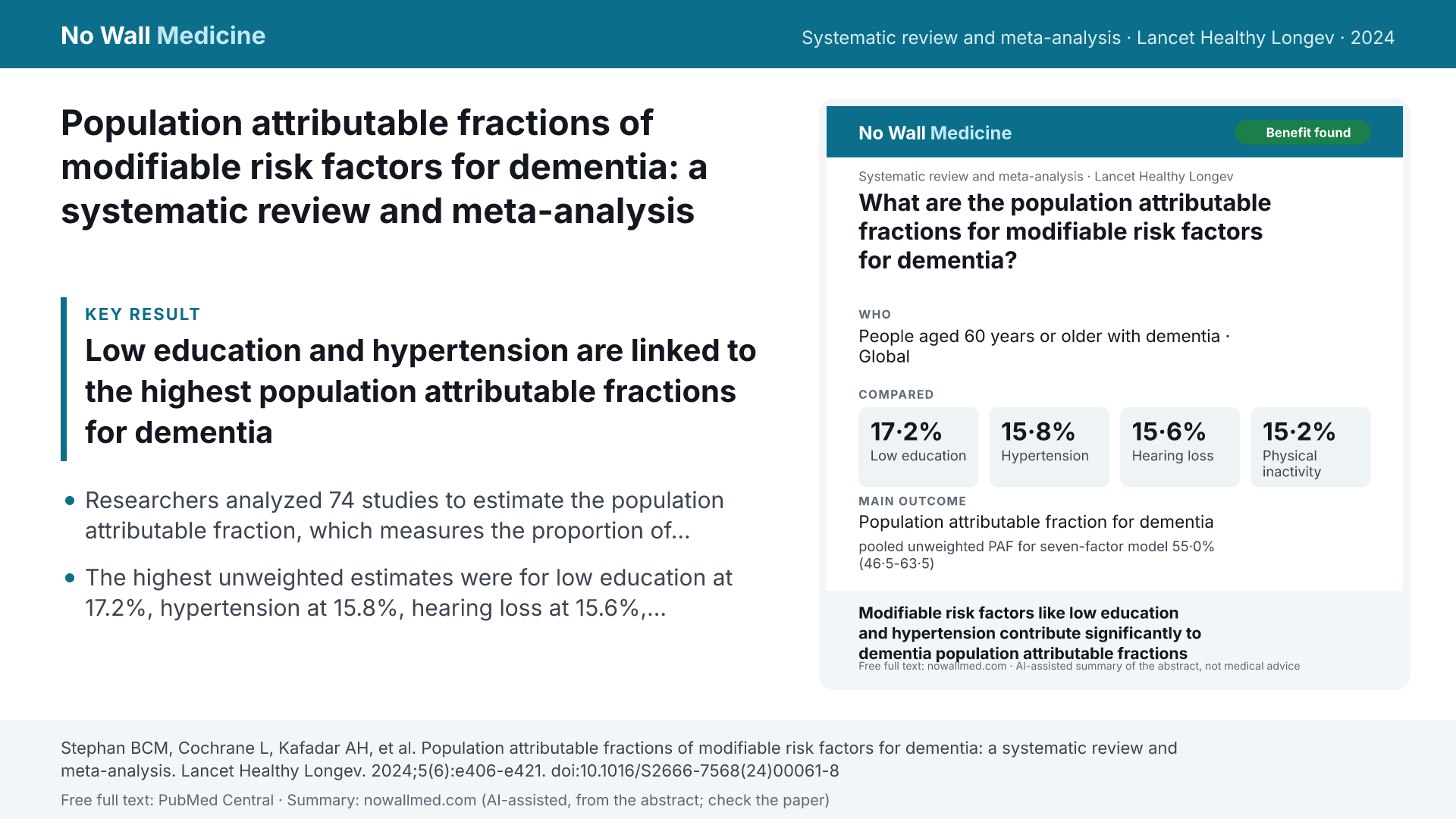
Low education and hypertension are linked to the highest population attributable fractions for dementia
Population attributable fractions of modifiable risk factors for dementia: a systematic review and meta-analysis
Systematic review and meta-analysisBenefit found
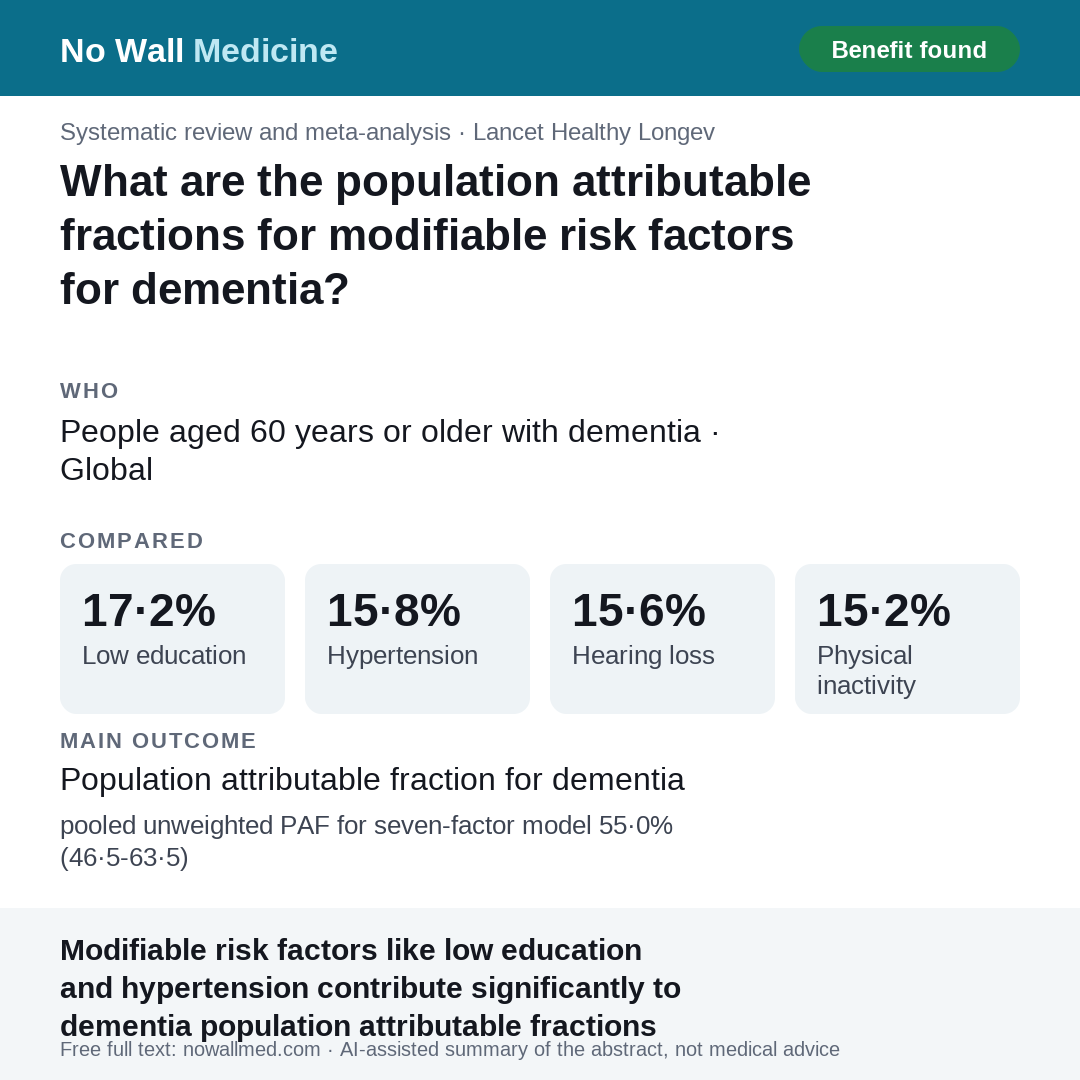
What are the population attributable fractions for modifiable risk factors for dementia?
Who
People aged 60 years or older with dementia · Global
Compared
17·2%Low education (unweighted)
15·8%Hypertension (unweighted)
15·6%Hearing loss (unweighted)
15·2%Physical inactivity (unweighted)
Main outcome
Population attributable fraction for dementia
Result: pooled unweighted PAF for seven-factor model 55·0% (46·5-63·5)
Bottom line: Modifiable risk factors like low education and hypertension contribute significantly to dementia population attributable fractions worldwide.
Funded by: UK Research and Innovation (Medical Research Council)
Lancet Healthy Longev · 2024-06-03Download image
Clinical question: What are the population attributable fractions for modifiable risk factors for dementia?
Why it matters: The specific proportion of dementia cases in a population that can be attributed to various modifiable risk factors was not clearly quantified.
Key points
- Researchers analyzed 74 studies to estimate the population attributable fraction, which measures the proportion of disease in a population that could be prevented by addressing a specific risk factor.
- The highest unweighted estimates were for low education at 17.2%, hypertension at 15.8%, hearing loss at 15.6%, physical inactivity at 15.2%, and obesity at 9.4%.
- Combining seven factors including midlife hypertension, obesity, and smoking resulted in a pooled unweighted population attributable fraction of 55.0%.
Headline and key points written with AI from the paper’s abstract, with every number checked against it. Read the paper before relying on them.
Was this summary helpful?
Abstract
Background
More than 57 million people have dementia worldwide. Evidence indicates a change in dementia prevalence and incidence in high-income countries, which is likely to be due to improved life-course population health. Identifying key modifiable risk factors for dementia is essential for informing risk reduction and prevention strategies. We therefore aimed to estimate the population attributable fraction (PAF) for dementia associated with modifiable risk factors. Methods
In this systematic review and meta-analysis, we searched Embase, MEDLINE, and PsycINFO, via Ovid, from database inception up to June 29, 2023, for population-derived or community-based studies and reviews reporting a PAF value for one or more modifiable risk factor for later-life dementia (prevalent or incident dementia in people aged ≥60 years), with no restrictions on dementia subtype, the sex or baseline age of participants, or the period of study. Articles were independently screened for inclusion by four authors, with disagreements resolved through consensus. Data including unweighted and weighted PAF values (weighted to account for communality or overlap in risk) were independently extracted into a predefined template by two authors and checked by two other authors. When five or more unique studies investigated a given risk factor or combination of the same factors, random-effects meta-analyses were used to calculate a pooled PAF percentage estimate for the factor or combination of factors. The review protocol was registered on PROSPERO, CRD42022323429. Findings
4024 articles were identified, and 74 were included in our narrative synthesis. Overall, PAFs were reported for 61 modifiable risk factors, with sufficient data available for meta-analysis of 12 factors (n=48 studies). In meta-analyses, the highest pooled unweighted PAF values were estimated for low education (17·2% [95% CI 14·4-20·0], p<0·0001), hypertension (15·8% [14·7-17·1], p<0·0001), hearing loss (15·6% [10·3-20·9], p<0·0001), physical inactivity (15·2% [12·8-17·7], p<0·0001), and obesity (9·4% [7·3-11·7], p<0·0001). According to weighted PAF values, low education (9·3% [6·9-11·7], p<0·0001), physical inactivity (7·3% [3·9-11·2], p=0·0021), hearing loss (7·2% [5·2-9·7], p<0·0001), hypertension (7·1% [5·4-8·8], p<0·0001), and obesity (5·3% [3·2-7·4], p=0·0001) had the highest pooled estimates. When low education, midlife hypertension, midlife obesity, smoking, physical inactivity, depression, and diabetes were combined (Barnes and Yaffe seven-factor model; n=9 studies), the pooled unweighted and weighted PAF values were 55·0% (46·5-63·5; p<0·0001) and 32·0% (26·6-37·5; p<0·0001), respectively. The pooled PAF values for most individual risk factors were higher in low-income and middle-income countries (LMICs) versus high-income countries. Interpretation
Governments need to invest in a life-course approach to dementia prevention, including policies that enable quality education, health-promoting environments, and improved health. This investment is particularly important in LMICs, where the potential for prevention is high, but resources, infrastructure, budgets, and research focused on ageing and dementia are limited. Funding
UK Research and Innovation (Medical Research Council).
Abstract reproduced under the article’s CC BY licence.
Subject terms
Cite this article
Stephan BCM, Cochrane L, Kafadar AH, et al. Population attributable fractions of modifiable risk factors for dementia: a systematic review and meta-analysis. Lancet Healthy Longev. 2024. doi:10.1016/S2666-7568(24)00061-8
Spotted a mistake? Suggest a correction