Portable oxygenated machine perfusion was noninferior to cold storage for preserving livers during transplantation
Portable hypothermic oxygenated machine perfusion for organ preservation in liver transplantation: A randomized, open-label, clinical trial
Randomized, open-label, noninferiority trialBenefit found
Is portable hypothermic oxygenated machine perfusion noninferior to static cold storage for liver preservation?
Who
179
Patients undergoing liver transplantation · Multicenter, United States
Compared
11.1%Hypothermic oxygenated machine perfusion (N=7)
16.4%Static cold storage (N=12)
Main outcome
Early allograft dysfunction
Result: -5.33% (one-sided 95% upper confidence limit of 5.81%)
Bottom line: Portable hypothermic oxygenated machine perfusion is noninferior to static cold storage for liver graft preservation.
Hepatology · 2023-12-13Download image
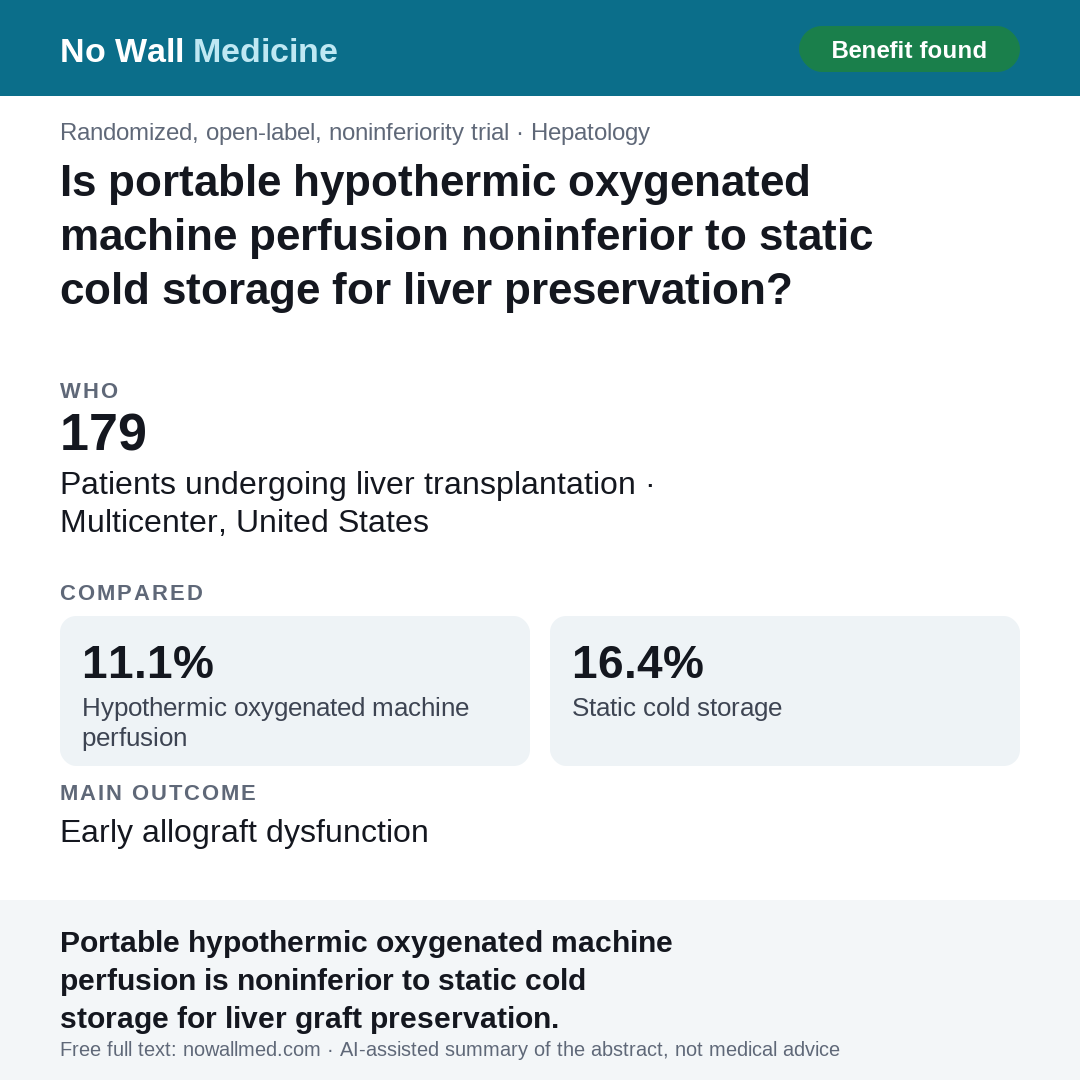
Clinical question: Is portable hypothermic oxygenated machine perfusion noninferior to static cold storage for liver preservation?
Why it matters: Cold preservation of livers can cause ischemia and reperfusion injury, and it is unknown if a portable oxygenated machine perfusion device is as effective as traditional cold storage.
Key points
- Researchers conducted a multicenter trial with 179 patients randomized to either hypothermic oxygenated machine perfusion or static cold storage.
- Early allograft dysfunction, or early organ failure, occurred in 11.1% of the machine perfusion group compared to 16.4% in the cold storage group.
- The risk of graft failure predicted by the L-GrAFT 7 score at seven days was 3.4% for machine perfusion versus 4.5% for cold storage.
Headline and key points written with AI from the paper’s abstract, with every number checked against it. Read the paper before relying on them.
Was this summary helpful?
Subject terms
Cite this article
Panayotova GG, Lunsford KE, Quillin RC, Rana A, Agopian VG, Lee-Riddle GS. Portable hypothermic oxygenated machine perfusion for organ preservation in liver transplantation: A randomized, open-label, clinical trial. Hepatology. 2023. doi:10.1097/HEP.0000000000000715
Spotted a mistake? Suggest a correction
Top studies every Monday
The week’s key trials and guidelines in your specialties, plus any topics you follow. By email, free.
Get the weekly digest