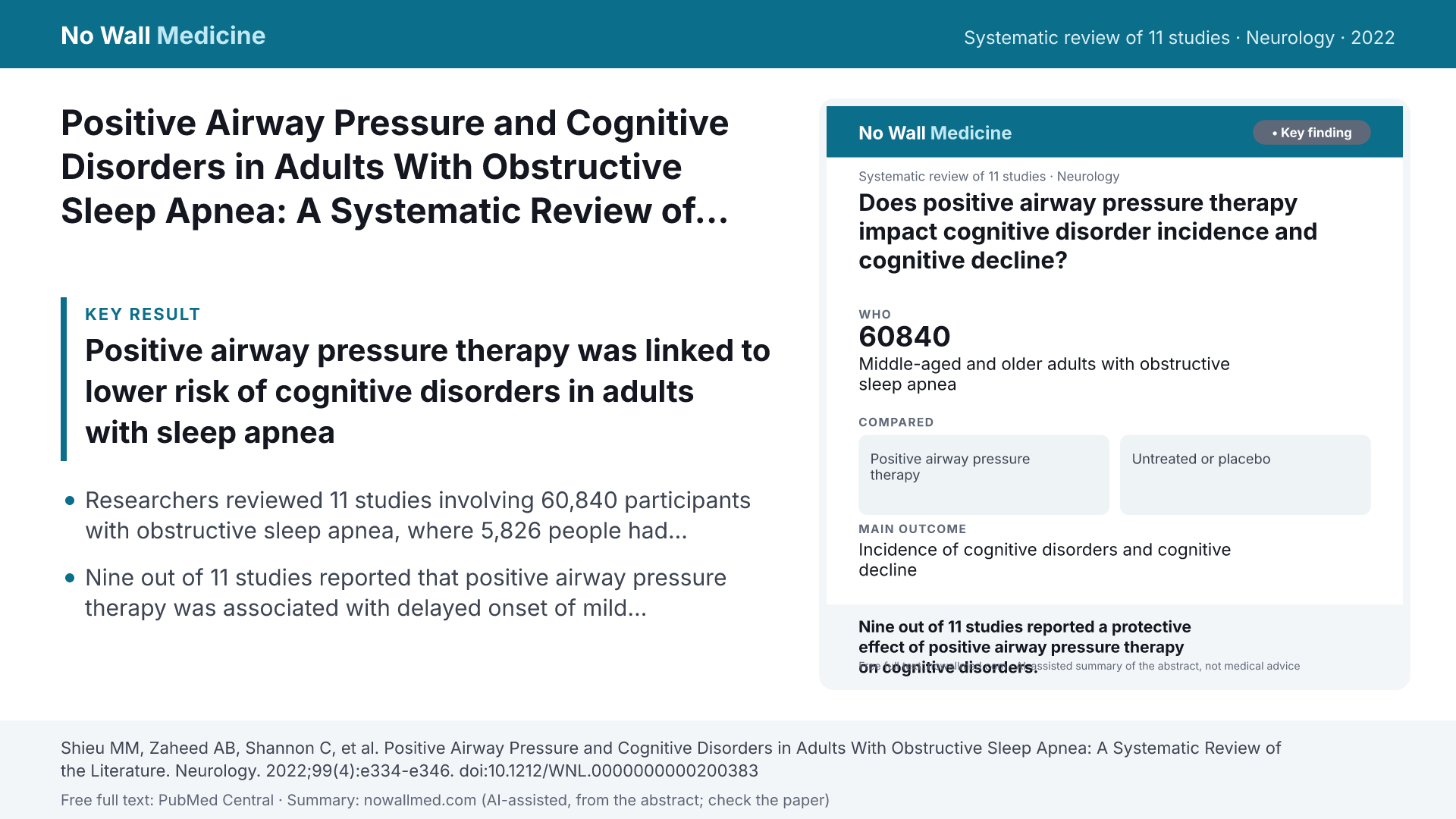
Positive airway pressure therapy was linked to lower risk of cognitive disorders in adults with sleep apnea
Positive Airway Pressure and Cognitive Disorders in Adults With Obstructive Sleep Apnea: A Systematic Review of the Literature
Systematic review of 11 studiesKey finding
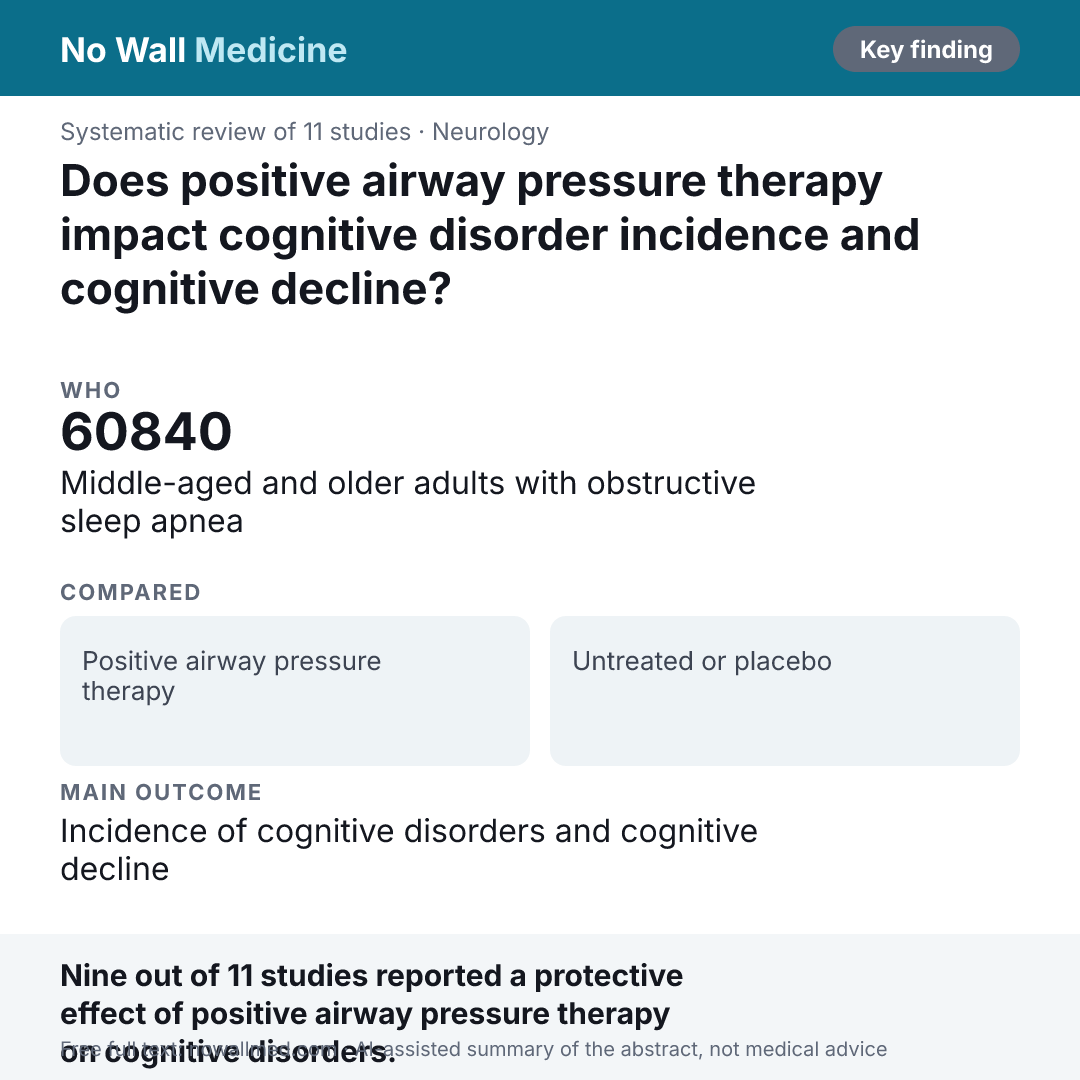
Does positive airway pressure therapy impact cognitive disorder incidence and cognitive decline?
Who
60840
Middle-aged and older adults with obstructive sleep apnea
Compared
Positive airway pressure therapy
Untreated or placebo
Main outcome
Incidence of cognitive disorders and cognitive decline
Bottom line: Nine out of 11 studies reported a protective effect of positive airway pressure therapy on cognitive disorders.
Neurology · 2022-07-25 · Save PNG
Clinical question: Does positive airway pressure therapy impact cognitive disorder incidence and cognitive decline?
Key points
- Researchers reviewed 11 studies involving 60,840 participants with obstructive sleep apnea, where 5,826 people had baseline cognitive impairment.
- Nine out of 11 studies reported that positive airway pressure therapy was associated with delayed onset of mild cognitive impairment or Alzheimer disease.
- The reviewed studies also linked the therapy to slower cognitive decline or slower progression to Alzheimer disease in some participants.
Limitation the authors note: The authors noted that certain ethnoracial groups have been underrepresented and underinvestigated in the existing literature.
Headline and key points written with AI from the paper’s abstract, with every number checked against it. Read the paper before relying on them.
Was this summary helpful?
Subject terms
Headline, design, result, key points, caveat and citation as plain text.
Cite this article
Shieu MM, Zaheed AB, Shannon C, et al. Positive Airway Pressure and Cognitive Disorders in Adults With Obstructive Sleep Apnea: A Systematic Review of the Literature. Neurology. 2022;99(4):e334-e346. doi:10.1212/WNL.0000000000200383
Spotted a mistake? Suggest a correction