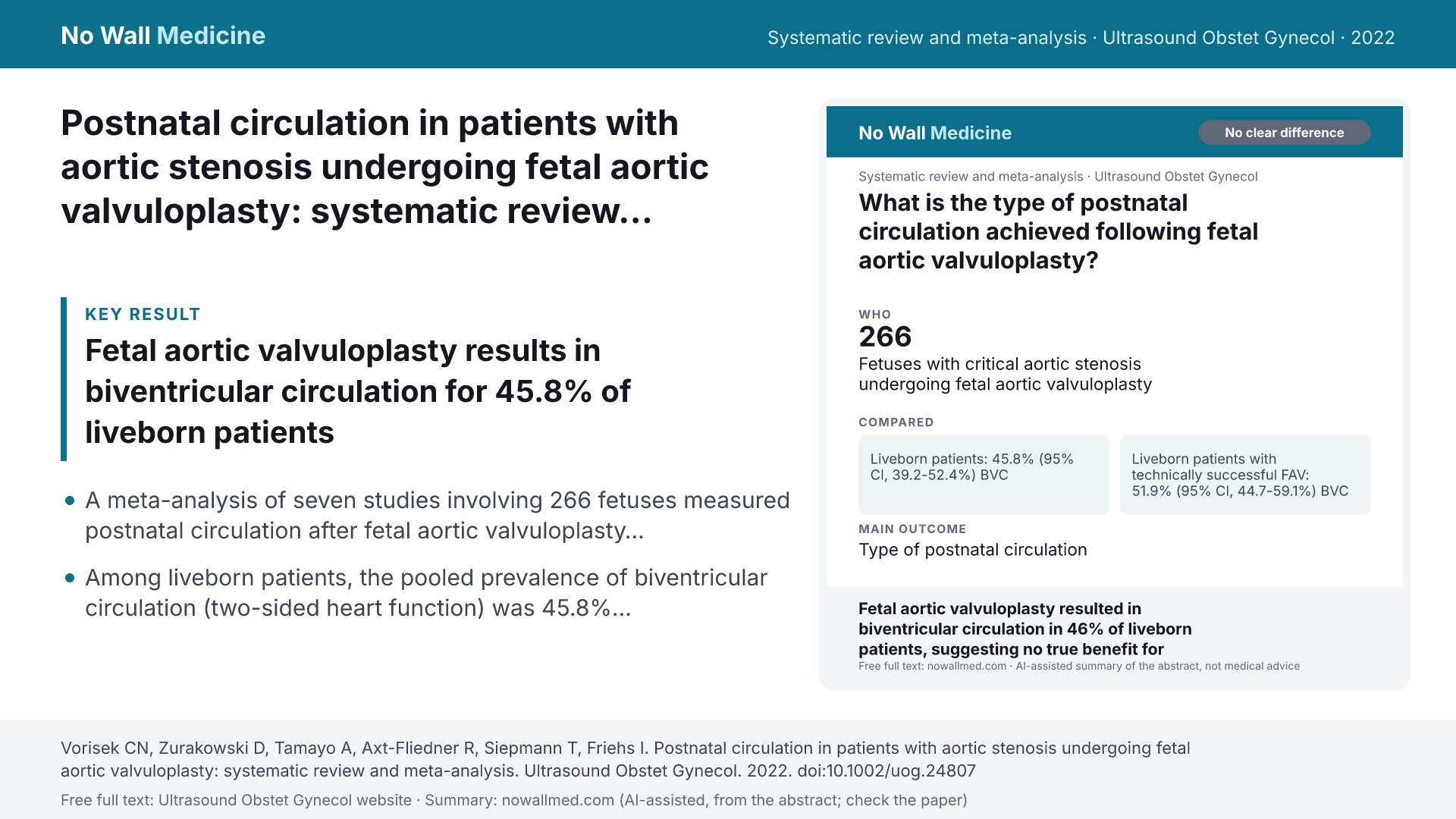
Fetal aortic valvuloplasty results in biventricular circulation for 45.8% of liveborn patients
Postnatal circulation in patients with aortic stenosis undergoing fetal aortic valvuloplasty: systematic review and meta-analysis
Systematic review and meta-analysisNo clear difference
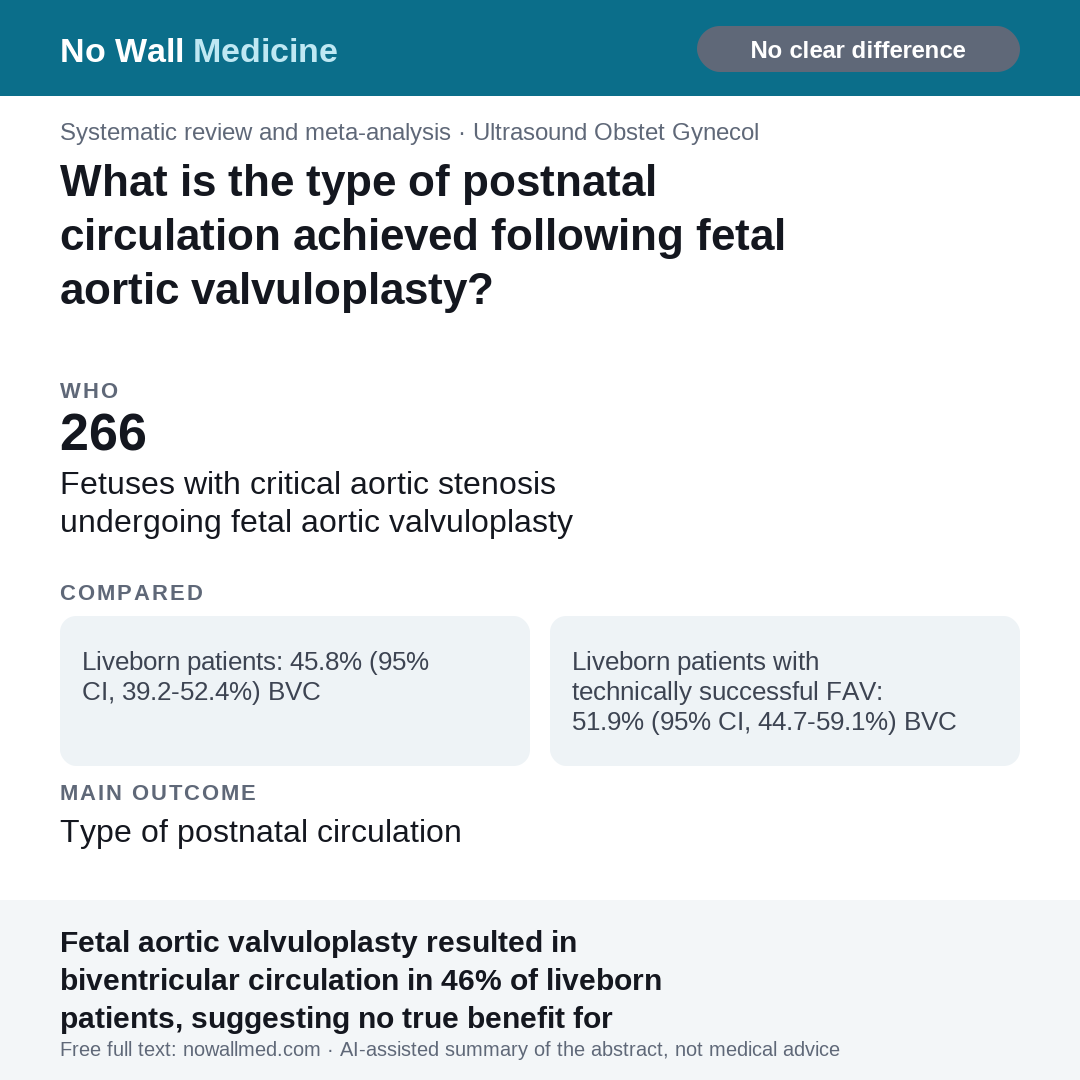
What is the type of postnatal circulation achieved following fetal aortic valvuloplasty?
Who
266
Fetuses with critical aortic stenosis undergoing fetal aortic valvuloplasty
Compared
Liveborn patients: 45.8% (95% CI, 39.2-52.4%) BVC
Liveborn patients with technically successful FAV: 51.9% (95% CI, 44.7-59.1%) BVC
Main outcome
Type of postnatal circulation
Result: 45.8% (95% CI, 39.2-52.4%) BVC prevalence
Bottom line: Fetal aortic valvuloplasty resulted in biventricular circulation in 46% of liveborn patients, suggesting no true benefit for achieving it.
Limitation: Lack of randomized clinical trials
Ultrasound Obstet Gynecol · 2022-04-11Download image
Clinical question: What is the type of postnatal circulation achieved following fetal aortic valvuloplasty?
Why it matters: It is unclear how many patients achieve biventricular circulation following fetal aortic valvuloplasty for critical fetal aortic stenosis.
Key points
- A meta-analysis of seven studies involving 266 fetuses measured postnatal circulation after fetal aortic valvuloplasty for critical aortic stenosis.
- Among liveborn patients, the pooled prevalence of biventricular circulation (two-sided heart function) was 45.8% and univentricular circulation (one-sided heart function) was 43.6%.
- In patients where the procedure was technically successful, the prevalence of biventricular circulation was 51.9%.
Limitation the authors note: The authors state that the lack of randomized clinical trials means results should be interpreted with caution.
Headline and key points written with AI from the paper’s abstract, with every number checked against it. Read the paper before relying on them.
Was this summary helpful?
Subject terms
Cite this article
Vorisek CN, Zurakowski D, Tamayo A, Axt-Fliedner R, Siepmann T, Friehs I. Postnatal circulation in patients with aortic stenosis undergoing fetal aortic valvuloplasty: systematic review and meta-analysis. Ultrasound Obstet Gynecol. 2022. doi:10.1002/uog.24807
Spotted a mistake? Suggest a correction
Top studies every Monday
The week’s key trials and guidelines in your specialties, plus any topics you follow. By email, free.
Get the weekly digest