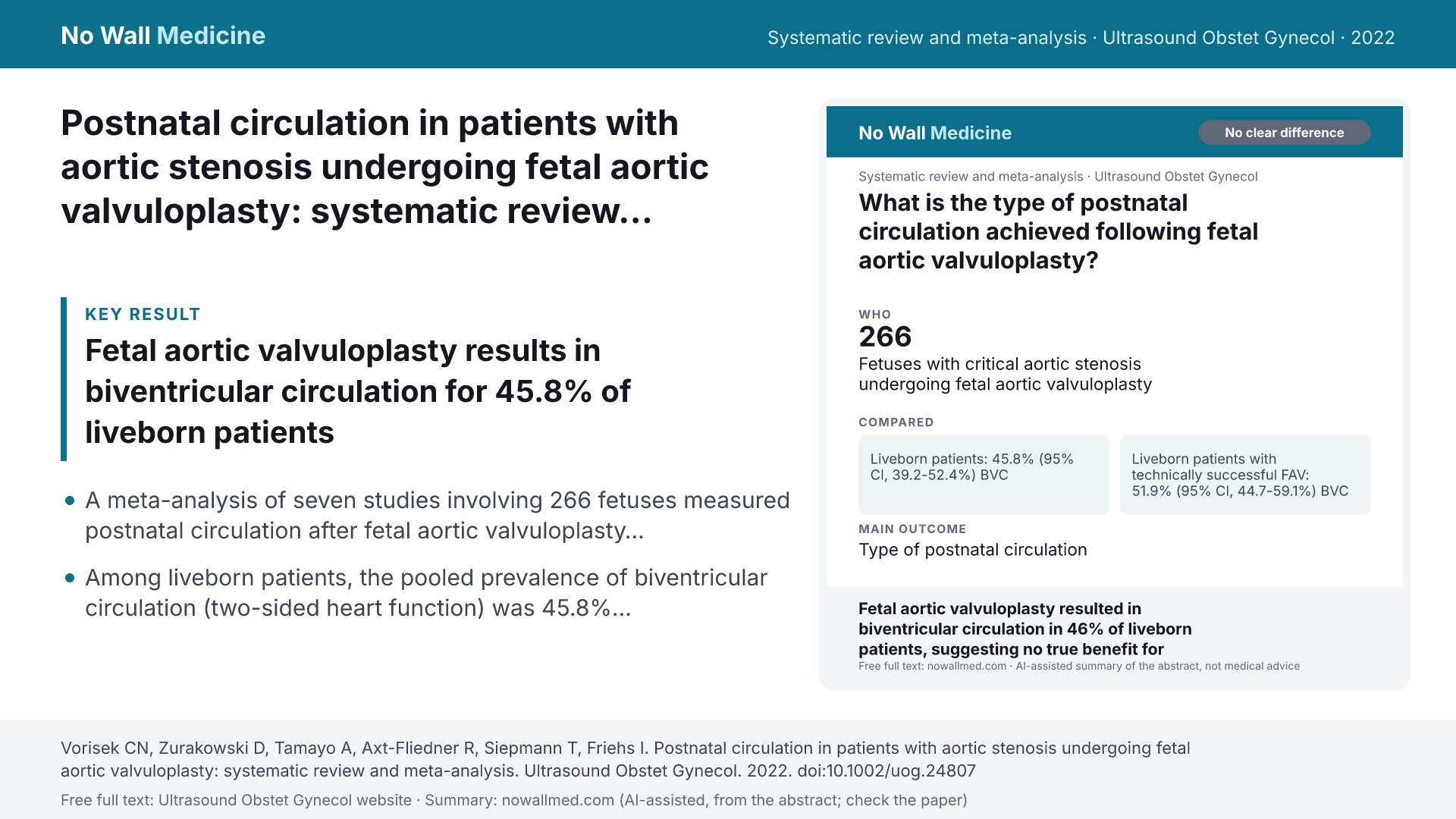
Postnatal circulation in patients with aortic stenosis undergoing fetal aortic valvuloplasty: systematic review and meta-analysis
Key result: Fetal aortic valvuloplasty results in biventricular circulation for 45.8% of liveborn patients
Key points
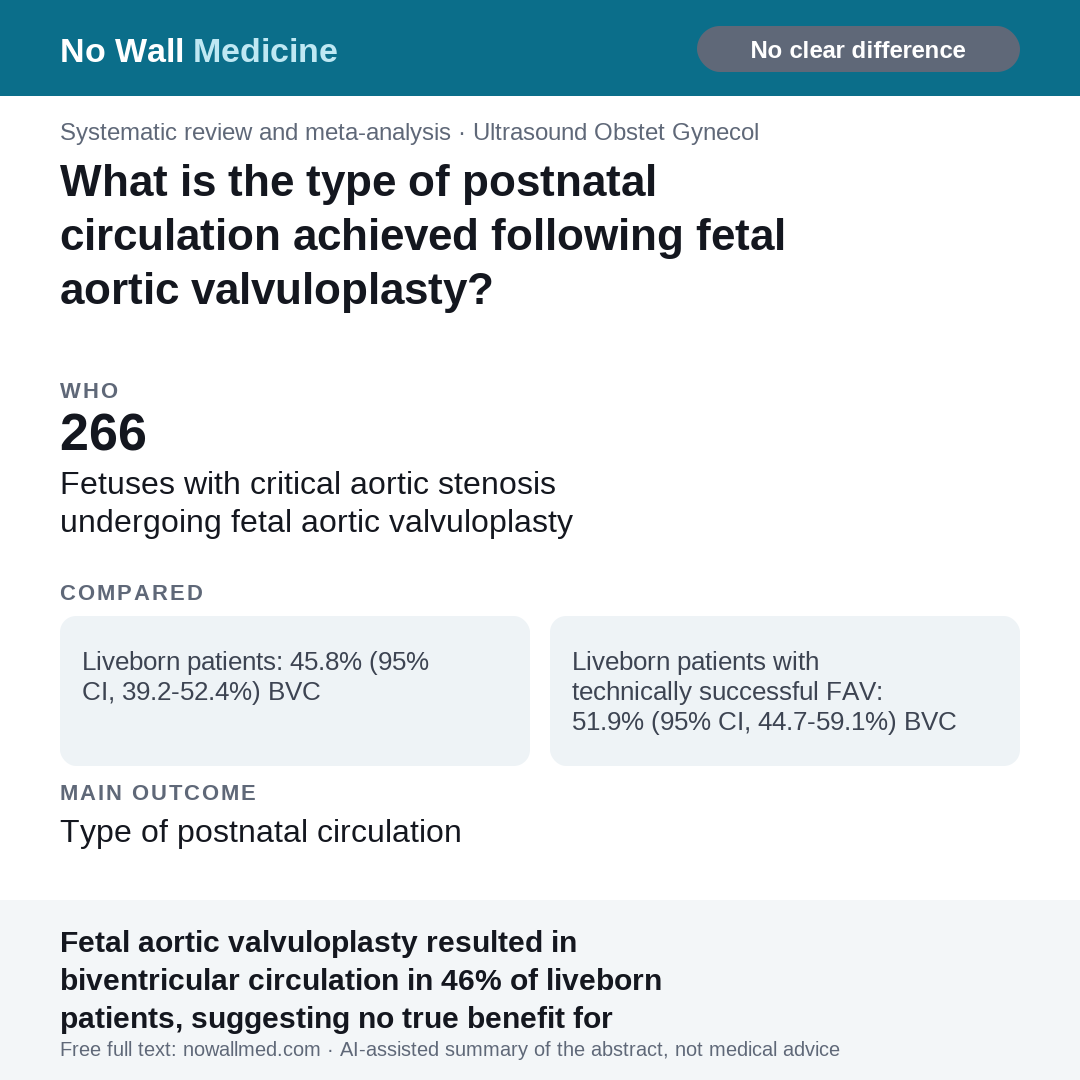
- A meta-analysis of seven studies involving 266 fetuses measured postnatal circulation after fetal aortic valvuloplasty for critical aortic stenosis.
- Among liveborn patients, the pooled prevalence of biventricular circulation (two-sided heart function) was 45.8% and univentricular circulation (one-sided heart function) was 43.6%.
- In patients where the procedure was technically successful, the prevalence of biventricular circulation was 51.9%.
Why it matters: It is unclear how many patients achieve biventricular circulation following fetal aortic valvuloplasty for critical fetal aortic stenosis.
Limitation the authors note: The authors state that the lack of randomized clinical trials means results should be interpreted with caution.
Discussion prompts
- Would these patients look like yours? Who was left out?
- Is the main outcome one that matters to patients?
- Is the difference large enough to change what you do?
Cite: Vorisek CN, Zurakowski D, Tamayo A, Axt-Fliedner R, Siepmann T, Friehs I. Postnatal circulation in patients with aortic stenosis undergoing fetal aortic valvuloplasty: systematic review and meta-analysis. Ultrasound Obstet Gynecol. 2022. doi:10.1002/uog.24807
Free full text: Ultrasound Obstet Gynecol website · Summary and visual abstract: nowallmed.com/a/postnatal-circulation-in-patients-with-aortic-stenosis-undergoing-ns161a/ (AI-assisted from the abstract; check the paper before relying on it).