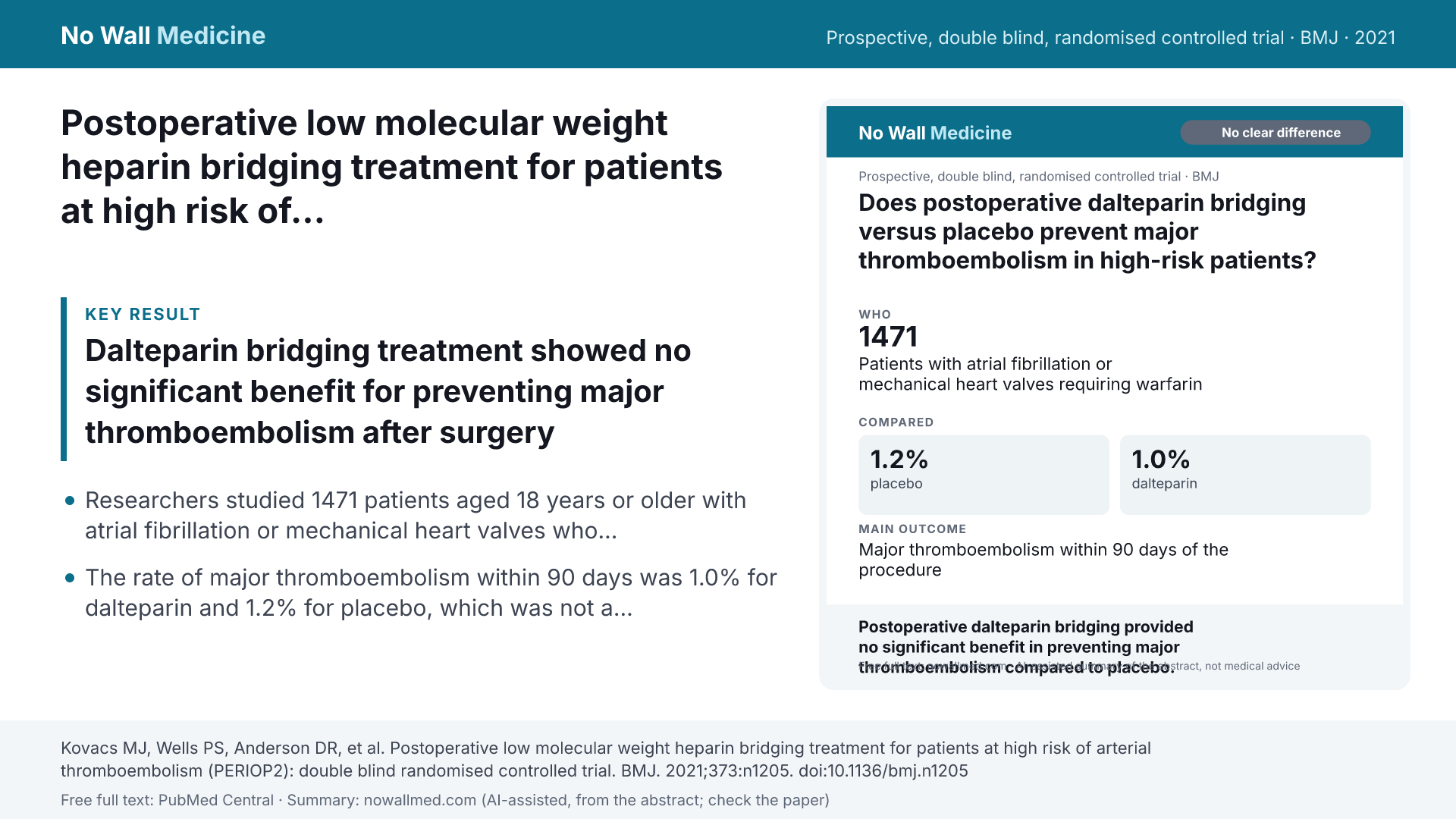
Dalteparin bridging treatment showed no significant benefit for preventing major thromboembolism after surgery
Postoperative low molecular weight heparin bridging treatment for patients at high risk of arterial thromboembolism (PERIOP2): double blind randomised controlled trial
Prospective, double blind, randomised controlled trialNo clear difference
Does postoperative dalteparin bridging versus placebo prevent major thromboembolism in high-risk patients?
Who
1471
Patients with atrial fibrillation or mechanical heart valves requiring warfarin interruption · 10 thrombosis research sites in Canada and India
Compared
1.2%placebo (eight events in 650 patients)
1.0%dalteparin (eight events in 820 patients)
Main outcome
Major thromboembolism within 90 days of the procedure
Result: risk difference -0.3%, 95% confidence interval -1.3 to 0.8
Bottom line: Postoperative dalteparin bridging provided no significant benefit in preventing major thromboembolism compared to placebo.
BMJ · 2021-06-09Download image
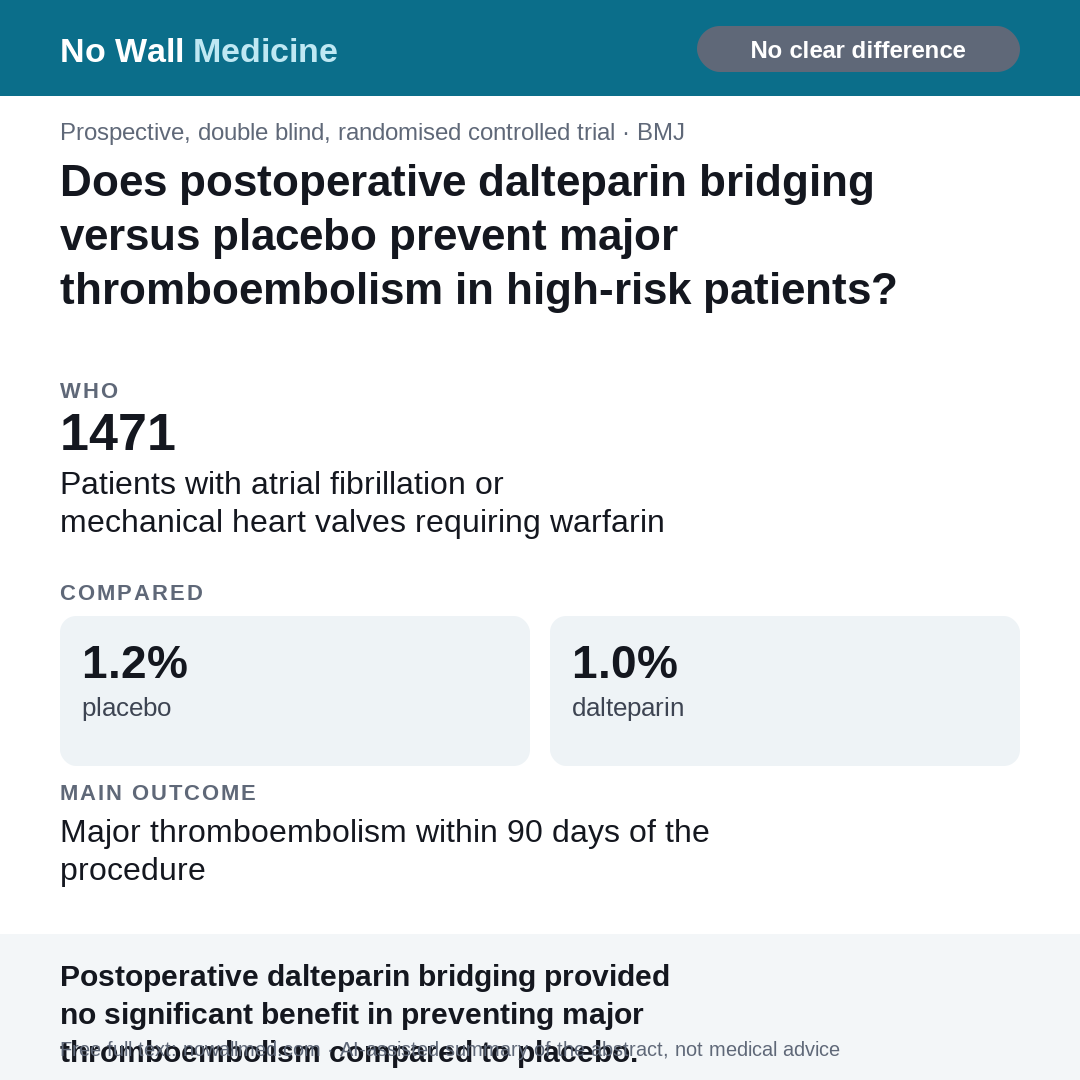
Clinical question: Does postoperative dalteparin bridging versus placebo prevent major thromboembolism in high-risk patients?
Why it matters: It was unknown if postoperative dalteparin bridging treatment improves outcomes for patients at high risk of arterial blood clots when warfarin is interrupted for surgery.
Key points
- Researchers studied 1471 patients aged 18 years or older with atrial fibrillation or mechanical heart valves who temporarily stopped warfarin for a procedure.
- The rate of major thromboembolism within 90 days was 1.0% for dalteparin and 1.2% for placebo, which was not a statistically significant difference.
- Major bleeding occurred in 1.3% of the dalteparin group and 2.0% of the placebo group, showing no significant difference between the two.
Headline and key points written with AI from the paper’s abstract, with every number checked against it. Read the paper before relying on them.
Was this summary helpful?
Abstract
Objective
To determine the efficacy and safety of dalteparin postoperative bridging treatment versus placebo for patients with atrial fibrillation or mechanical heart valves when warfarin is temporarily interrupted for a planned procedure. Design
Prospective, double blind, randomised controlled trial. Setting
10 thrombosis research sites in Canada and India between February 2007 and March 2016. Participants
1471 patients aged 18 years or older with atrial fibrillation or mechanical heart valves who required temporary interruption of warfarin for a procedure. Intervention
Random assignment to dalteparin (n=821; one patient withdrew consent immediately after randomisation) or placebo (n=650) after the procedure. Main outcome measures
Major thromboembolism (stroke, transient ischaemic attack, proximal deep vein thrombosis, pulmonary embolism, myocardial infarction, peripheral embolism, or vascular death) and major bleeding according to the International Society on Thrombosis and Haemostasis criteria within 90 days of the procedure. Results
The rate of major thromboembolism within 90 days was 1.2% (eight events in 650 patients) for placebo and 1.0% (eight events in 820 patients) for dalteparin (P=0.64, risk difference -0.3%, 95% confidence interval -1.3 to 0.8). The rate of major bleeding was 2.0% (13 events in 650 patients) for placebo and 1.3% (11 events in 820 patients) for dalteparin (P=0.32, risk difference -0.7, 95% confidence interval -2.0 to 0.7). The results were consistent for the atrial fibrillation and mechanical heart valves groups. Conclusions
In patients with atrial fibrillation or mechanical heart valves who had warfarin interrupted for a procedure, no significant benefit was found for postoperative dalteparin bridging to prevent major thromboembolism. Trial registration
Clinicaltrials.gov NCT00432796.
Abstract reproduced under the article’s CC BY NC licence.
Subject terms
Cite this article
Kovacs MJ, Wells PS, Anderson DR, et al. Postoperative low molecular weight heparin bridging treatment for patients at high risk of arterial thromboembolism (PERIOP2): double blind randomised controlled trial. BMJ. 2021. doi:10.1136/bmj.n1205
Spotted a mistake? Suggest a correction