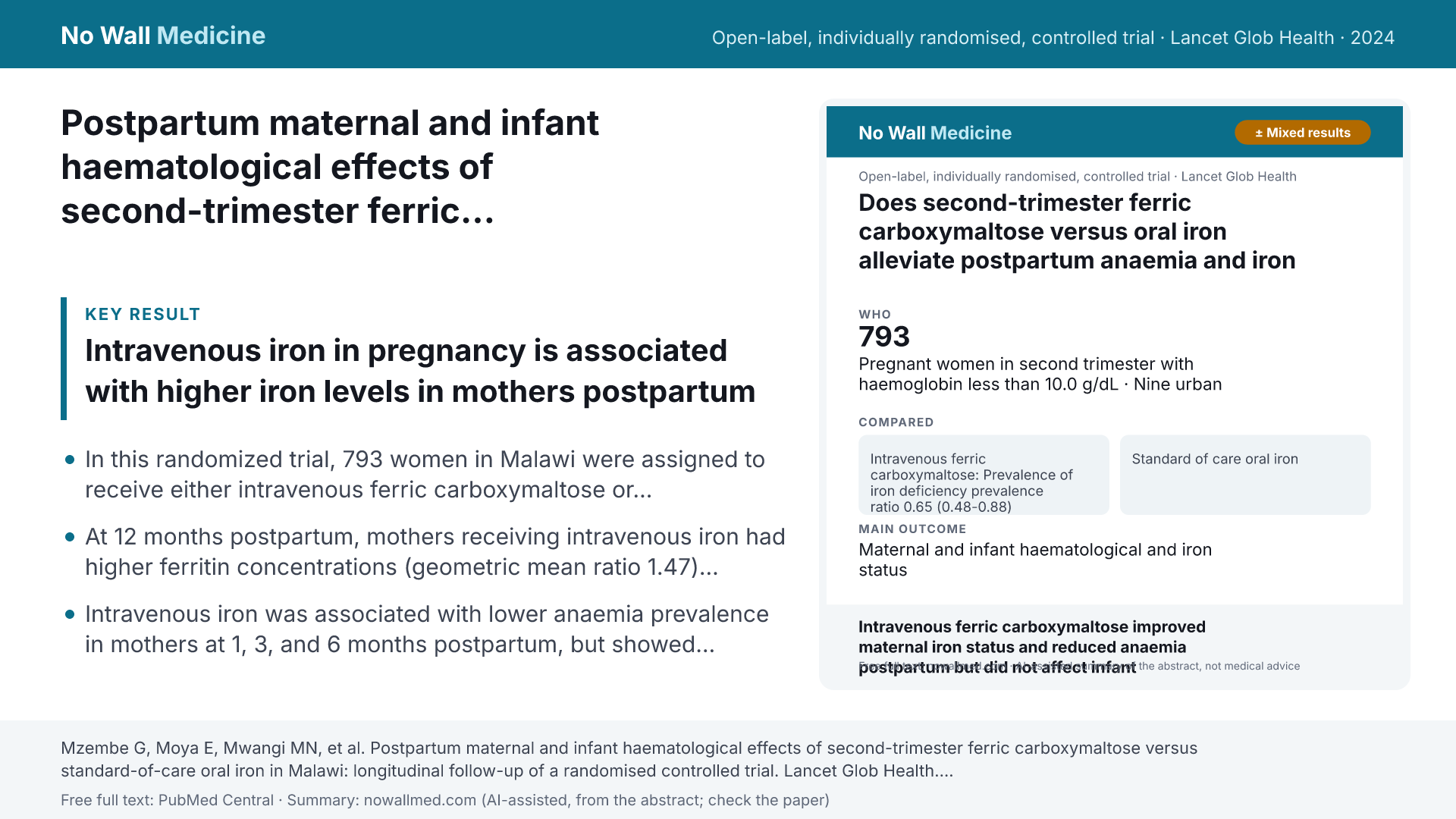
Intravenous iron in pregnancy is associated with higher iron levels in mothers postpartum
Postpartum maternal and infant haematological effects of second-trimester ferric carboxymaltose versus standard-of-care oral iron in Malawi: longitudinal follow-up of a randomised controlled trial
Open-label, individually randomised, controlled trialMixed results
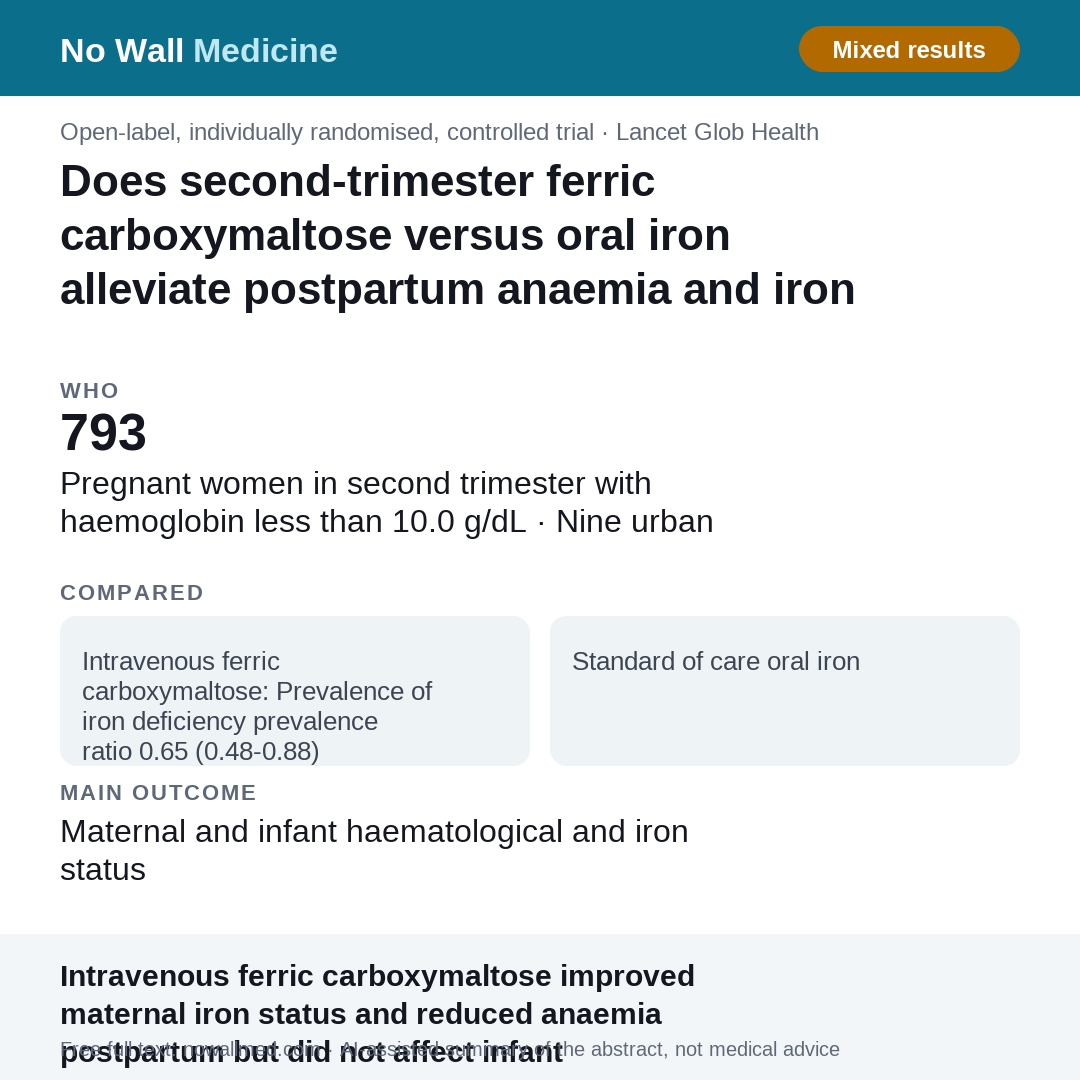
Does second-trimester ferric carboxymaltose versus oral iron alleviate postpartum anaemia and iron deficiency in mothers and infants?
Who
793
Pregnant women in second trimester with haemoglobin less than 10.0 g/dL · Nine urban and five rural health centres in Malawi
Compared
Intravenous ferric carboxymaltose: Prevalence of iron deficiency prevalence ratio 0.65 (0.48-0.88)
Standard of care oral iron
Main outcome
Maternal and infant haematological and iron status
Result: prevalence ratio 0.65 (95% CI 0.48 to 0.88)
Bottom line: Intravenous ferric carboxymaltose improved maternal iron status and reduced anaemia postpartum but did not affect infant haematological outcomes.
Funded by: Bill & Melinda Gates Foundation
Lancet Glob Health · 2024-11-23Download image
Clinical question: Does second-trimester ferric carboxymaltose versus oral iron alleviate postpartum anaemia and iron deficiency in mothers and infants?
Why it matters: It was unknown if treating anaemia with a single dose of intravenous iron in the second trimester could prevent anaemia in mothers and infants during the first year after birth.
Key points
- In this randomized trial, 793 women in Malawi were assigned to receive either intravenous ferric carboxymaltose or standard oral iron during their second trimester.
- At 12 months postpartum, mothers receiving intravenous iron had higher ferritin concentrations (geometric mean ratio 1.47) and a lower prevalence of iron deficiency (prevalence ratio 0.65).
- Intravenous iron was associated with lower anaemia prevalence in mothers at 1, 3, and 6 months postpartum, but showed no difference in infant iron or haemoglobin levels.
Headline and key points written with AI from the paper’s abstract, with every number checked against it. Read the paper before relying on them.
Was this summary helpful?
Abstract
Background
Anaemia is common in mothers and infants in the first year postpartum, especially in sub-Saharan Africa. We evaluated whether treating anaemia in the second trimester of pregnancy with a single dose of intravenous iron, ferric carboxymaltose, compared with standard-of-care oral iron could alleviate anaemia in postpartum women and their infants. Methods
REVAMP (ACTRN12618001268235), an open-label, individually randomised, controlled trial done across nine urban and five rural health centres in Malawi, recruited women if they were in the second trimester of singleton pregnancy, had a capillary haemoglobin concentration of less than 10·0 g/dL, and had a negative malaria rapid diagnostic test. Once enrolled, women were randomly assigned (1:1) to receive intravenous ferric carboxymaltose (20 mg/kg up to 1000 mg) or standard of care (60 mg oral elemental iron twice daily for 90 days); all women received preventive malaria treatment. The primary endpoint of REVAMP was anaemia prevalence at 36 weeks of gestation, with follow-up of mothers and infants until 1 month postpartum. In REVAMP-EXTENDED, women from REVAMP who gave consent, and their infants, were followed up at 3, 6, 9, and 12 months postpartum, and venous blood was collected for haemoglobin, ferritin, and C-reactive protein measurement. Maternal postpartum outcomes comprised prevalence of anaemia (venous haemoglobin concentration <11 g/dL up to and including delivery and <12·0 g/dL postpartum) and haemoglobin concentration, as well as iron status (iron deficiency, defined as serum ferritin <15 μg/L, or <30 μg/L if C-reactive protein >5 mg/L, and iron deficiency anaemia [both iron deficiency and anaemia]). Infant outcomes comprised cord ferritin concentration, and haemoglobin and ferritin concentrations at 1, 3, 6, 9, and 12 months of age. Findings
Between Nov 12, 2018, and March 2, 2021, 862 women were randomly assigned in REVAMP, of whom 793 (393 in the ferric carboxymaltose group [376 liveborn infants] and 400 [379 liveborn infants] in the standard-of-care group) provided consent for REVAMP-EXTENDED. At 12 months postpartum, ferritin concentrations were higher (geometric mean ratio 1·47 [95% CI 1·29-1·66], p<0·0001), and prevalence of iron deficiency was lower (prevalence ratio 0·65 [0·48-0·88], p=0·0050), in mothers receiving ferric carboxymaltose than in those receiving standard of care. Anaemia was less common in women who received ferric carboxymaltose than in those who received standard of care at 1 month (prevalence ratio 0·84 [95% CI 0·71-0·98], p=0·027), 3 months (0·75 [0·62-0·91], p=0·0029), and 6 months (0·78 [0·63-0·96], p=0·018) postpartum but not thereafter. There was no evidence of a difference between groups regarding cord ferritin, infant ferritin, or infant haemoglobin concentrations at any timepoint. Benefits on postpartum anaemia were restricted to mothers with baseline iron deficiency. Interpretation
Ferric carboxymaltose treatment in the second trimester protected women from postpartum anaemia and iron deficiency but did not affect infant haematological or iron status. Funding
Bill & Melinda Gates Foundation. Translation
For the Chichewa translation of the abstract see Supplementary Materials section.
Abstract reproduced under the article’s CC BY licence.
Subject terms
Cite this article
Mzembe G, Moya E, Mwangi MN, et al. Postpartum maternal and infant haematological effects of second-trimester ferric carboxymaltose versus standard-of-care oral iron in Malawi: longitudinal follow-up of a randomised controlled trial. Lancet Glob Health. 2024. doi:10.1016/S2214-109X(24)00380-2
Spotted a mistake? Suggest a correction