No consistent threshold exists for defining chronic urinary retention using postvoid residual volumes
Postvoid Residual Thresholds Used to Define Chronic Urinary Retention: A Systematic Review
Systematic-narrative reviewUnclear result
What postvoid residual thresholds are used to define chronic urinary retention?
Who
14
Adult patients with chronic urinary retention
Compared
Reported thresholds: 150 ml to 1000 ml
Most reported threshold: 300 ml
Main outcome
Postvoid residual thresholds used to define chronic urinary retention
Bottom line: There is no consensus on a single definitive postvoid residual threshold to define chronic urinary retention.
Limitation: Available evidence was limited and heterogeneous with substantial variation in populations and measurement methods.
Eur Urol Open Sci · 2026-07-03Download image
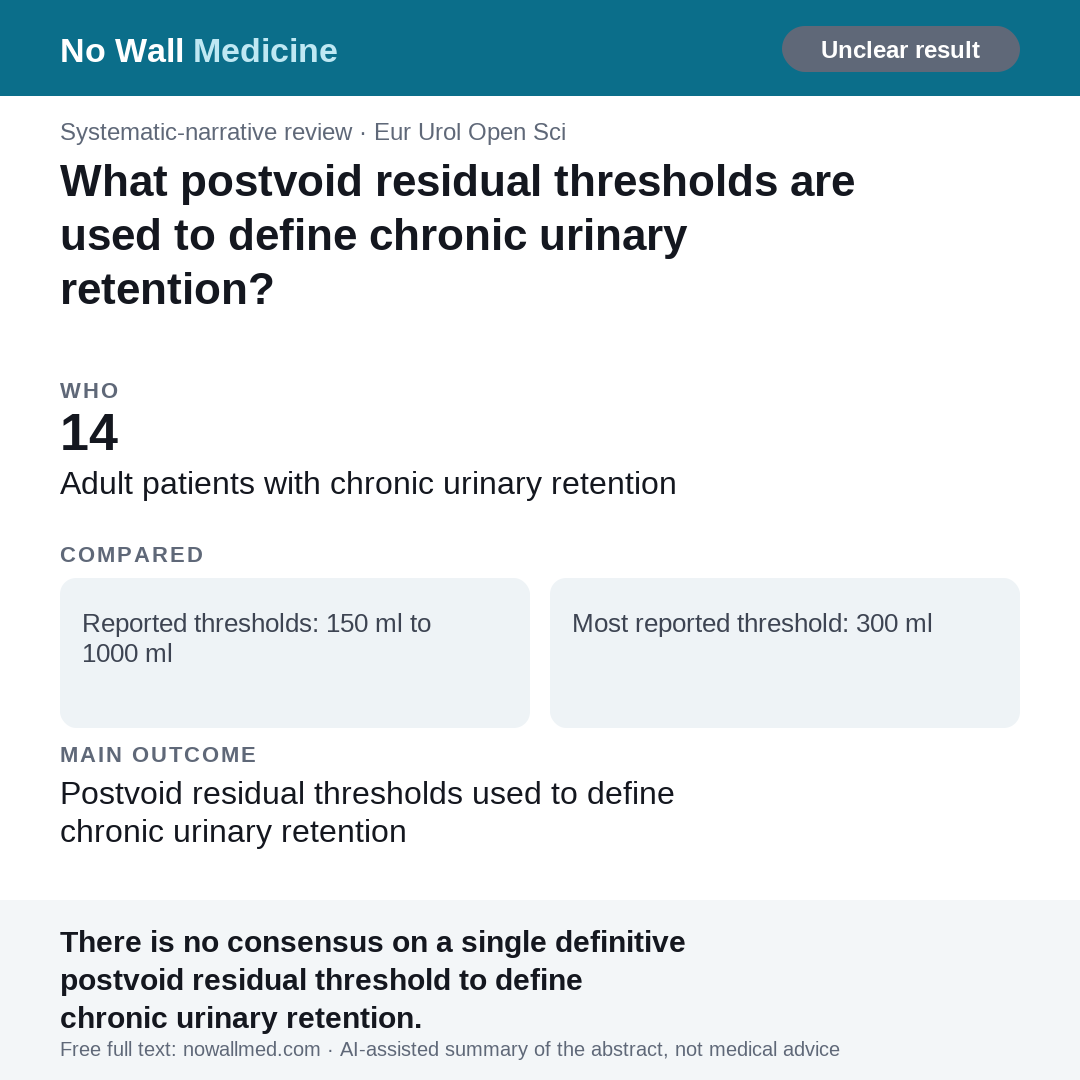
Clinical question: What postvoid residual thresholds are used to define chronic urinary retention?
Why it matters: A lack of consensus on the postvoid residual threshold limits diagnostic consistency and the ability to compare research findings regarding chronic urinary retention.
Key points
- Researchers reviewed 14 studies to examine how chronic urinary retention is defined using postvoid residual, which is the amount of urine left in the bladder after urinating.
- The reported thresholds for defining the condition varied widely between 150 ml and 1000 ml, although 300 ml was the most common value used in 10 studies.
- The included studies showed substantial variation in patient populations, whether patients could void, and the methods used to measure urine volume.
Limitation the authors note: The available evidence was limited and heterogeneous, with substantial variation in study populations, voiding status, and measurement methods.
Headline and key points written with AI from the paper’s abstract, with every number checked against it. Read the paper before relying on them.
Spotted a mistake? Suggest a correction
More in Urology
Checkpoint inhibitor regimens benefit renal cell carcinoma patients with poor prognosis most
Which Patients with Advanced Clear Cell Renal Cell Carcinoma Benefit Most from First-line Checkpoint Inhibitor Combination Regimens: A Meta-analysis of Individual Patient Data and Aggregate Data from Randomised Trials
Male factor infertility is influenced by genetics, environment, and lifestyle choices
Key Determinants and Clinical Impact of Male Factor Infertility: From Etiology to Treatment
Nectin-4-targeted PET/CT compared to FDG PET/CT for urothelial carcinoma staging
Diagnostic Performance of Nectin-4-targeted [68Ga]Ga-DOTA-N188 PET/CT versus [18F]-FDG PET/CT for Staging of Locally Advanced and Metastatic Urothelial Carcinoma: A Prospective, Single-center, Phase 2 Feasibility Trial
Robotic surgery worked as well as open surgery for Wilms tumor in selected cases
Exploring the Limits of Robotic Surgery for Wilms Tumor: A Descriptive Analysis