Choroidal thickening was linked to the effects of high-dose atropine on nearsightedness progression
Potential Choroidal Mechanisms Underlying Atropine's Antimyopic and Rebound Effects: A Mediation Analysis in a Randomized Clinical Trial
Mediation analysis within a randomized controlled trialBenefit found
Does choroidal vascularity participate in high-dose atropine's antimyopia and rebound mechanisms?
Who
207
Myopic children
Compared
Group A (1% weekly then 0.01% daily): LA, SA, and TCA increased significantly after 1% atropine
Group B (0.01% daily): Parameters remained stable
Main outcome
Spherical equivalent progression and choroidal parameters
Bottom line: Total choroidal area partially explains atropine's antimyopic and myopic-rebound mechanisms through changes in luminal and stromal areas.
Invest Ophthalmol Vis Sci · 2023-04-12Download image
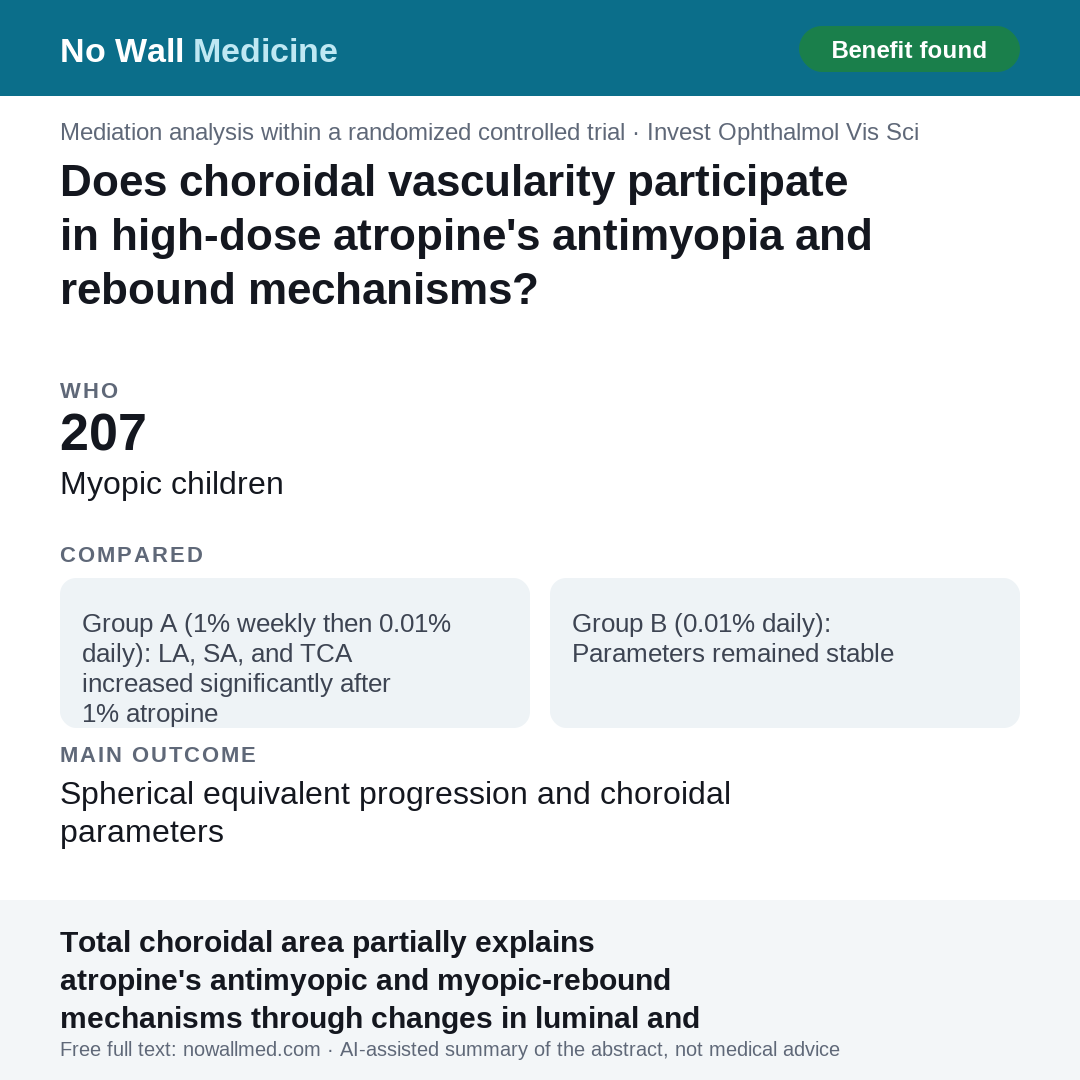
Clinical question: Does choroidal vascularity participate in high-dose atropine's antimyopia and rebound mechanisms?
Why it matters: It was unknown if changes in the choroidal vascularity, the blood vessel components of the eye's middle layer, explained how atropine affects nearsightedness and rebound effects.
Key points
- The study analyzed 207 myopic children assigned to either a high-dose then low-dose atropine regimen or a low-dose atropine regimen alone.
- In the high-dose group, total choroidal area, luminal area, and stromal area increased after 6 months of 1% atropine, but these increases diminished after tapering to 0.01% atropine.
- Total choroidal area mediated approximately one-third of the effect of 1% atropine on spherical equivalent progression, while the choroidal vascularity index showed no mediation effect.
Headline and key points written with AI from the paper’s abstract, with every number checked against it. Read the paper before relying on them.
Was this summary helpful?
Subject terms
Cite this article
Xu H, Ye L, Peng Y, Yu T, Li S, Weng S. Potential Choroidal Mechanisms Underlying Atropine's Antimyopic and Rebound Effects: A Mediation Analysis in a Randomized Clinical Trial. Invest Ophthalmol Vis Sci. 2023. doi:10.1167/iovs.64.4.13
Spotted a mistake? Suggest a correction
Top studies every Monday
The week’s key trials and guidelines in your specialties, plus any topics you follow. By email, free.
Get the weekly digest