Potential of BMI as a screening indicator for extracranial-intracranial bypass surgery in patients with symptomatic artery occlusion: a post-hoc analysis of the CMOSS trial
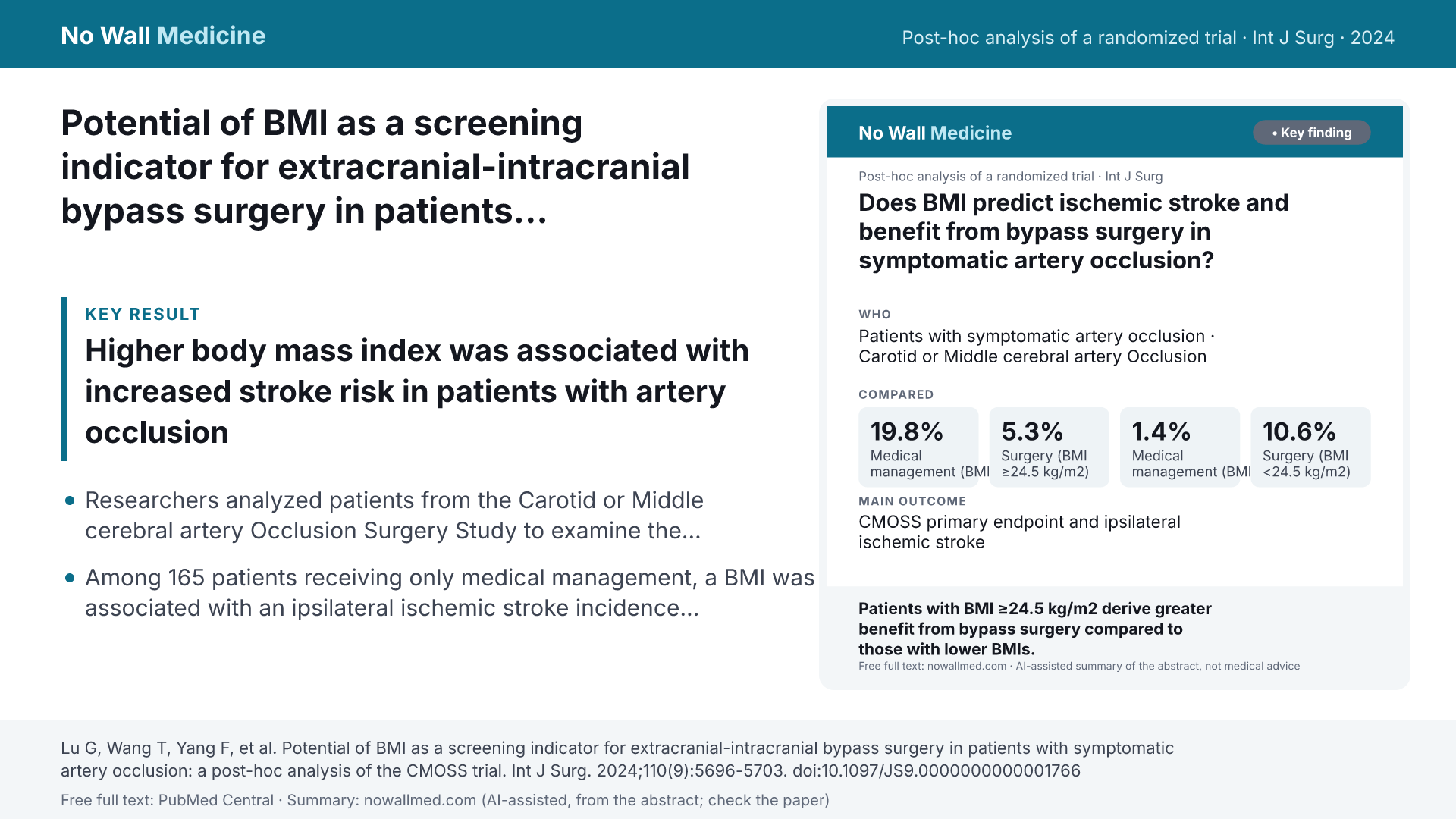
Key result: Higher body mass index was associated with increased stroke risk in patients with artery occlusion
Post-hoc analysis of a randomized trialKey finding
Does BMI predict ischemic stroke and benefit from bypass surgery in symptomatic artery occlusion?
Who
Patients with symptomatic artery occlusion · Carotid or Middle cerebral artery Occlusion Surgery Study
Compared
19.8%Medical management (BMI ≥24.5 kg/m2)
5.3%Surgery (BMI ≥24.5 kg/m2)
1.4%Medical management (BMI <24.5 kg/m2)
10.6%Surgery (BMI <24.5 kg/m2)
Main outcome
CMOSS primary endpoint and ipsilateral ischemic stroke
Result: hazard ratio 1.16 per kg/m 2 (95% CI 1.06-1.27)
Bottom line: Patients with BMI ≥24.5 kg/m2 derive greater benefit from bypass surgery compared to those with lower BMIs.
Limitation: Small sample size and inherent limitations of retrospective analyses.
Int J Surg · 2024-09-01
Key points
- Researchers analyzed patients from the Carotid or Middle cerebral artery Occlusion Surgery Study to examine the link between body mass index (BMI) and ischemic stroke.
- Among 165 patients receiving only medical management, a BMI was associated with an ipsilateral ischemic stroke incidence of 9.7% within 2 years.
- Patients with a BMI of 24.5 kg/m 2 or higher had a 17.4% incidence of ipsilateral ischemic stroke compared to 0.0% for those with a lower BMI.
Limitation the authors note: The authors state the findings are limited by the small sample size and the retrospective nature of the analysis.
Discussion prompts
- Would these patients look like yours? Who was left out?
- Is the main outcome one that matters to patients?
- Is the difference large enough to change what you do?
Cite: Lu G, Wang T, Yang F, et al. Potential of BMI as a screening indicator for extracranial-intracranial bypass surgery in patients with symptomatic artery occlusion: a post-hoc analysis of the CMOSS trial. Int J Surg. 2024;110(9):5696-5703. doi:10.1097/JS9.0000000000001766
Free full text: PubMed Central · Summary and visual abstract: nowallmed.com/a/potential-of-bmi-as-a-screening-indicator-for-extracranial-fmtkk4/ (AI-assisted from the abstract; check the paper before relying on it).