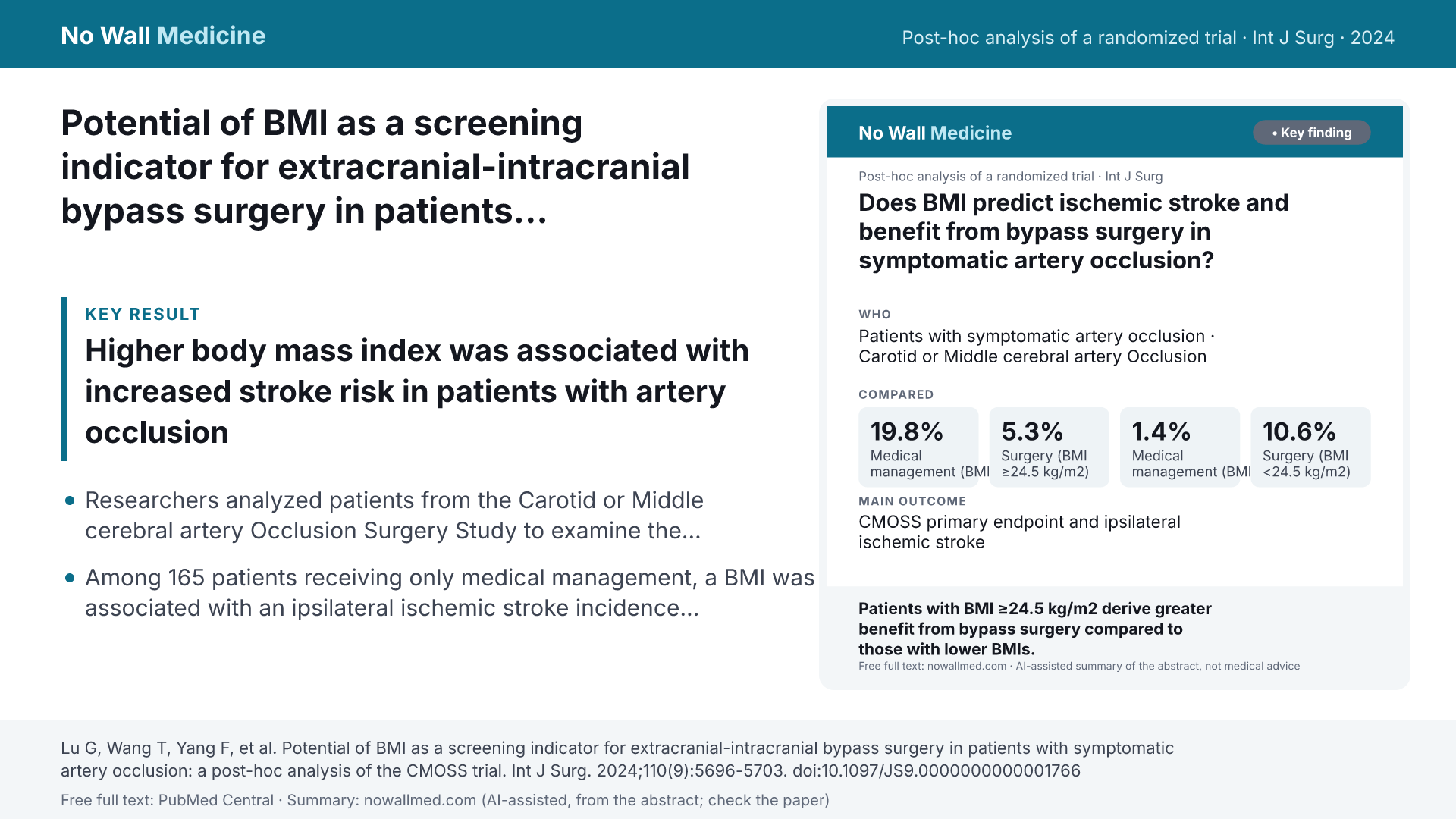
Higher body mass index was associated with increased stroke risk in patients with artery occlusion
Potential of BMI as a screening indicator for extracranial-intracranial bypass surgery in patients with symptomatic artery occlusion: a post-hoc analysis of the CMOSS trial
Post-hoc analysis of a randomized trialBenefit found
Does BMI predict ischemic stroke and benefit from bypass surgery in symptomatic artery occlusion?
Who
Patients with symptomatic artery occlusion · Carotid or Middle cerebral artery Occlusion Surgery Study
Compared
19.8%Medical management (BMI ≥24.5 kg/m2)
5.3%Surgery (BMI ≥24.5 kg/m2)
1.4%Medical management (BMI <24.5 kg/m2)
10.6%Surgery (BMI <24.5 kg/m2)
Main outcome
CMOSS primary endpoint and ipsilateral ischemic stroke
Result: hazard ratio 1.16 per kg/m 2 (95% CI 1.06-1.27)
Bottom line: Patients with BMI ≥24.5 kg/m2 derive greater benefit from bypass surgery compared to those with lower BMIs.
Limitation: Small sample size and inherent limitations of retrospective analyses.
Int J Surg · 2024-09-01Download image
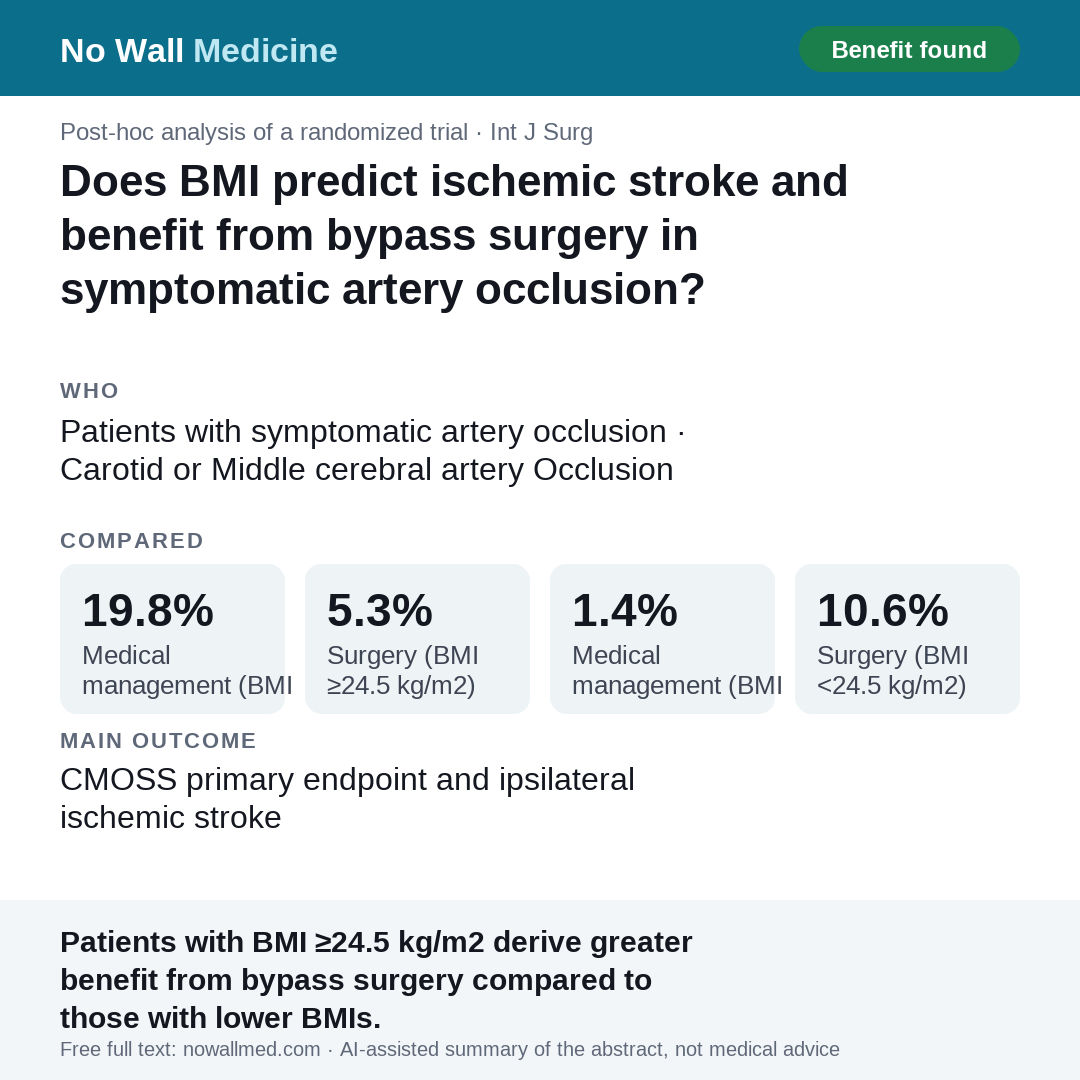
Clinical question: Does BMI predict ischemic stroke and benefit from bypass surgery in symptomatic artery occlusion?
Why it matters: It was unknown if body mass index could serve as a screening tool to identify which patients with symptomatic artery occlusion might benefit from bypass surgery.
Key points
- Researchers analyzed patients from the Carotid or Middle cerebral artery Occlusion Surgery Study to examine the link between body mass index (BMI) and ischemic stroke.
- Among 165 patients receiving only medical management, a BMI was associated with an ipsilateral ischemic stroke incidence of 9.7% within 2 years.
- Patients with a BMI of 24.5 kg/m 2 or higher had a 17.4% incidence of ipsilateral ischemic stroke compared to 0.0% for those with a lower BMI.
Limitation the authors note: The authors state the findings are limited by the small sample size and the retrospective nature of the analysis.
Headline and key points written with AI from the paper’s abstract, with every number checked against it. Read the paper before relying on them.
Was this summary helpful?
Subject terms
Cite this article
Lu G, Wang T, Yang F, Sun X, Yang R, Luo J. Potential of BMI as a screening indicator for extracranial-intracranial bypass surgery in patients with symptomatic artery occlusion: a post-hoc analysis of the CMOSS trial. Int J Surg. 2024. doi:10.1097/JS9.0000000000001766
Spotted a mistake? Suggest a correction