Researchers design a trial testing a precision medicine care model for young-onset type 2 diabetes
Precision Medicine to Redefine Insulin Secretion and Monogenic Diabetes-Randomized Controlled Trial (PRISM-RCT) in Chinese patients with young-onset diabetes: design, methods and baseline characteristics
Randomized controlled trialUnclear result
Does a multicomponent precision medicine care model improve outcomes in young-onset type 2 diabetes?
Who
884
Chinese patients with type 2 diabetes diagnosed at ≤40 years and aged ≤50 years · diabetes center setting
Compared
JADE-only (usual care)
JADE-PRISM (precision medicine)
Main outcome
incidence of all diabetes-related complications
Bottom line: The study describes the design and baseline characteristics of a trial evaluating precision medicine for young-onset diabetes.
BMJ Open Diabetes Res Care · 2024-06-19Download image
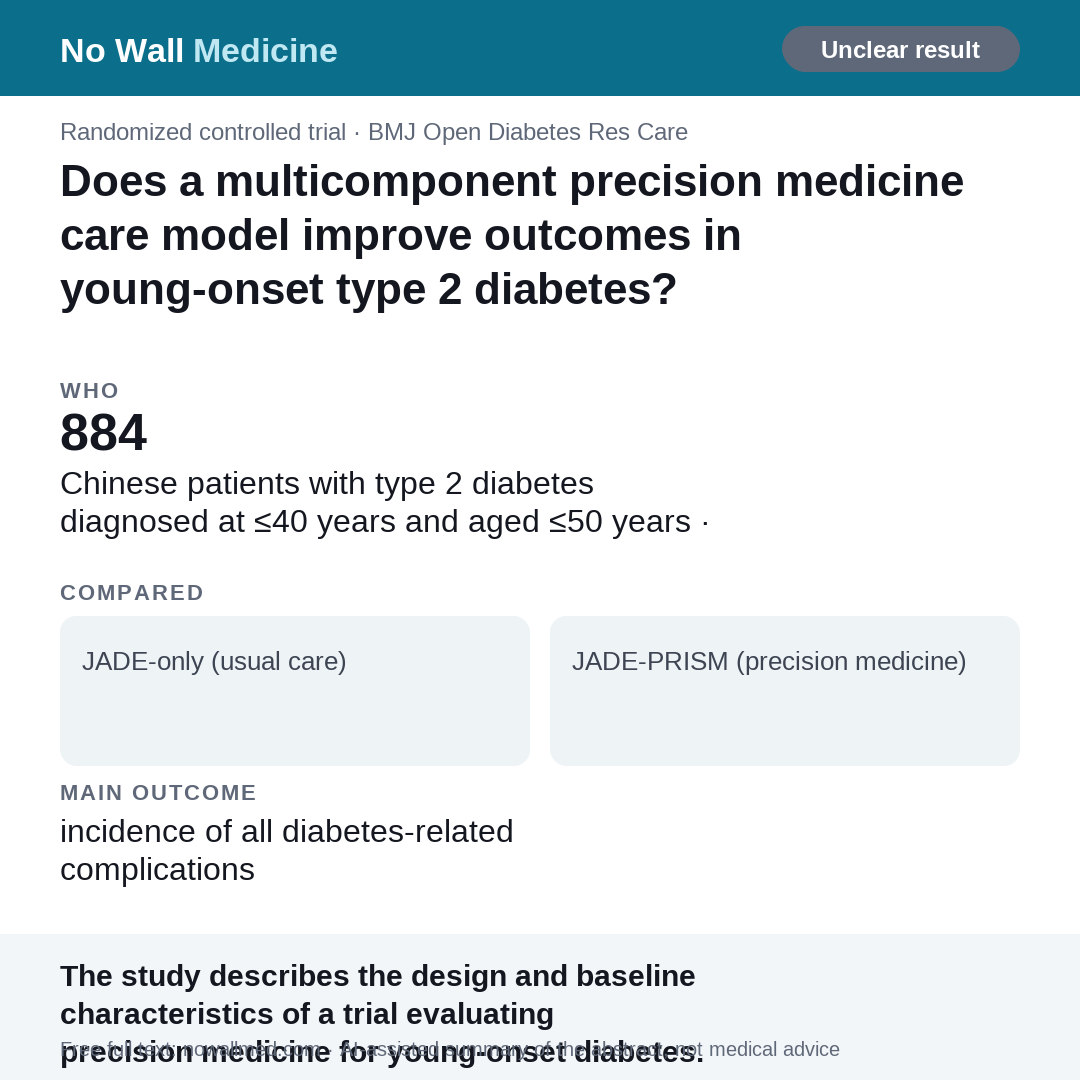
Clinical question: Does a multicomponent precision medicine care model improve outcomes in young-onset type 2 diabetes?
Why it matters: Evidence-based practice guidelines are lacking for the management of patients with young-onset type 2 diabetes.
Key points
- The study enrolled 884 patients with type 2 diabetes diagnosed at age 40 or younger to compare a multicomponent care model against usual care.
- The precision medicine group used genetic markers and specialist-led management to target blood sugar, blood pressure, cholesterol, and waist circumference.
- Baseline data showed 74.7% of participants had a positive family history and 51.4% had general obesity.
Headline and key points written with AI from the paper’s abstract, with every number checked against it. Read the paper before relying on them.
Was this summary helpful?
Abstract
Introduction
We designed and implemented a patient-centered, data-driven, holistic care model with evaluation of its impacts on clinical outcomes in patients with young-onset type 2 diabetes (T2D) for which there is a lack of evidence-based practice guidelines. Research design and methods
In this 3-year Precision Medicine to Redefine Insulin Secretion and Monogenic Diabetes-Randomized Controlled Trial, we evaluate the effects of a multicomponent care model integrating use of information and communication technology (Joint Asia Diabetes Evaluation (JADE) platform), biogenetic markers and patient-reported outcome measures in patients with T2D diagnosed at ≤40 years of age and aged ≤50 years. The JADE-PRISM group received 1 year of specialist-led team-based management using treatment algorithms guided by biogenetic markers (genome-wide single-nucleotide polymorphism arrays, exome-sequencing of 34 monogenic diabetes genes, C-peptide, autoantibodies) to achieve multiple treatment goals (glycated hemoglobin (HbA1c) <6.2%, blood pressure <120/75 mm Hg, low-density lipoprotein-cholesterol <1.2 mmol/L, waist circumference <80 cm (women) or <85 cm (men)) in a diabetes center setting versus usual care (JADE-only). The primary outcome is incidence of all diabetes-related complications. Results
In 2020-2021, 884 patients (56.6% men, median (IQR) diabetes duration: 7 (3-12) years, current/ex-smokers: 32.5%, body mass index: 28.40±5.77 kg/m2, HbA1c: 7.52%±1.66%, insulin-treated: 27.7%) were assigned to JADE-only (n=443) or JADE-PRISM group (n=441). The profiles of the whole group included positive family history (74.7%), general obesity (51.4%), central obesity (79.2%), hypertension (66.7%), dyslipidemia (76.4%), albuminuria (35.4%), estimated glomerular filtration rate <60 mL/min/1.73 m2 (4.0%), retinopathy (13.8%), atherosclerotic cardiovascular disease (5.2%), cancer (3.1%), emotional distress (26%-38%) and suboptimal adherence (54%) with 5-item EuroQol for Quality of Life index of 0.88 (0.87-0.96). Overall, 13.7% attained ≥3 metabolic targets defined in secondary outcomes. In the JADE-PRISM group, 4.5% had pathogenic/likely pathogenic variants of monogenic diabetes genes; 5% had autoantibodies and 8.4% had fasting C-peptide <0.2 nmol/L. Other significant events included low/large birth weight (33.4%), childhood obesity (50.7%), mental illness (10.3%) and previous suicide attempts (3.6%). Among the women, 17.3% had polycystic ovary syndrome, 44.8% required insulin treatment during pregnancy and 17.3% experienced adverse pregnancy outcomes. Conclusions
Young-onset diabetes is characterized by complex etiologies with comorbidities including mental illness and lifecourse events. Trial registration number
NCT04049149.
Abstract reproduced under the article’s CC BY NC licence.
Subject terms
Cite this article
O CK, Fan YN, Fan B, Lim C, Lau ESH, Tsoi STF. Precision Medicine to Redefine Insulin Secretion and Monogenic Diabetes-Randomized Controlled Trial (PRISM-RCT) in Chinese patients with young-onset diabetes: design, methods and baseline characteristics. BMJ Open Diabetes Res Care. 2024. doi:10.1136/bmjdrc-2024-004120
Spotted a mistake? Suggest a correction
Top studies every Monday
The week’s key trials and guidelines in your specialties, plus any topics you follow. By email, free.
Get the weekly digest