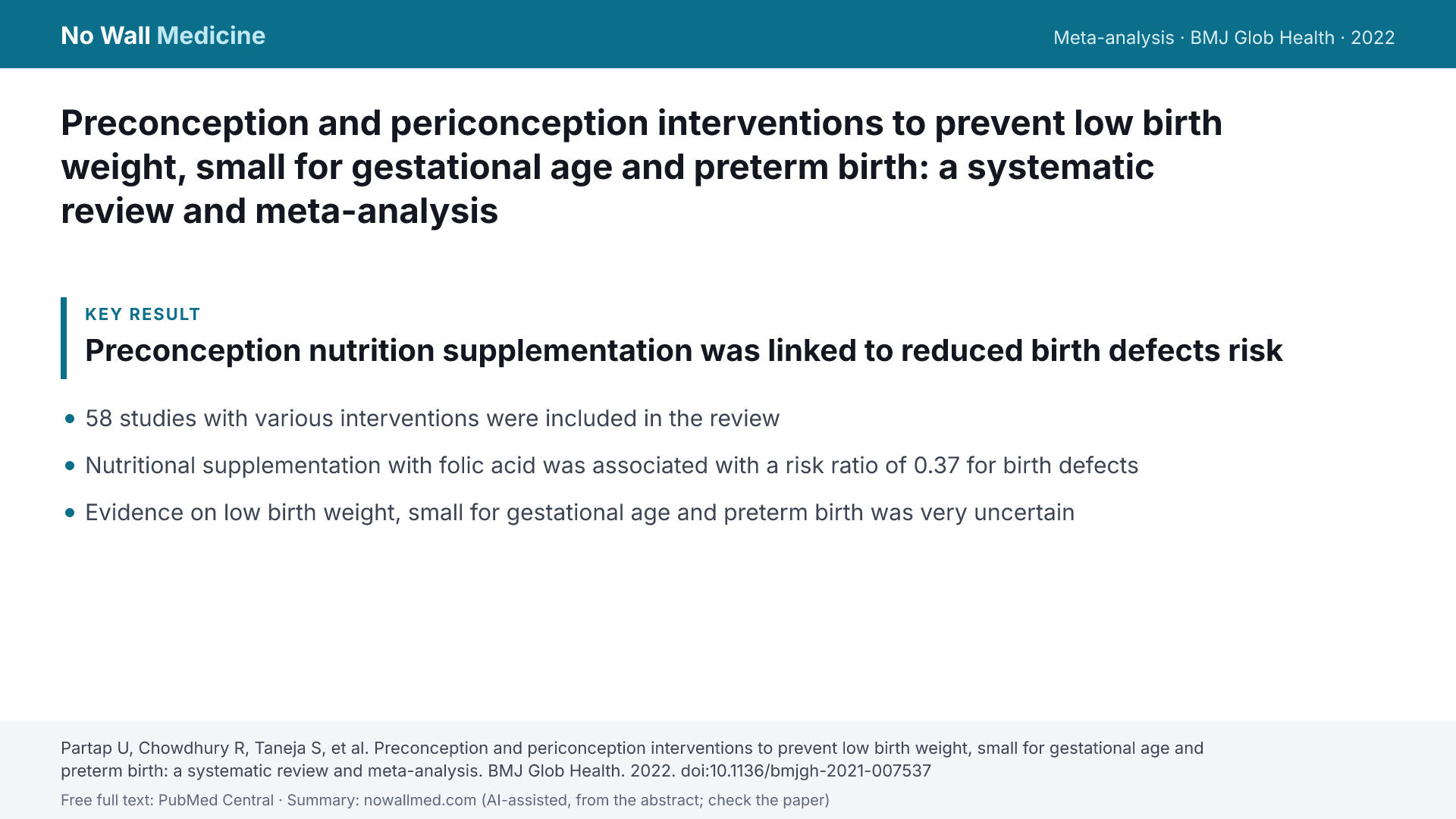
Preconception nutrition supplementation was linked to reduced birth defects risk
Preconception and periconception interventions to prevent low birth weight, small for gestational age and preterm birth: a systematic review and meta-analysis
Why it matters: Effectiveness of preconception interventions on low birth weight and preterm birth is unclear
Key points
- 58 studies with various interventions were included in the review.
- Nutritional supplementation with folic acid was associated with a risk ratio of 0.37 for birth defects.
- Evidence on low birth weight, small for gestational age and preterm birth was very uncertain.
Limitation the authors note: The evidence was generally very uncertain due to few studies for any single comparison
Headline and key points written with AI from the paper’s abstract, with every number checked against it. Read the paper before relying on them.
Was this summary helpful?
Abstract
Background
Low birth weight (LBW), including preterm birth (PTB) and small for gestational age (SGA), contributes a significant global health burden. We aimed to summarise current evidence on the effect of preconception and periconception interventions on LBW, SGA and PTB. Methods
In this systematic review and meta-analysis, we searched PubMed, Embase, Cochrane Library and WHO Global Index Medicus for randomised controlled trials and quasi-experimental studies published by 28 November 2020, which assessed interventions delivered in preconception and periconception or preconception and pregnancy. Primary outcomes were LBW, SGA and PTB. Studies were categorised by intervention type and delivery during preconception and periconception or during preconception and pregnancy. Estimates were pooled using fixed-effects or random-effects restricted maximum likelihood method meta-analyses. Quality of evidence for primary outcomes was assessed using the Grades of Recommendations, Assessment, Development and Evaluation approach. Results
We included 58 studies. Twenty-eight studies examined nutrition interventions (primarily micronutrient or food supplementation). Thirty studies (including one reporting a nutrition intervention) provided health interventions (general preconception health, early adverse pregnancy outcome prevention, non-communicable disease and infectious disease prevention and management). One study assessed a social intervention (reproductive planning). Studies varied in terms of specific interventions, including delivery across preconception or pregnancy, resulting in few studies for any single comparison. Overall, the evidence was generally very uncertain regarding the impact of any intervention on LBW, SGA and PTB. Additionally, preconception and periconception nutritional supplementation containing folic acid was associated with reduced risk of birth defects (10 studies, N=3 13 312, risk ratio: 0.37 (95% CI: 0.24 to 0.55), I2: 74.33%). Conclusion
We found a paucity of evidence regarding the impact of preconception and periconception interventions on LBW, SGA and PTB. Further research on a wider range of interventions is required to clearly ascertain their potential effectiveness. Trial registration number
This review was prospectively registered with PROSPERO (CRD42020220915).
Abstract reproduced under the article’s CC BY NC licence.
Subject terms
Cite this article
Partap U, Chowdhury R, Taneja S, et al. Preconception and periconception interventions to prevent low birth weight, small for gestational age and preterm birth: a systematic review and meta-analysis. BMJ Glob Health. 2022. doi:10.1136/bmjgh-2021-007537
Spotted a mistake? Suggest a correction