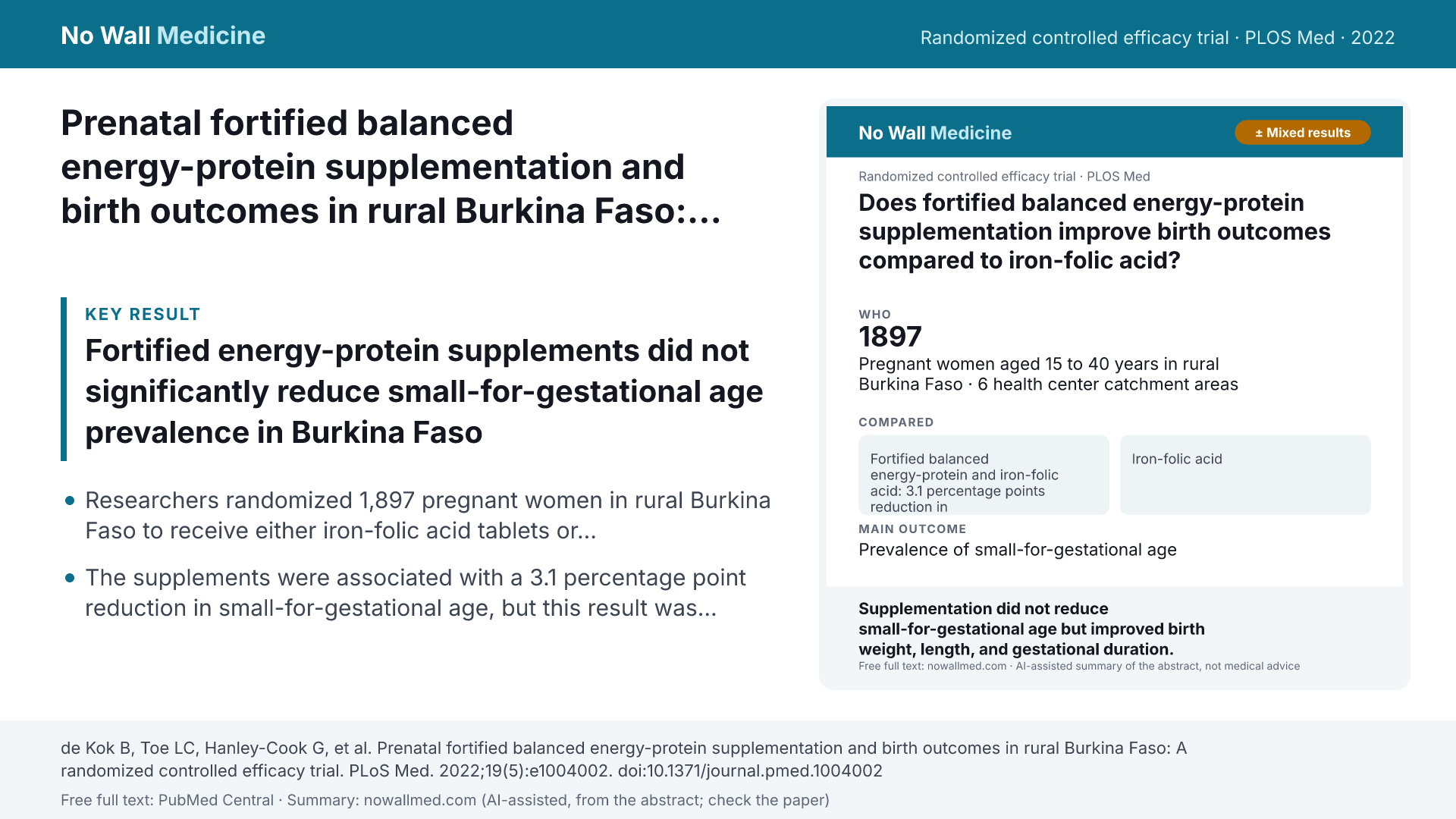
Fortified energy-protein supplements did not significantly reduce small-for-gestational age prevalence in Burkina Faso
Prenatal fortified balanced energy-protein supplementation and birth outcomes in rural Burkina Faso: A randomized controlled efficacy trial
Randomized controlled efficacy trialMixed results
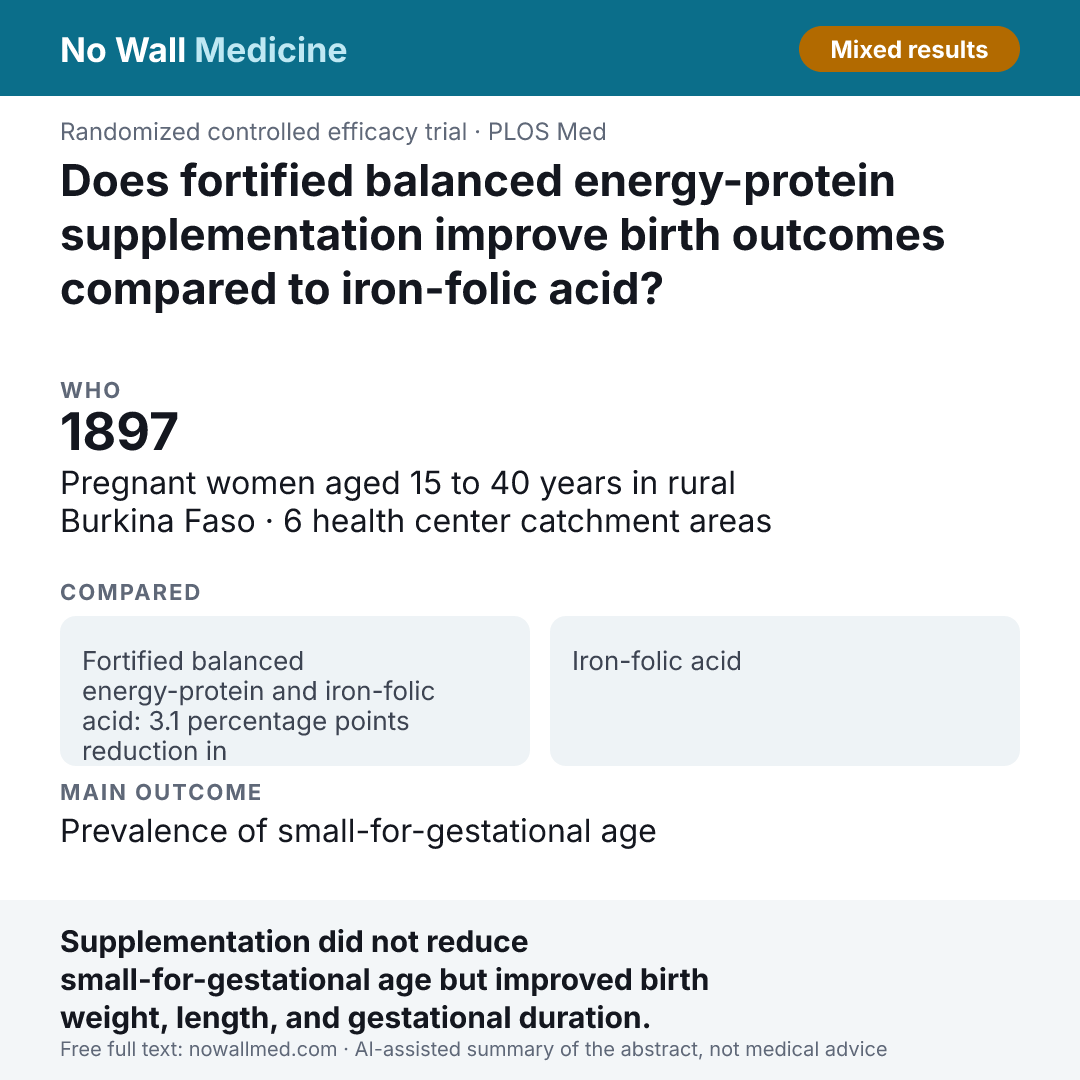
Does fortified balanced energy-protein supplementation improve birth outcomes compared to iron-folic acid?
Who
1897
Pregnant women aged 15 to 40 years in rural Burkina Faso · 6 health center catchment areas in rural Burkina Faso
Compared
Fortified balanced energy-protein and iron-folic acid: 3.1 percentage points reduction in small-for-gestational age
Iron-folic acid
Main outcome
Prevalence of small-for-gestational age
Result: -3.1 percentage points (95% CI -7.39 to 1.16)
Bottom line: Supplementation did not reduce small-for-gestational age but improved birth weight, length, and gestational duration.
Limitation: Nonblinded administration of supplements and lack of information on other prognostic factors.
PLOS Med · 2022-05-13 · Save PNG
Same trial (NCT03533712)
Papers we list that report this registered trial, oldest first. Read a secondary analysis alongside the main results.
- Main results Mixed results
This paper PLOS Med 2022-05 - Related analysis Benefit found
Prenatal energy-protein supplementation is linked to better infant length and lower stunting at 6 months PLOS Med 2023-02 - Secondary analysis Benefit found
Prenatal energy-protein supplements increased fat-free mass in mothers and newborns in Burkina Faso PLOS Med 2023-07
Clinical question: Does fortified balanced energy-protein supplementation improve birth outcomes compared to iron-folic acid?
Key points
- Researchers randomized 1,897 pregnant women in rural Burkina Faso to receive either iron-folic acid tablets or iron-folic acid plus fortified energy-protein supplements.
- The supplements were associated with a 3.1 percentage point reduction in small-for-gestational age, but this result was not statistically significant (P = 0.151).
- The intervention was associated with increased gestational duration by 0.20 weeks, higher birth weight by 50.1 g, and a 3.95 percentage point decrease in low birth weight prevalence.
Limitation the authors note: The authors noted the nonblinded administration of supplements and a lack of information on other prognostic factors like infection, inflammation, stress, and physical activity.
Headline and key points written with AI from the paper’s abstract, with every number checked against it. Read the paper before relying on them.
Was this summary helpful?
Subject terms
Headline, design, result, key points, caveat and citation as plain text.
Cite this article
de Kok B, Toe LC, Hanley-Cook G, et al. Prenatal fortified balanced energy-protein supplementation and birth outcomes in rural Burkina Faso: A randomized controlled efficacy trial. PLoS Med. 2022;19(5):e1004002. doi:10.1371/journal.pmed.1004002
Spotted a mistake? Suggest a correction