Precuneus magnetic stimulation for Alzheimer's disease: a randomized, sham-controlled trial
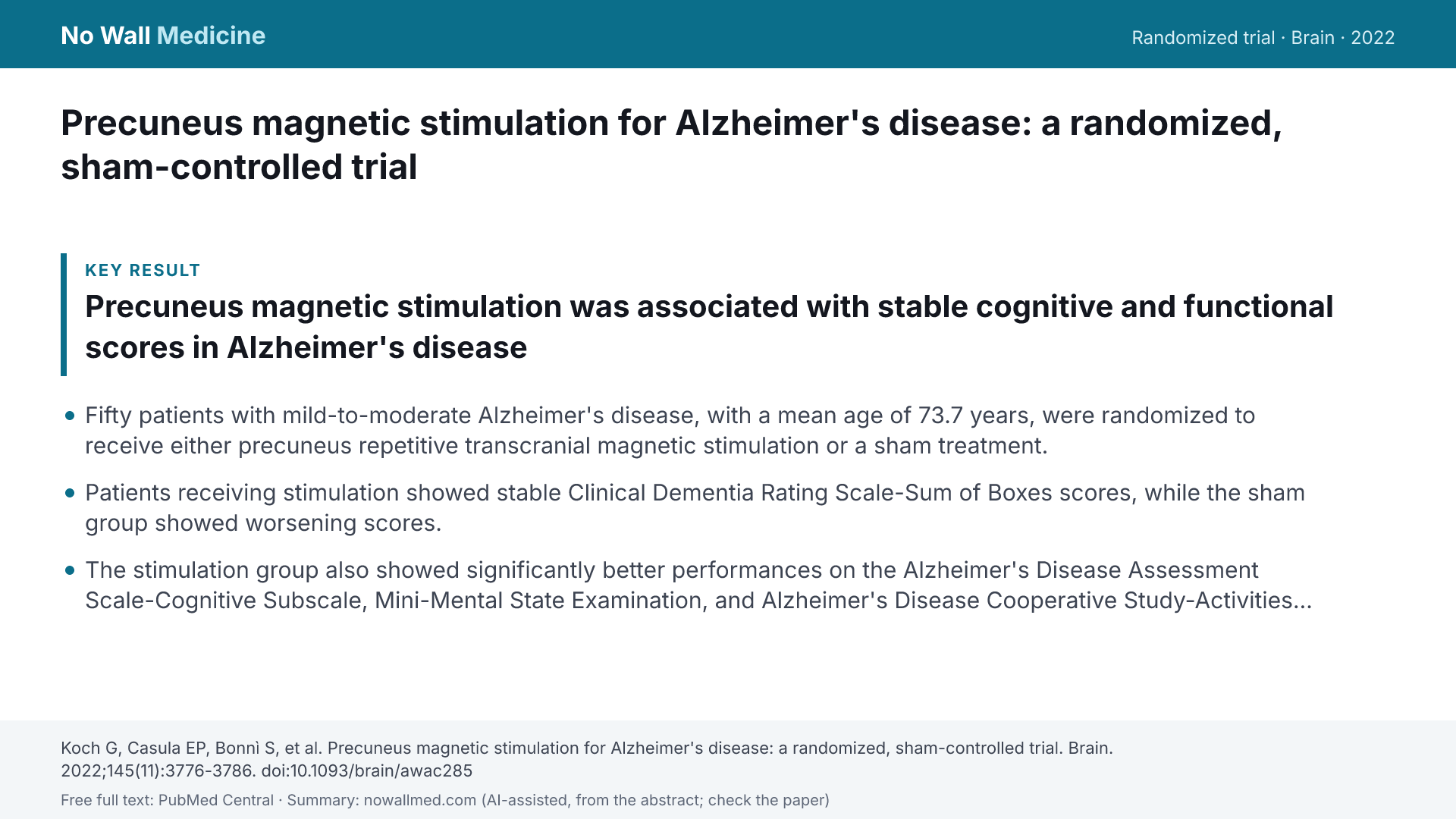
Key result: Precuneus magnetic stimulation was associated with stable cognitive and functional scores in Alzheimer's disease
Key points
- Fifty patients with mild-to-moderate Alzheimer's disease, with a mean age of 73.7 years, were randomized to receive either precuneus repetitive transcranial magnetic stimulation or a sham treatment.
- Patients receiving stimulation showed stable Clinical Dementia Rating Scale-Sum of Boxes scores, while the sham group showed worsening scores.
- The stimulation group also showed significantly better performances on the Alzheimer's Disease Assessment Scale-Cognitive Subscale, Mini-Mental State Examination, and Alzheimer's Disease Cooperative Study-Activities of Daily Living scale.
Discussion prompts
- Would these patients look like yours? Who was left out?
- Is the main outcome one that matters to patients?
- Is the difference large enough to change what you do?
Cite: Koch G, Casula EP, Bonnì S, et al. Precuneus magnetic stimulation for Alzheimer's disease: a randomized, sham-controlled trial. Brain. 2022;145(11):3776-3786. doi:10.1093/brain/awac285
Free full text: PubMed Central · Summary and visual abstract: nowallmed.com/a/precuneus-magnetic-stimulation-for-alzheimer-s-disease-a-randomized-1krehwa/ (AI-assisted from the abstract; check the paper before relying on it).