Baseline anti-Müllerian hormone levels predict ovarian function loss in young breast cancer patients
Predicting ovarian function loss after chemotherapy and anti-HER2 therapy in young breast cancer patients
Biomarker analysis of 2 trialsBenefit found
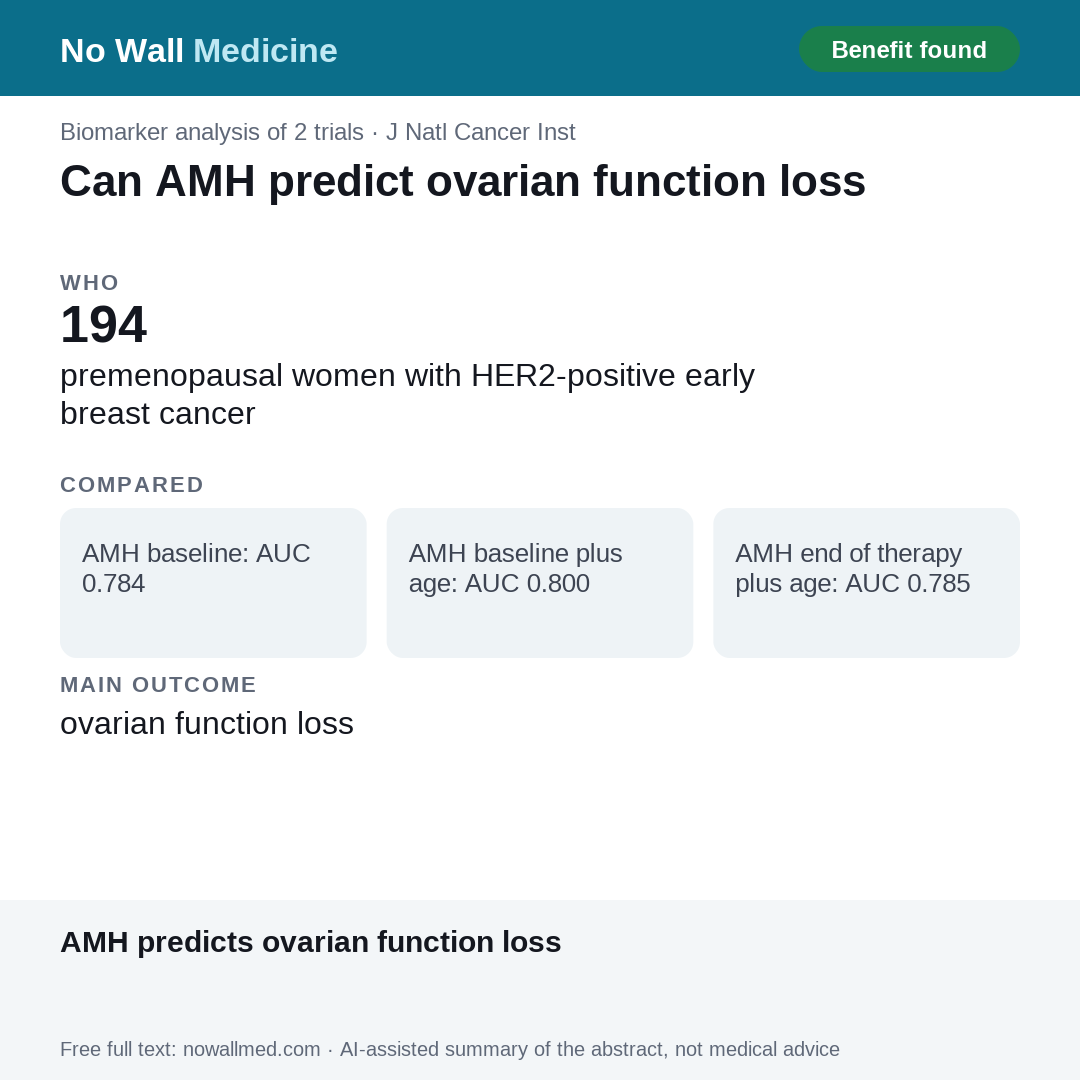
Can AMH predict ovarian function loss
Who
194
premenopausal women with HER2-positive early breast cancer
Compared
AMH baseline: AUC 0.784
AMH baseline plus age: AUC 0.800
AMH end of therapy plus age: AUC 0.785
Main outcome
ovarian function loss
Bottom line: AMH predicts ovarian function loss
J Natl Cancer Inst · 2025-08-13Download image
Why it matters: Predicting ovarian function loss is important for fertility counseling and therapy decision-making in young women with early breast cancer.
Key points
- Researchers analyzed 194 premenopausal women with HER2-positive early breast cancer from two randomized trials to evaluate how hormone levels predict ovarian function loss.
- Baseline anti-Müllerian hormone levels predicted ovarian loss with an area under the ROC curve of 0.784, which increased to 0.800 when age was added.
- Combining baseline and end-of-therapy anti-Müllerian hormone levels with age provided a prediction area under the ROC curve of 0.820, while adding follicle stimulating hormone and estradiol did not improve prediction.
Headline and key points written with AI from the paper’s abstract, with every number checked against it. Read the paper before relying on them.
Topics
Cite this article
Lambertini M, Allegranza D, Laubender RP, Harbeck N, Swain SM, Geyer CE. Predicting ovarian function loss after chemotherapy and anti-HER2 therapy in young breast cancer patients. J Natl Cancer Inst. 2025. doi:10.1093/jnci/djaf198
Spotted a mistake? Suggest a correction
Top studies every Monday
The week’s key trials and guidelines in your specialties, by email. Free.
Get the weekly digest