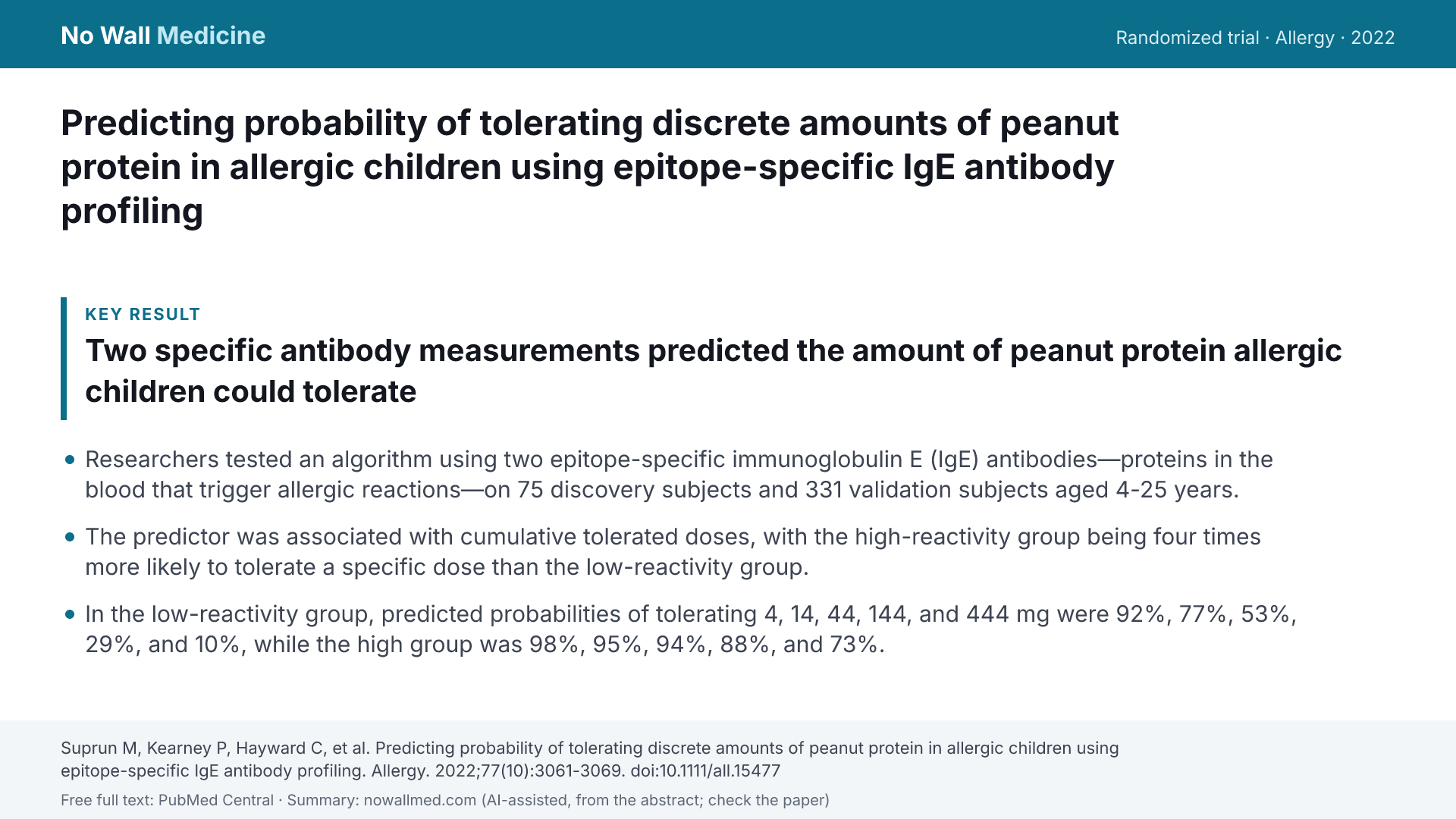
Predicting probability of tolerating discrete amounts of peanut protein in allergic children using epitope-specific IgE antibody profiling
Key result: Two specific antibody measurements predicted the amount of peanut protein allergic children could tolerate
Key points
- Researchers tested an algorithm using two epitope-specific immunoglobulin E (IgE) antibodies—proteins in the blood that trigger allergic reactions—on 75 discovery subjects and 331 validation subjects aged 4-25 years.
- The predictor was associated with cumulative tolerated doses, with the high-reactivity group being four times more likely to tolerate a specific dose than the low-reactivity group.
- In the low-reactivity group, predicted probabilities of tolerating 4, 14, 44, 144, and 444 mg were 92%, 77%, 53%, 29%, and 10%, while the high group was 98%, 95%, 94%, 88%, and 73%.
Limitation the authors note: Predictions are complex due to limited responder sample sizes at each dose and variations in study-specific challenge protocols.
Discussion prompts
- Would these patients look like yours? Who was left out?
- Is the main outcome one that matters to patients?
- Is the difference large enough to change what you do?
Cite: Suprun M, Kearney P, Hayward C, et al. Predicting probability of tolerating discrete amounts of peanut protein in allergic children using epitope-specific IgE antibody profiling. Allergy. 2022;77(10):3061-3069. doi:10.1111/all.15477
Free full text: PubMed Central · Summary and visual abstract: nowallmed.com/a/predicting-probability-of-tolerating-discrete-amounts-of-peanut-14f80j0/ (AI-assisted from the abstract; check the paper before relying on it).