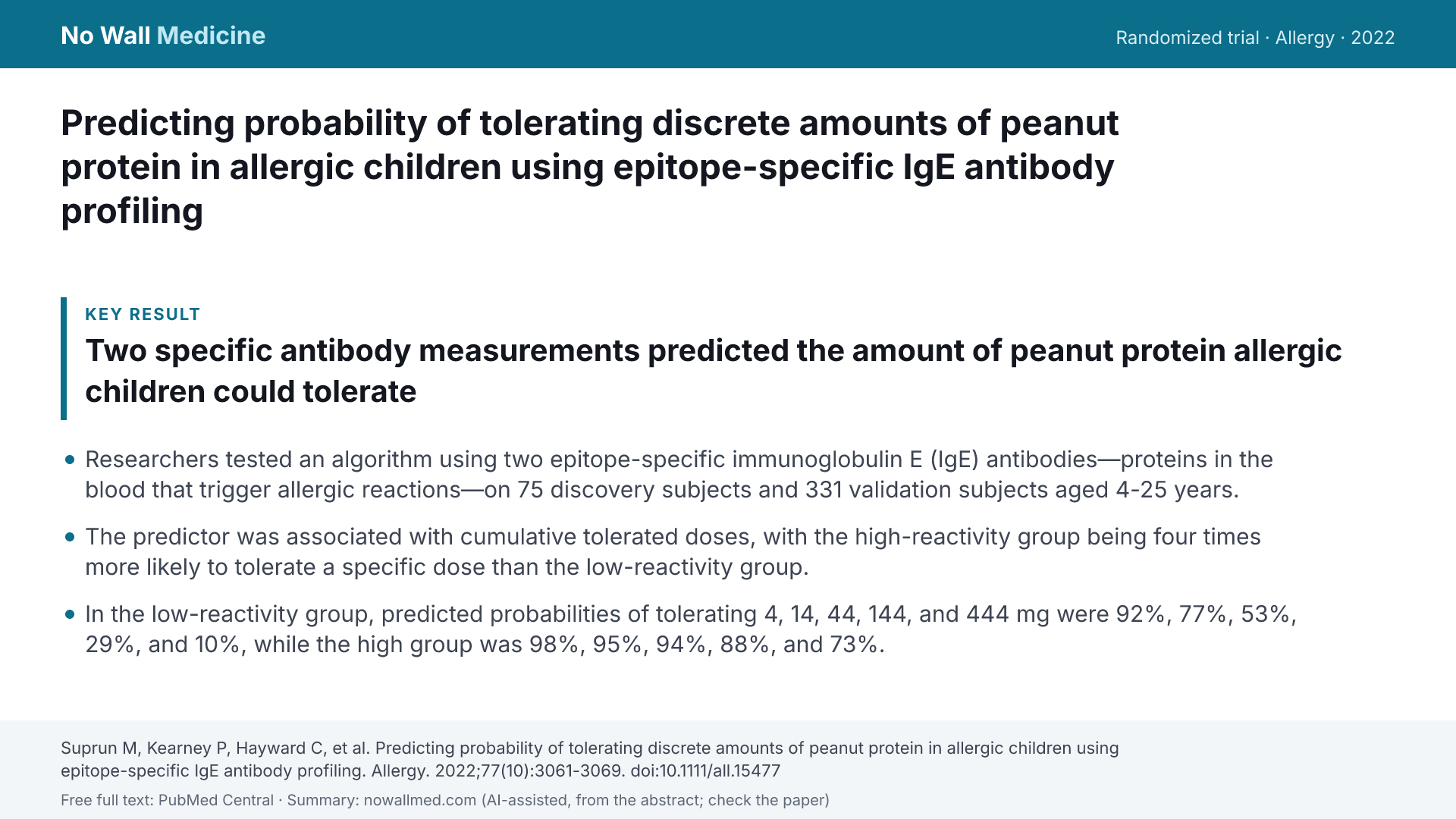
Two specific antibody measurements predicted the amount of peanut protein allergic children could tolerate
Predicting probability of tolerating discrete amounts of peanut protein in allergic children using epitope-specific IgE antibody profiling
Key points
- Researchers tested an algorithm using two epitope-specific immunoglobulin E (IgE) antibodies—proteins in the blood that trigger allergic reactions—on 75 discovery subjects and 331 validation subjects aged 4-25 years.
- The predictor was associated with cumulative tolerated doses, with the high-reactivity group being four times more likely to tolerate a specific dose than the low-reactivity group.
- In the low-reactivity group, predicted probabilities of tolerating 4, 14, 44, 144, and 444 mg were 92%, 77%, 53%, 29%, and 10%, while the high group was 98%, 95%, 94%, 88%, and 73%.
Limitation the authors note: Predictions are complex due to limited responder sample sizes at each dose and variations in study-specific challenge protocols.
Headline and key points written with AI from the paper’s abstract, with every number checked against it. Read the paper before relying on them.
Was this summary helpful?
Subject terms
Headline, design, result, key points, caveat and citation as plain text.
Cite this article
Suprun M, Kearney P, Hayward C, et al. Predicting probability of tolerating discrete amounts of peanut protein in allergic children using epitope-specific IgE antibody profiling. Allergy. 2022;77(10):3061-3069. doi:10.1111/all.15477
Spotted a mistake? Suggest a correction