Predicting treatment response using EEG in major depressive disorder: A machine-learning meta-analysis
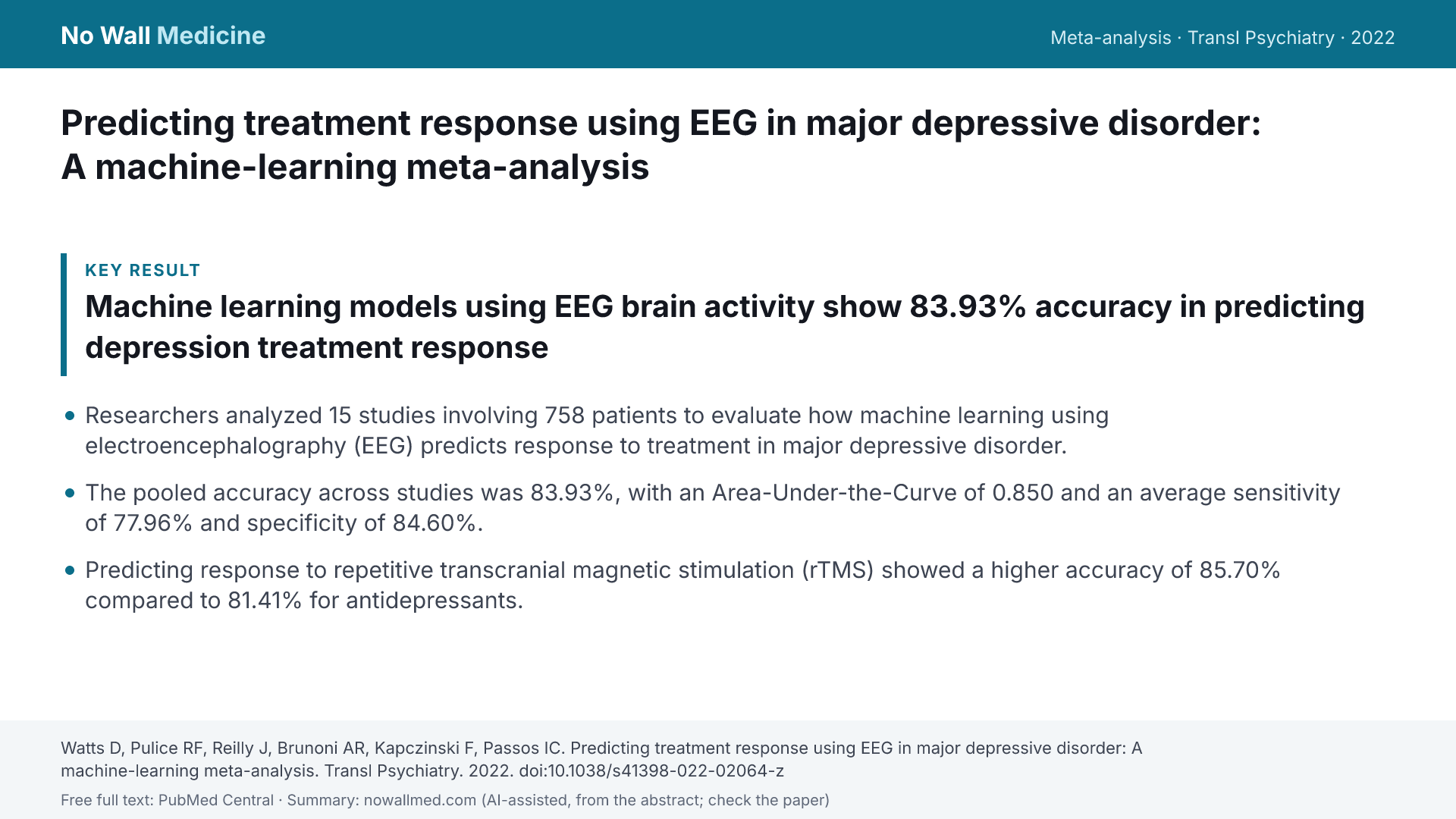
Key result: Machine learning models using EEG brain activity show 83.93% accuracy in predicting depression treatment response
Key points
- Researchers analyzed 15 studies involving 758 patients to evaluate how machine learning using electroencephalography (EEG) predicts response to treatment in major depressive disorder.
- The pooled accuracy across studies was 83.93%, with an Area-Under-the-Curve of 0.850 and an average sensitivity of 77.96% and specificity of 84.60%.
- Predicting response to repetitive transcranial magnetic stimulation (rTMS) showed a higher accuracy of 85.70% compared to 81.41% for antidepressants.
Why it matters: Selecting psychiatric treatments is often a trial-and-error process, and it is unknown if electroencephalography (EEG) can reliably predict which patients will respond to specific therapies.
Limitation the authors note: Several models used data from open-label trials with small sample sizes and lacked separate training and testing sets, increasing the risk of statistical overfitting.
Discussion prompts
- Would these patients look like yours? Who was left out?
- Is the main outcome one that matters to patients?
- Is the difference large enough to change what you do?
Cite: Watts D, Pulice RF, Reilly J, Brunoni AR, Kapczinski F, Passos IC. Predicting treatment response using EEG in major depressive disorder: A machine-learning meta-analysis. Transl Psychiatry. 2022. doi:10.1038/s41398-022-02064-z
Free full text: PubMed Central · Summary and visual abstract: nowallmed.com/a/predicting-treatment-response-using-eeg-in-major-depressive-disorder-1qbdukk/ (AI-assisted from the abstract; check the paper before relying on it).