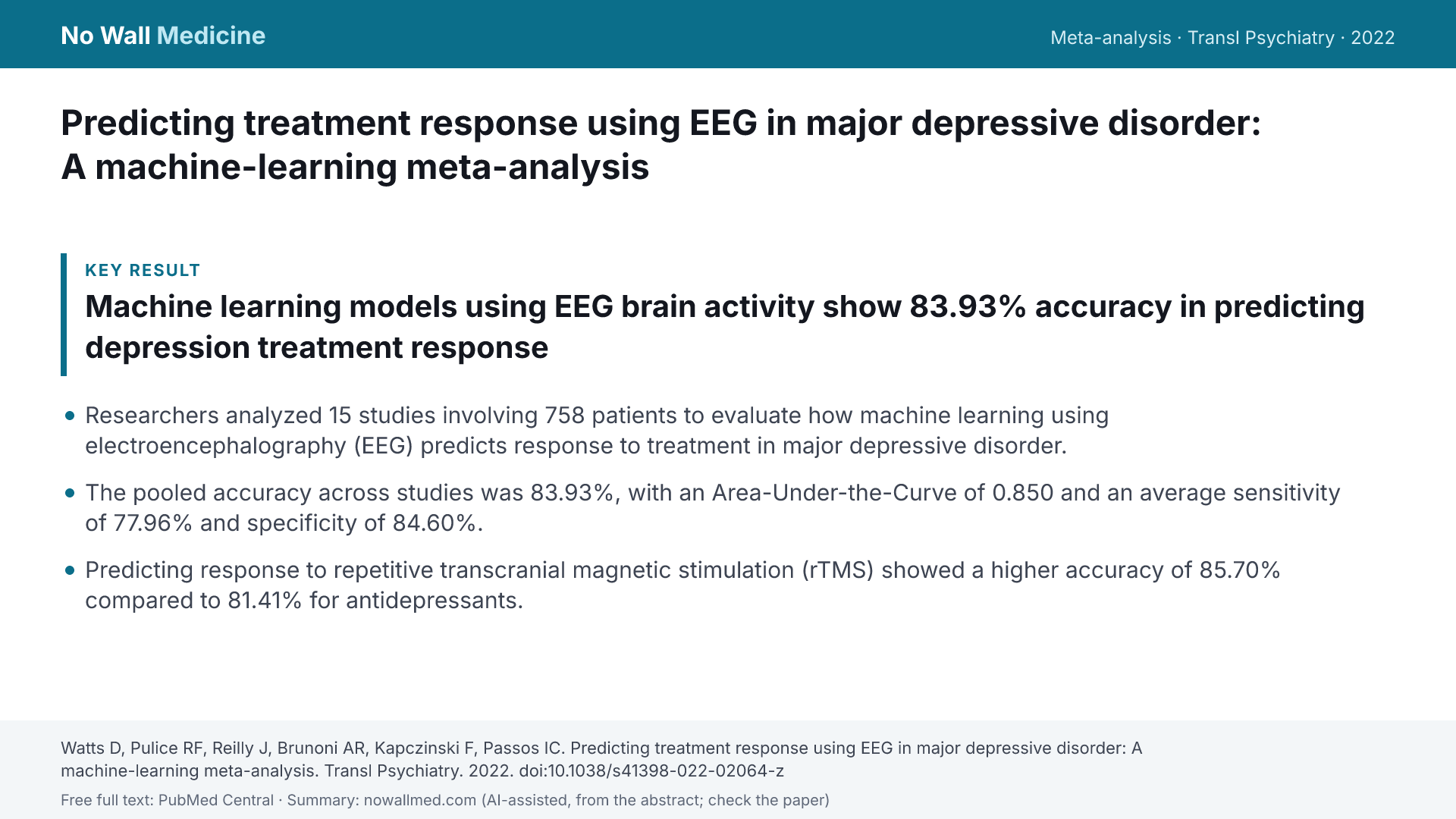
Machine learning models using EEG brain activity show 83.93% accuracy in predicting depression treatment response
Predicting treatment response using EEG in major depressive disorder: A machine-learning meta-analysis
Why it matters: Selecting psychiatric treatments is often a trial-and-error process, and it is unknown if electroencephalography (EEG) can reliably predict which patients will respond to specific therapies.
Key points
- Researchers analyzed 15 studies involving 758 patients to evaluate how machine learning using electroencephalography (EEG) predicts response to treatment in major depressive disorder.
- The pooled accuracy across studies was 83.93%, with an Area-Under-the-Curve of 0.850 and an average sensitivity of 77.96% and specificity of 84.60%.
- Predicting response to repetitive transcranial magnetic stimulation (rTMS) showed a higher accuracy of 85.70% compared to 81.41% for antidepressants.
Limitation the authors note: Several models used data from open-label trials with small sample sizes and lacked separate training and testing sets, increasing the risk of statistical overfitting.
Headline and key points written with AI from the paper’s abstract, with every number checked against it. Read the paper before relying on them.
Was this summary helpful?
Subject terms
Headline, design, result, key points, caveat and citation as plain text.
Cite this article
Watts D, Pulice RF, Reilly J, Brunoni AR, Kapczinski F, Passos IC. Predicting treatment response using EEG in major depressive disorder: A machine-learning meta-analysis. Transl Psychiatry. 2022. doi:10.1038/s41398-022-02064-z
Spotted a mistake? Suggest a correction