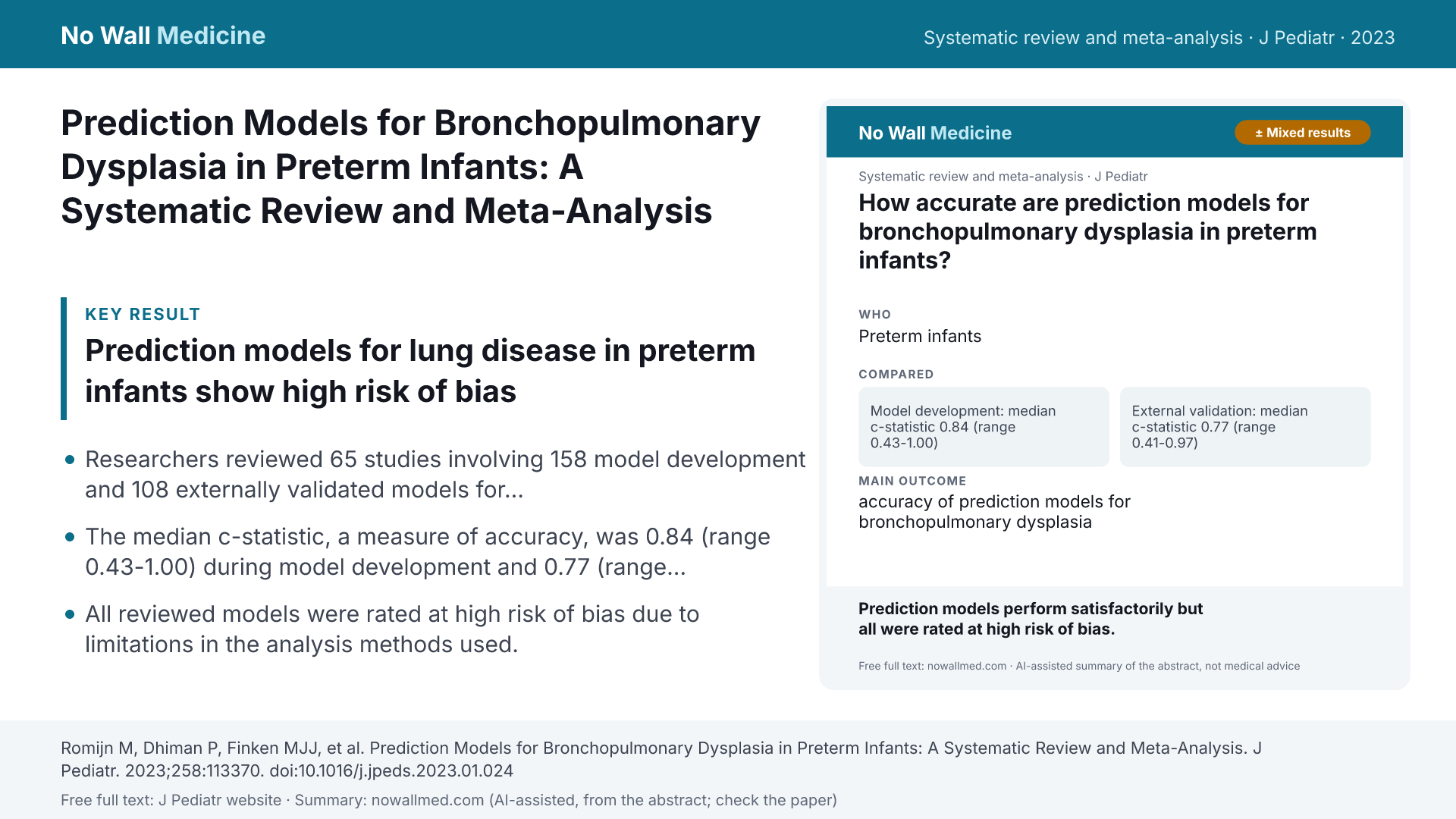
Prediction Models for Bronchopulmonary Dysplasia in Preterm Infants: A Systematic Review and Meta-Analysis
Key result: Prediction models for lung disease in preterm infants show high risk of bias
Systematic review and meta-analysisMixed results
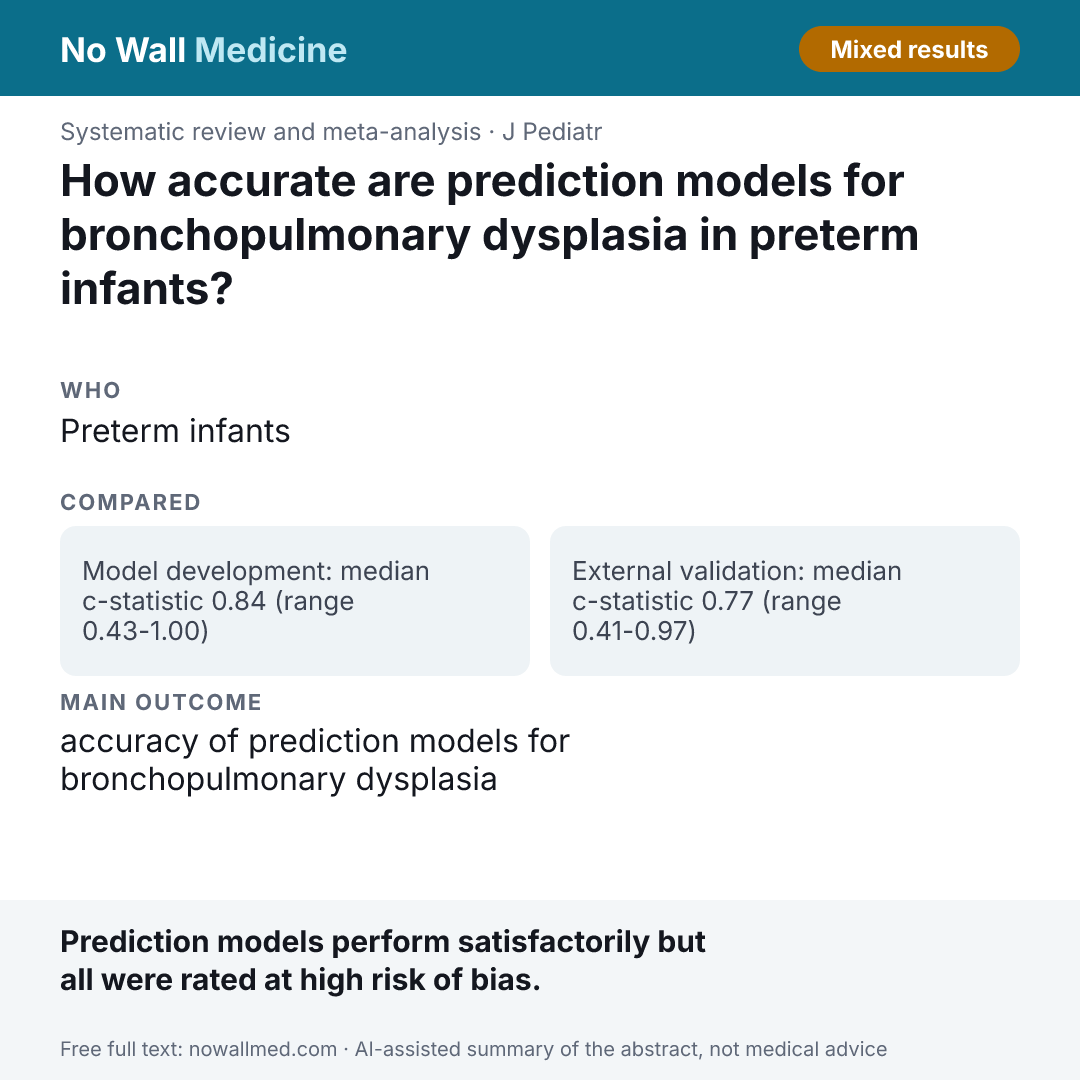
How accurate are prediction models for bronchopulmonary dysplasia in preterm infants?
Who
Preterm infants
Compared
Model development: median c-statistic 0.84 (range 0.43-1.00)
External validation: median c-statistic 0.77 (range 0.41-0.97)
Main outcome
accuracy of prediction models for bronchopulmonary dysplasia
Bottom line: Prediction models perform satisfactorily but all were rated at high risk of bias.
Limitation: All models were rated at high risk of bias due to analysis limitations.
J Pediatr · 2023-04-13 · Save PNG
Key points
- Researchers reviewed 65 studies involving 158 model development and 108 externally validated models for bronchopulmonary dysplasia, a chronic lung disease in preterm infants.
- The median c-statistic, a measure of accuracy, was 0.84 (range 0.43-1.00) during model development and 0.77 (range 0.41-0.97) during external validation.
- All reviewed models were rated at high risk of bias due to limitations in the analysis methods used.
Limitation the authors note: All models were rated at high risk of bias due to limitations in the analysis part.
Discussion prompts
- Would these patients look like yours? Who was left out?
- Is the main outcome one that matters to patients?
- Is the difference large enough to change what you do?
Cite: Romijn M, Dhiman P, Finken MJJ, et al. Prediction Models for Bronchopulmonary Dysplasia in Preterm Infants: A Systematic Review and Meta-Analysis. J Pediatr. 2023;258:113370. doi:10.1016/j.jpeds.2023.01.024
Free full text: J Pediatr website · Summary and visual abstract: nowallmed.com/a/prediction-models-for-bronchopulmonary-dysplasia-in-preterm-infants-a-13kt5ej/ (AI-assisted from the abstract; check the paper before relying on it).