Meta-analysis shows varying accuracy of prediction models for postoperative pulmonary complications
Prediction models for postoperative pulmonary complications: a systematic review and meta-analysis
Systematic review and meta-analysisMixed results
What is the discriminative ability of prediction models for postoperative pulmonary complications?
Who
1 004 029
Patients undergoing surgery at risk for postoperative pulmonary complications
Compared
ARISCAT PPC score: summary c-statistic 0.76 (95% CI 0.67-0.86)
0.82Xue's model (95% CI 0.75-0.89)
0.73CARDOT score (95% CI 0.61-0.85)
Main outcome
c-statistic of prediction models for composite postoperative pulmonary complications
Bottom line: Many prediction models exist, but most have high risk of bias and lack external validation for clinical utility.
Limitation: Reliability is limited by the lack of external validation cohorts and 90.2% of models had high risk of bias.
Br J Anaesth · 2025-06-04Download image
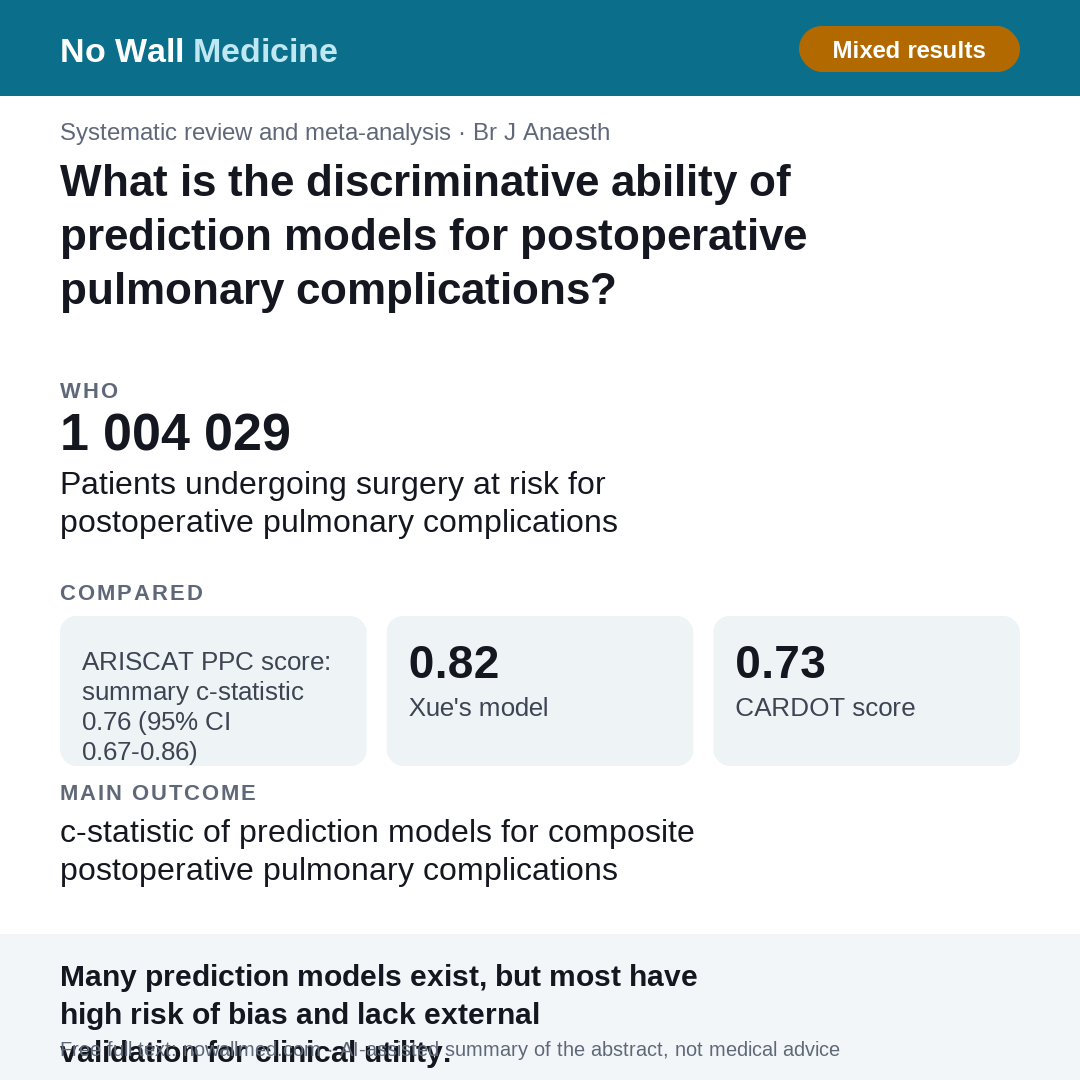
Clinical question: What is the discriminative ability of prediction models for postoperative pulmonary complications?
Why it matters: The discriminative ability and potential clinical impact of models used to identify high-risk patients for lung complications after surgery remain unclear.
Key points
- Researchers analyzed 123 studies covering 116 prediction models for postoperative pulmonary complications, including 14 models involving 1,004,029 patients.
- The median c-statistic, a measure of how well a model distinguishes between patients, was 0.80 across all models.
- A total of 90.2% of the models were assessed as having a high risk of bias.
Limitation the authors note: The reliability of these models is currently limited by the lack of external validation cohorts.
Headline and key points written with AI from the paper’s abstract, with every number checked against it. Read the paper before relying on them.
Topics
Cite this article
Huang Z, Han Y, Zhuang H, Jiang J, Zhou C, Yu H. Prediction models for postoperative pulmonary complications: a systematic review and meta-analysis. Br J Anaesth. 2025. doi:10.1016/j.bja.2025.04.025
Spotted a mistake? Suggest a correction