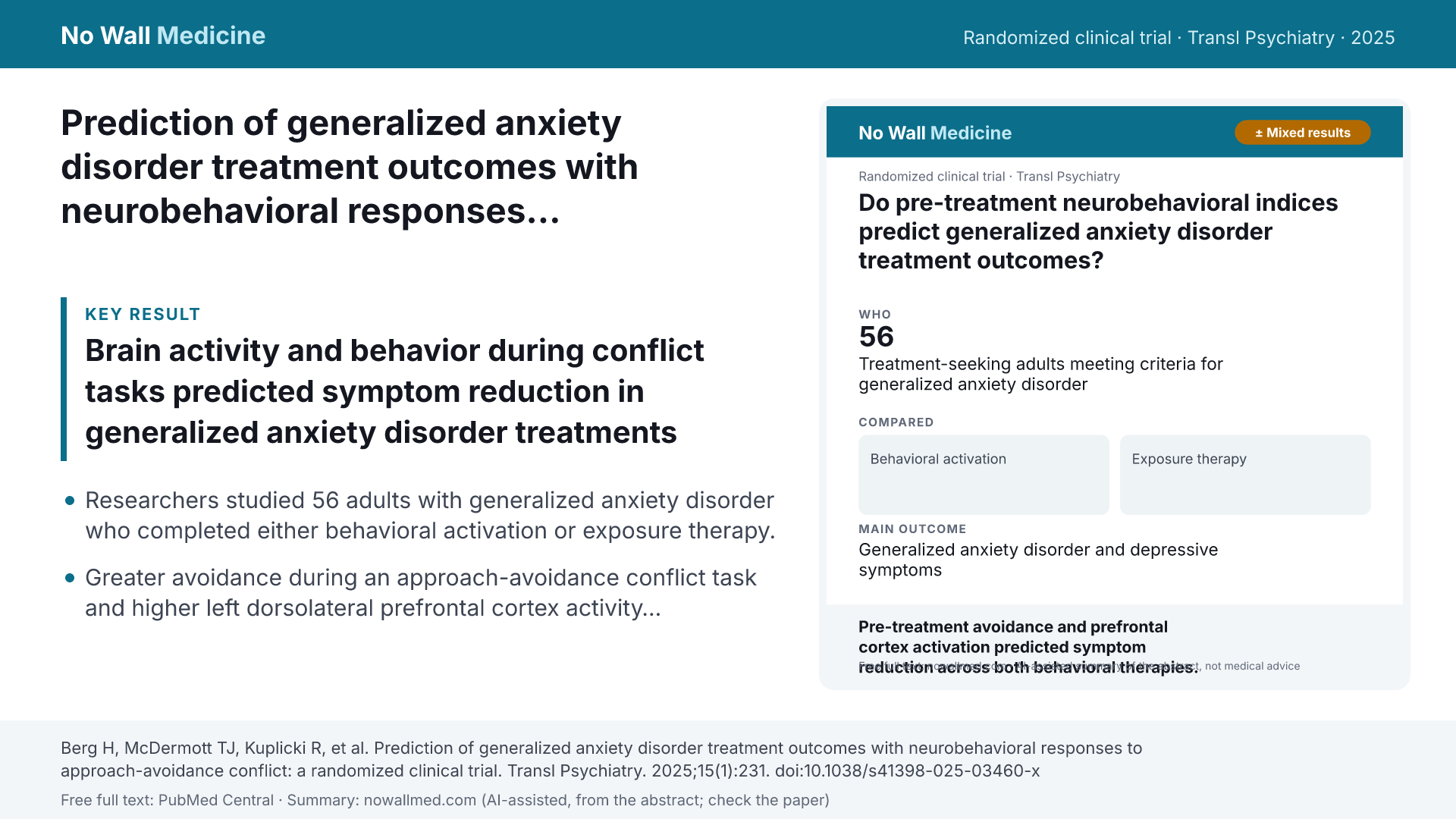
Brain activity and behavior during conflict tasks predicted symptom reduction in generalized anxiety disorder treatments
Prediction of generalized anxiety disorder treatment outcomes with neurobehavioral responses to approach-avoidance conflict: a randomized clinical trial
Randomized clinical trialMixed results
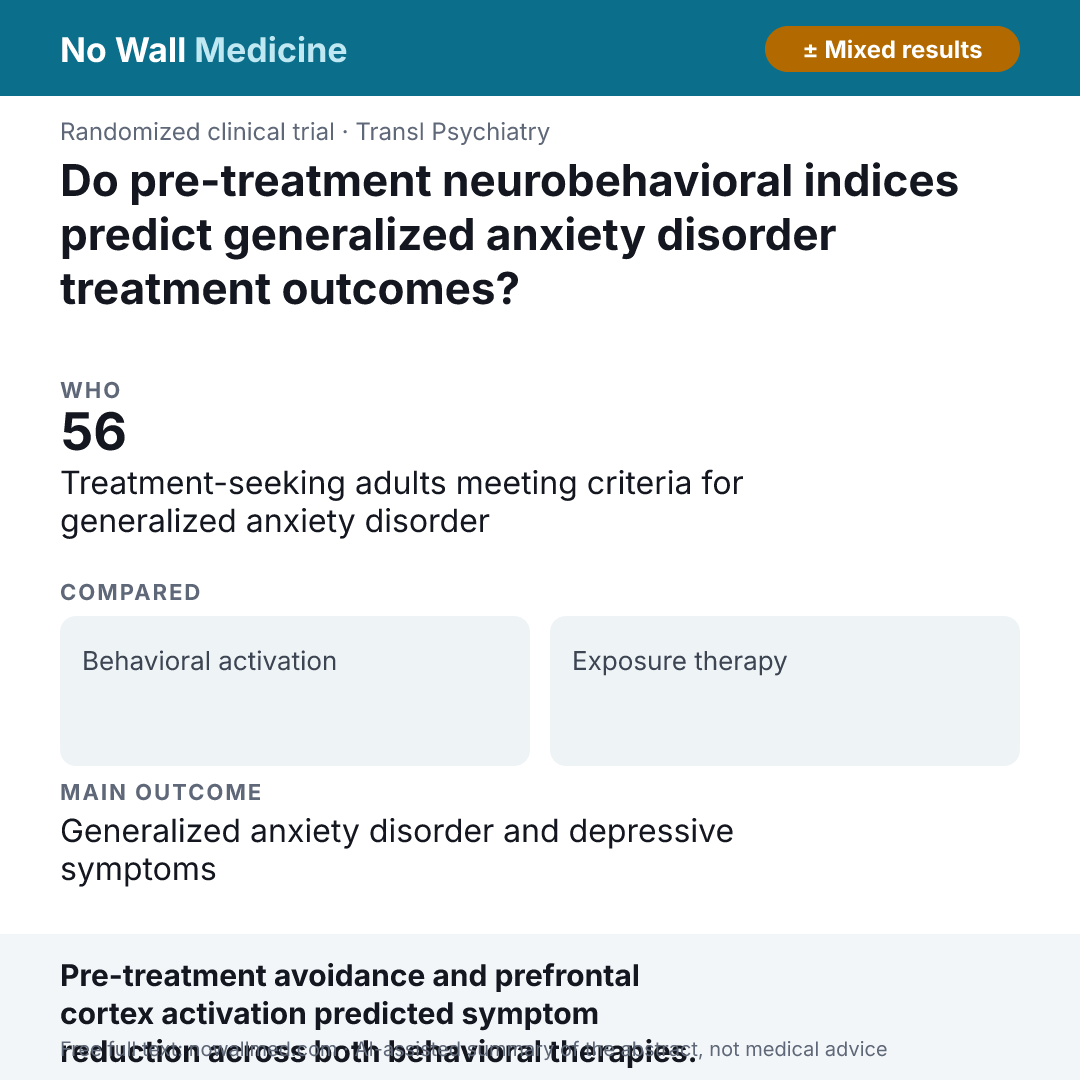
Do pre-treatment neurobehavioral indices predict generalized anxiety disorder treatment outcomes?
Who
56
Treatment-seeking adults meeting criteria for generalized anxiety disorder
Compared
Behavioral activation
Exposure therapy
Main outcome
Generalized anxiety disorder and depressive symptoms
Bottom line: Pre-treatment avoidance and prefrontal cortex activation predicted symptom reduction across both behavioral therapies.
Limitation: Larger, longitudinal studies in clinical settings are warranted.
Transl Psychiatry · 2025-07-05 · Save PNG
Clinical question: Do pre-treatment neurobehavioral indices predict generalized anxiety disorder treatment outcomes?
Key points
- Researchers studied 56 adults with generalized anxiety disorder who completed either behavioral activation or exposure therapy.
- Greater avoidance during an approach-avoidance conflict task and higher left dorsolateral prefrontal cortex activity during negative outcomes predicted greater symptom reduction.
- Blunted left amygdala activation to positive outcomes was associated at a trend level with favorable symptom reduction for behavioral activation but not exposure therapy.
Limitation the authors note: The study was a randomized clinical trial with 56 treatment completers, and the authors suggest larger, longitudinal studies are warranted.
Headline and key points written with AI from the paper’s abstract, with every number checked against it. Read the paper before relying on them.
Was this summary helpful?
Subject terms
Headline, design, result, key points, caveat and citation as plain text.
Cite this article
Berg H, McDermott TJ, Kuplicki R, et al. Prediction of generalized anxiety disorder treatment outcomes with neurobehavioral responses to approach-avoidance conflict: a randomized clinical trial. Transl Psychiatry. 2025;15(1):231. doi:10.1038/s41398-025-03460-x
Spotted a mistake? Suggest a correction