Predictive models identify high nodal burden in patients with certain luminal breast cancers
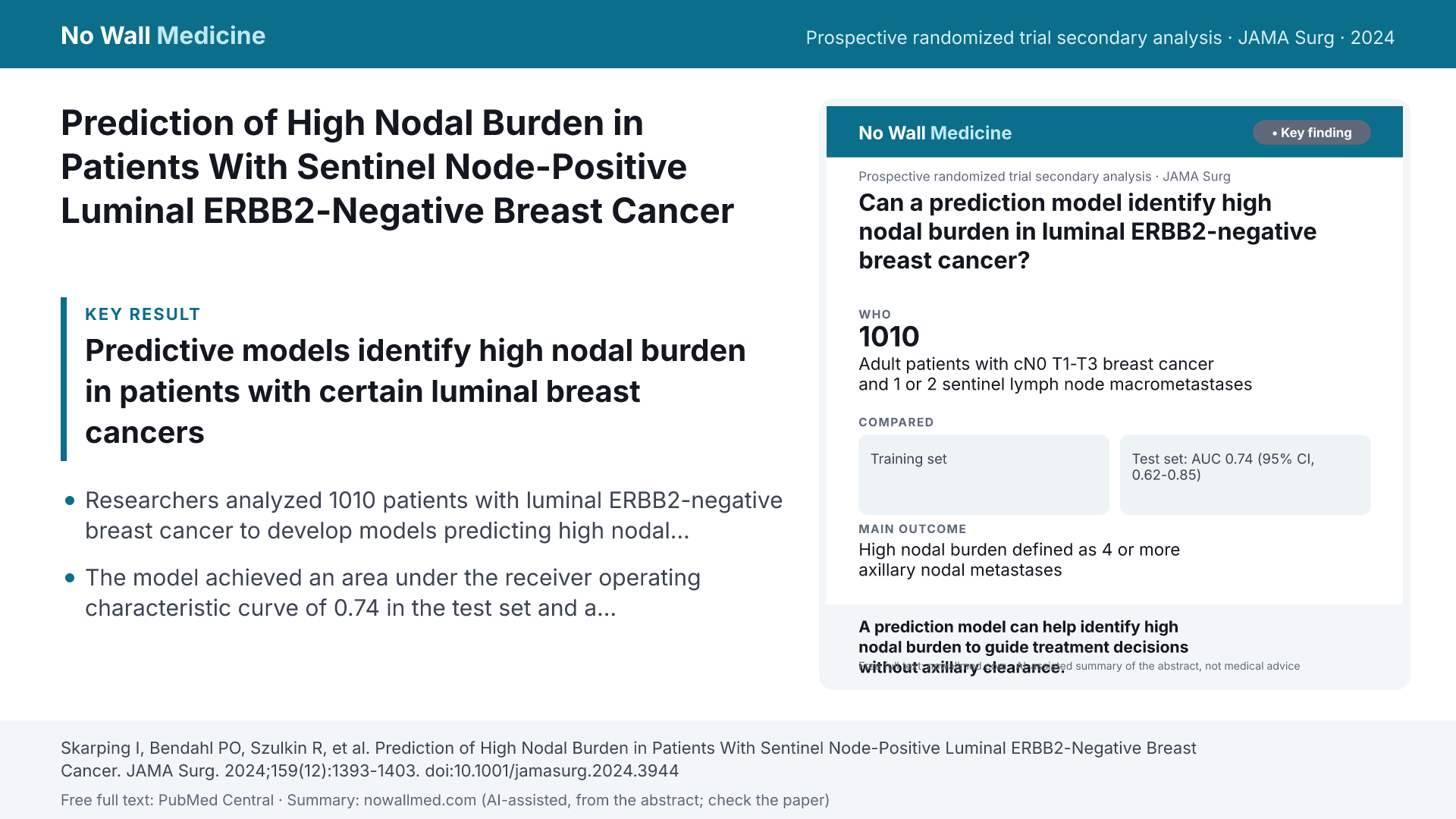
Prediction of High Nodal Burden in Patients With Sentinel Node-Positive Luminal ERBB2-Negative Breast Cancer
Prospective randomized trial secondary analysisKey finding
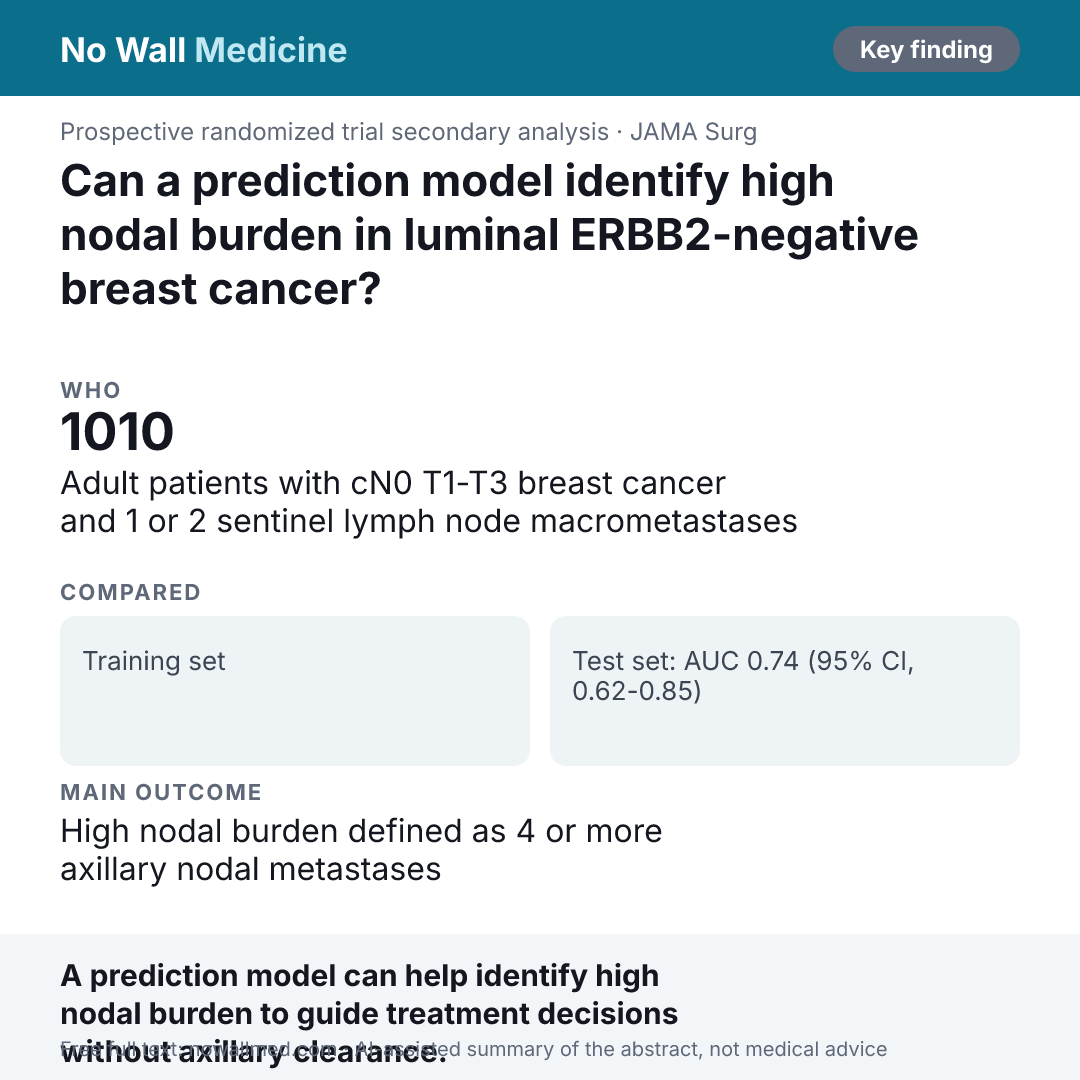
Can a prediction model identify high nodal burden in luminal ERBB2-negative breast cancer?
Who
1010
Adult patients with cN0 T1-T3 breast cancer and 1 or 2 sentinel lymph node macrometastases · 5 European countries
Compared
Training set
Test set: AUC 0.74 (95% CI, 0.62-0.85)
Main outcome
High nodal burden defined as 4 or more axillary nodal metastases
Result: AUC 0.74 (95% CI, 0.62-0.85)
Bottom line: A prediction model can help identify high nodal burden to guide treatment decisions without axillary clearance.
JAMA Surg · 2024-09-25 · Save PNG
Clinical question: Can a prediction model identify high nodal burden in luminal ERBB2-negative breast cancer?
Key points
- Researchers analyzed 1010 patients with luminal ERBB2-negative breast cancer to develop models predicting high nodal burden, defined as 4 or more axillary lymph node metastases.
- The model achieved an area under the receiver operating characteristic curve of 0.74 in the test set and a negative predictive value of 94% at a sensitivity threshold of ≥80%.
- A separate prediction model for the lobular breast cancer subgroup also reached an area under the receiver operating characteristic curve of 0.74.
Headline and key points written with AI from the paper’s abstract, with every number checked against it. Read the paper before relying on them.
Was this summary helpful?
Subject terms
Headline, design, result, key points, caveat and citation as plain text.
Cite this article
Skarping I, Bendahl PO, Szulkin R, et al. Prediction of High Nodal Burden in Patients With Sentinel Node-Positive Luminal ERBB2-Negative Breast Cancer. JAMA Surg. 2024;159(12):1393-1403. doi:10.1001/jamasurg.2024.3944
Spotted a mistake? Suggest a correction