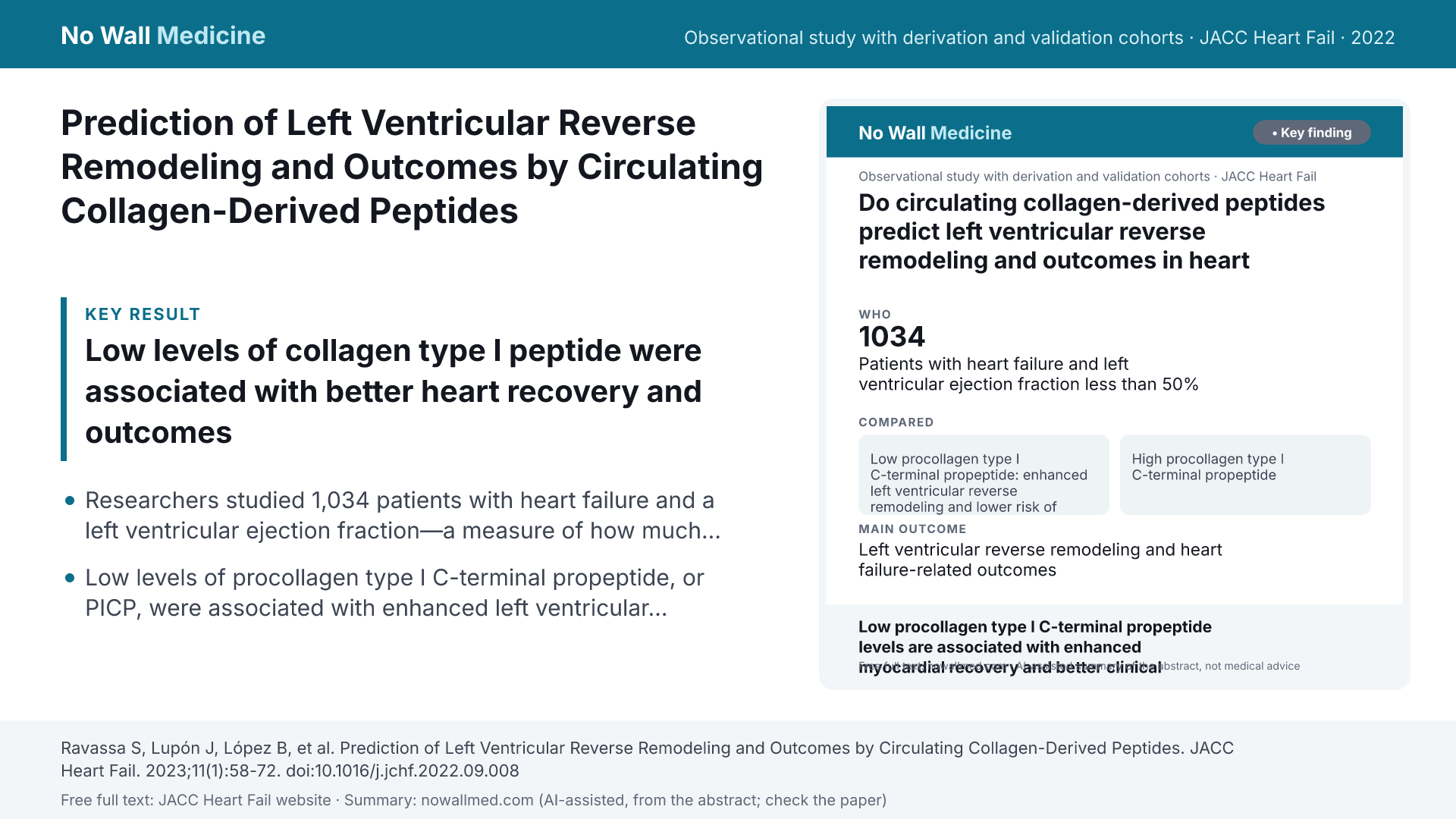
Low levels of collagen type I peptide were associated with better heart recovery and outcomes
Prediction of Left Ventricular Reverse Remodeling and Outcomes by Circulating Collagen-Derived Peptides
Observational study with derivation and validation cohortsBenefit found
Do circulating collagen-derived peptides predict left ventricular reverse remodeling and outcomes in heart failure?
Who
1034
Patients with heart failure and left ventricular ejection fraction less than 50%
Compared
Low procollagen type I C-terminal propeptide: enhanced left ventricular reverse remodeling and lower risk of heart failure-related outcomes
High procollagen type I C-terminal propeptide
Main outcome
Left ventricular reverse remodeling and heart failure-related outcomes
Bottom line: Low procollagen type I C-terminal propeptide levels are associated with enhanced myocardial recovery and better clinical outcomes.
JACC Heart Fail · 2022-11-09Download image
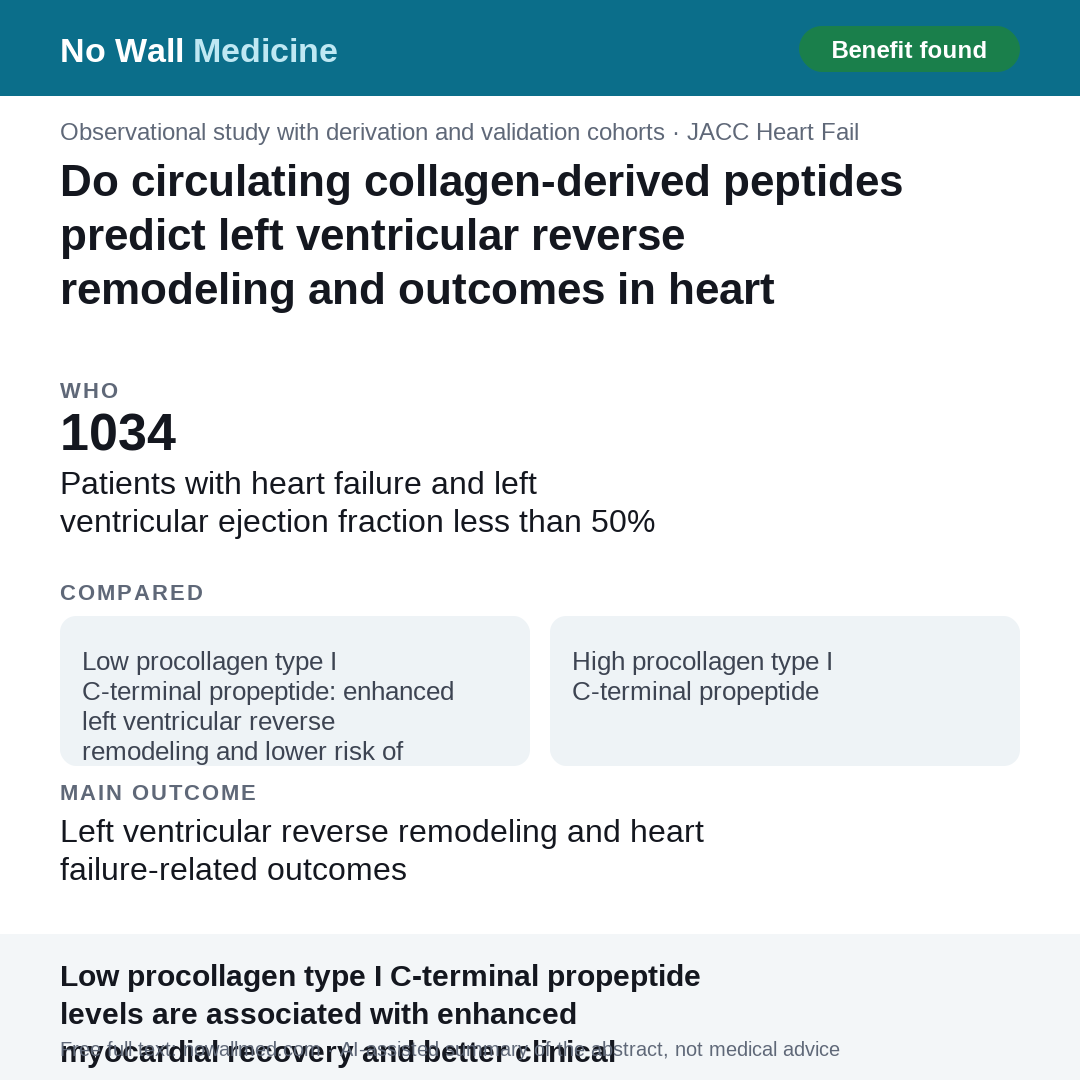
Clinical question: Do circulating collagen-derived peptides predict left ventricular reverse remodeling and outcomes in heart failure?
Why it matters: It is unknown if measuring collagen-derived peptides can help identify which heart failure patients are likely to experience clinical myocardial recovery.
Key points
- Researchers studied 1,034 patients with heart failure and a left ventricular ejection fraction—a measure of how much blood the heart pumps out—of less than 50%.
- Low levels of procollagen type I C-terminal propeptide, or PICP, were associated with enhanced left ventricular reverse remodeling and a lower risk of heart failure-related outcomes.
- Patients with both low PICP and improved ejection fraction showed a better clinical evolution than those with nonimproved ejection fraction (P < 0.001).
Headline and key points written with AI from the paper’s abstract, with every number checked against it. Read the paper before relying on them.
Was this summary helpful?
Subject terms
Cite this article
Ravassa S, Lupón J, López B, Codina P, Domingo M, Revuelta-López E. Prediction of Left Ventricular Reverse Remodeling and Outcomes by Circulating Collagen-Derived Peptides. JACC Heart Fail. 2022. doi:10.1016/j.jchf.2022.09.008
Spotted a mistake? Suggest a correction
Top studies every Monday
The week’s key trials and guidelines in your specialties, plus any topics you follow. By email, free.
Get the weekly digest