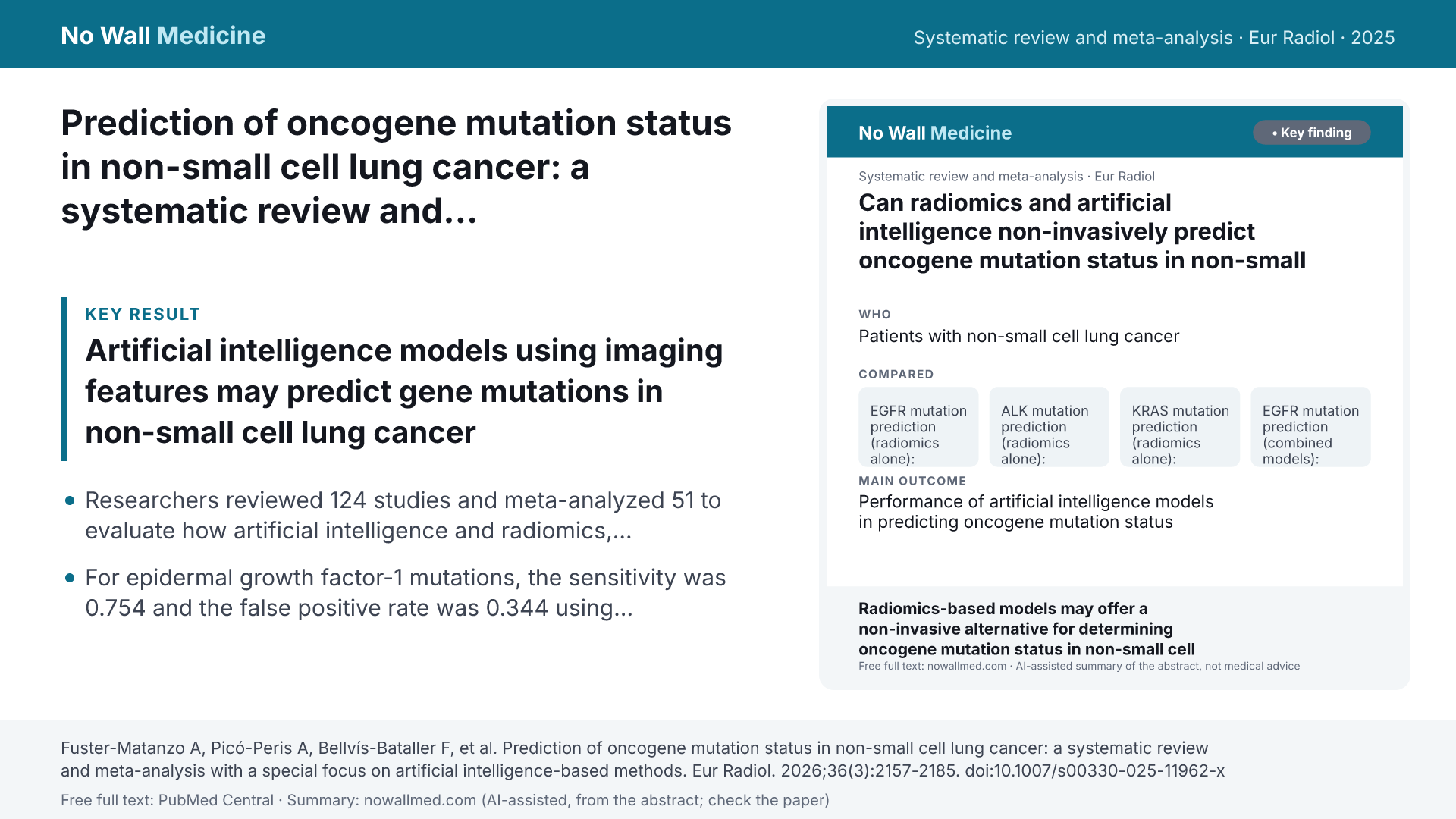
Artificial intelligence models using imaging features may predict gene mutations in non-small cell lung cancer
Prediction of oncogene mutation status in non-small cell lung cancer: a systematic review and meta-analysis with a special focus on artificial intelligence-based methods
Systematic review and meta-analysisKey finding
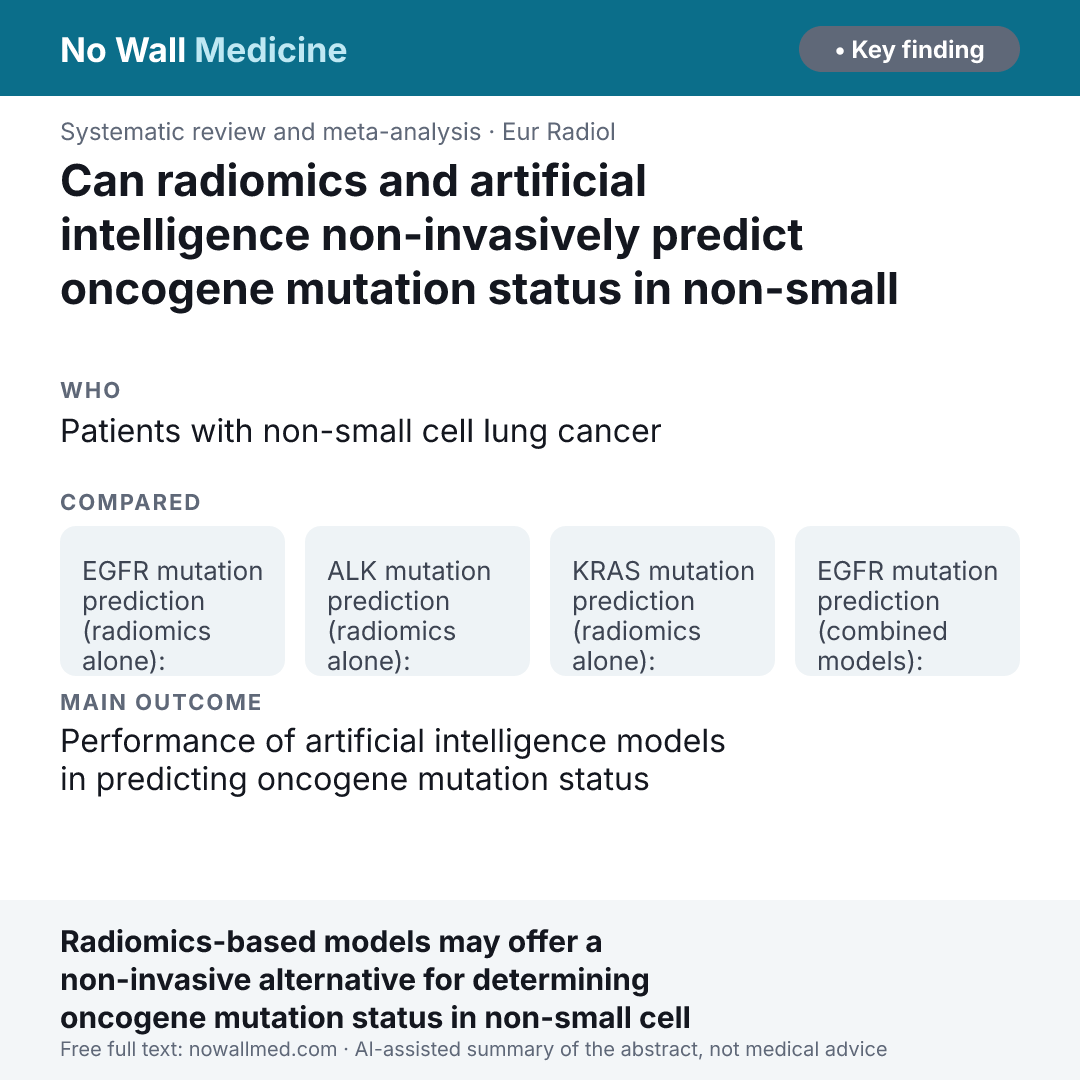
Can radiomics and artificial intelligence non-invasively predict oncogene mutation status in non-small cell lung cancer?
Who
Patients with non-small cell lung cancer
Compared
EGFR mutation prediction (radiomics alone): sensitivity 0.754 (95% CI 0.727-0.780)
ALK mutation prediction (radiomics alone): sensitivity 0.754 (95% CI 0.638-0.841)
KRAS mutation prediction (radiomics alone): sensitivity 0.475 (95% CI 0.153-0.820)
EGFR mutation prediction (combined models): sensitivity 0.806 (95% CI 0.777-0.833)
Main outcome
Performance of artificial intelligence models in predicting oncogene mutation status
Bottom line: Radiomics-based models may offer a non-invasive alternative for determining oncogene mutation status in non-small cell lung cancer.
Limitation: Further research is required to analyze whether clinical data might boost performance.
Eur Radiol · 2025-09-08 · Save PNG
Clinical question: Can radiomics and artificial intelligence non-invasively predict oncogene mutation status in non-small cell lung cancer?
Why it matters: Non-invasive alternatives to biopsy-dependent driver mutation analysis are needed for patients with non-small cell lung cancer.
Key points
- Researchers reviewed 124 studies and meta-analyzed 51 to evaluate how artificial intelligence and radiomics, or computer-analyzed medical images, predict specific gene mutations in lung cancer patients.
- For epidermal growth factor-1 mutations, the sensitivity was 0.754 and the false positive rate was 0.344 using radiomics alone, while combined models reached a sensitivity of 0.806.
- The sensitivity for anaplastic lymphoma kinase mutations was 0.754 and for Kirsten rat sarcoma virus mutations was 0.475 when using radiomics-based models.
Headline and key points written with AI from the paper’s abstract, with every number checked against it. Read the paper before relying on them.
Was this summary helpful?
Subject terms
Headline, design, result, key points, caveat and citation as plain text.
Cite this article
Fuster-Matanzo A, Picó-Peris A, Bellvís-Bataller F, et al. Prediction of oncogene mutation status in non-small cell lung cancer: a systematic review and meta-analysis with a special focus on artificial intelligence-based methods. Eur Radiol. 2026;36(3):2157-2185. doi:10.1007/s00330-025-11962-x
Spotted a mistake? Suggest a correction