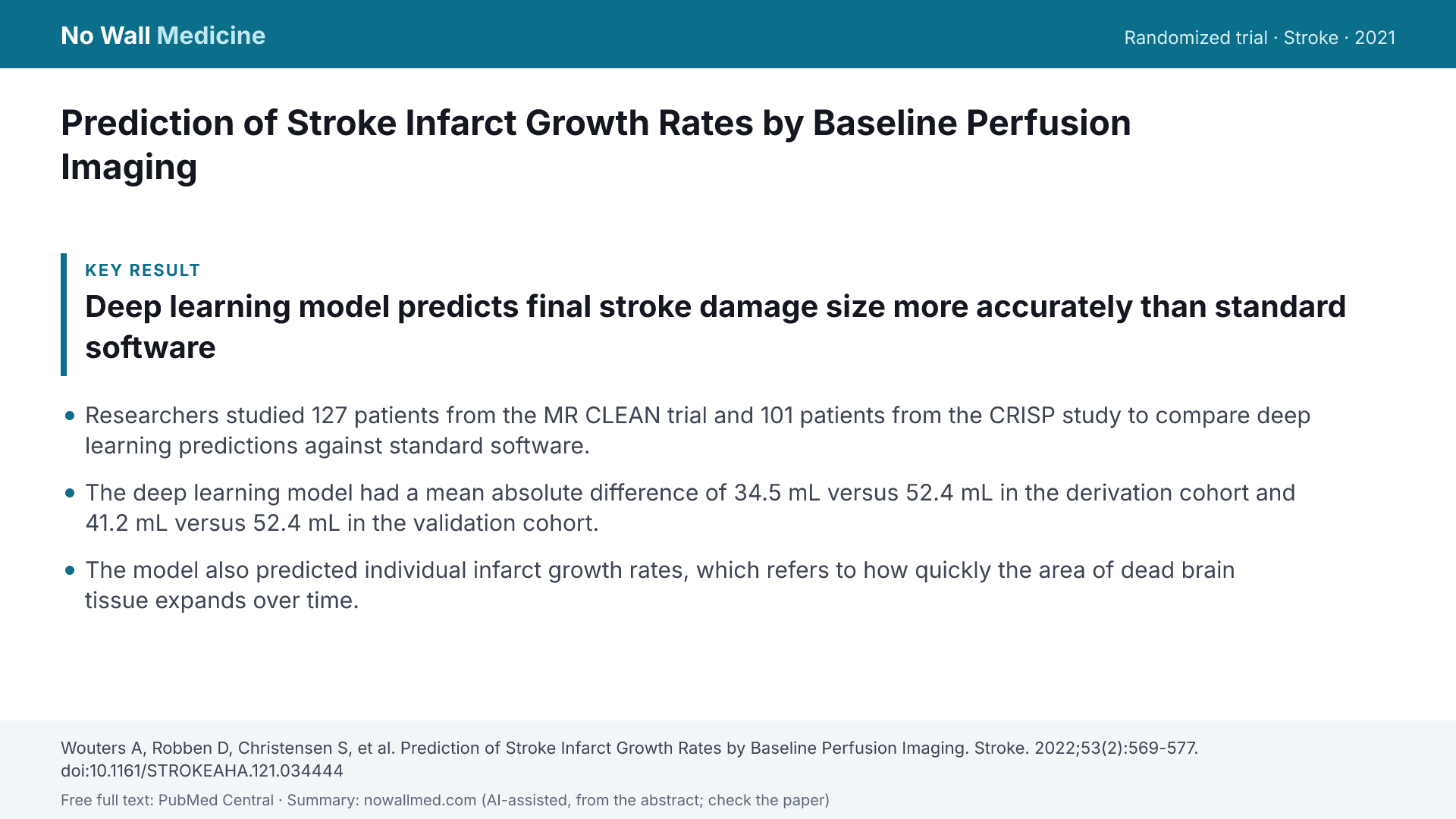
Deep learning model predicts final stroke damage size more accurately than standard software
Prediction of Stroke Infarct Growth Rates by Baseline Perfusion Imaging
Why it matters: It is difficult to accurately predict the final size of brain tissue damage and how fast it grows using current computed tomography perfusion imaging software.
Key points
- Researchers studied 127 patients from the MR CLEAN trial and 101 patients from the CRISP study to compare deep learning predictions against standard software.
- The deep learning model had a mean absolute difference of 34.5 mL versus 52.4 mL in the derivation cohort and 41.2 mL versus 52.4 mL in the validation cohort.
- The model also predicted individual infarct growth rates, which refers to how quickly the area of dead brain tissue expands over time.
Headline and key points written with AI from the paper’s abstract, with every number checked against it. Read the paper before relying on them.
Was this summary helpful?
Subject terms
Headline, design, result, key points, caveat and citation as plain text.
Cite this article
Wouters A, Robben D, Christensen S, et al. Prediction of Stroke Infarct Growth Rates by Baseline Perfusion Imaging. Stroke. 2022;53(2):569-577. doi:10.1161/STROKEAHA.121.034444
Spotted a mistake? Suggest a correction