Predictive power of extubation failure diagnosed by cough strength: a systematic review and meta-analysis
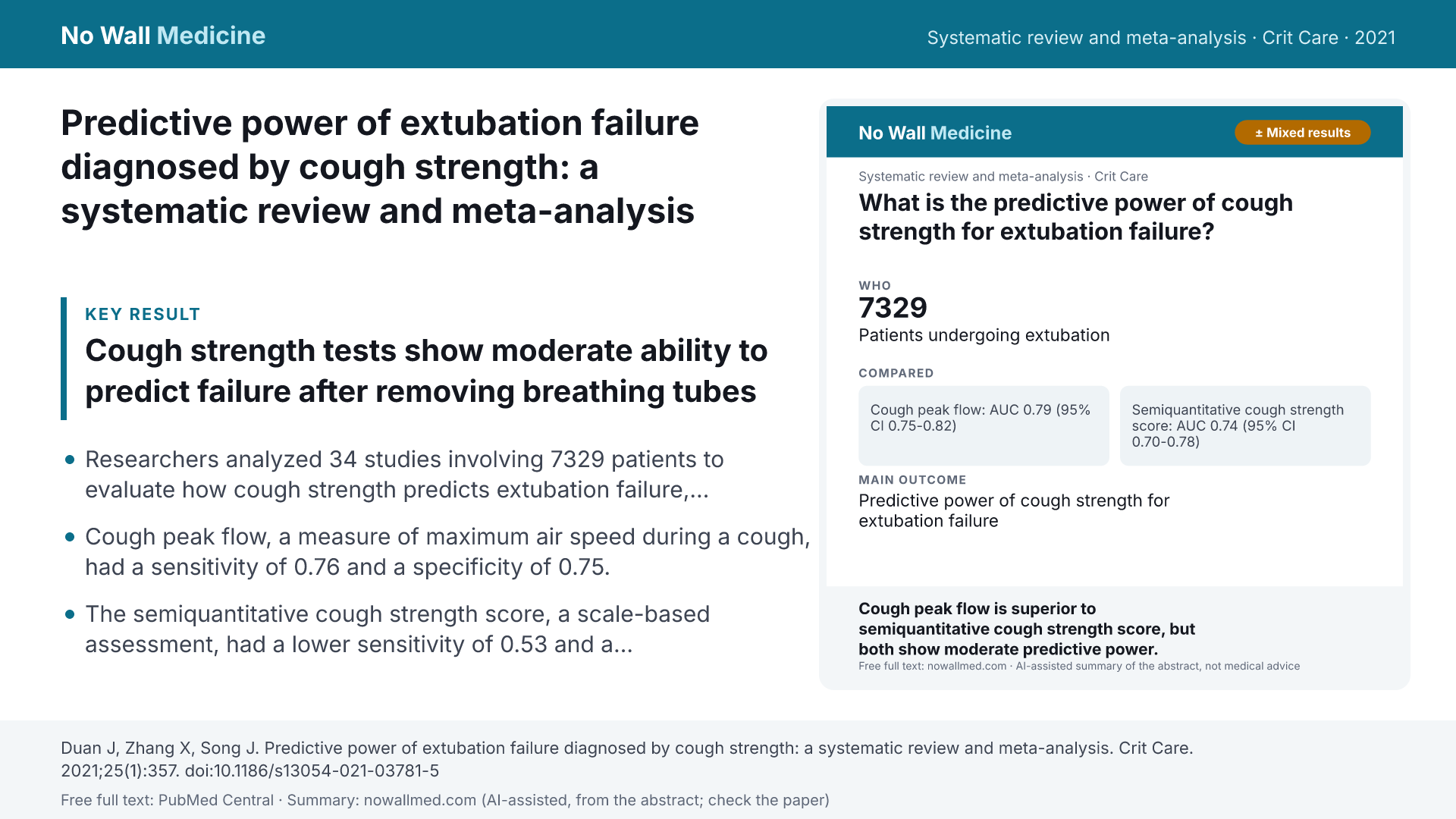
Key result: Cough strength tests show moderate ability to predict failure after removing breathing tubes
Systematic review and meta-analysisMixed results
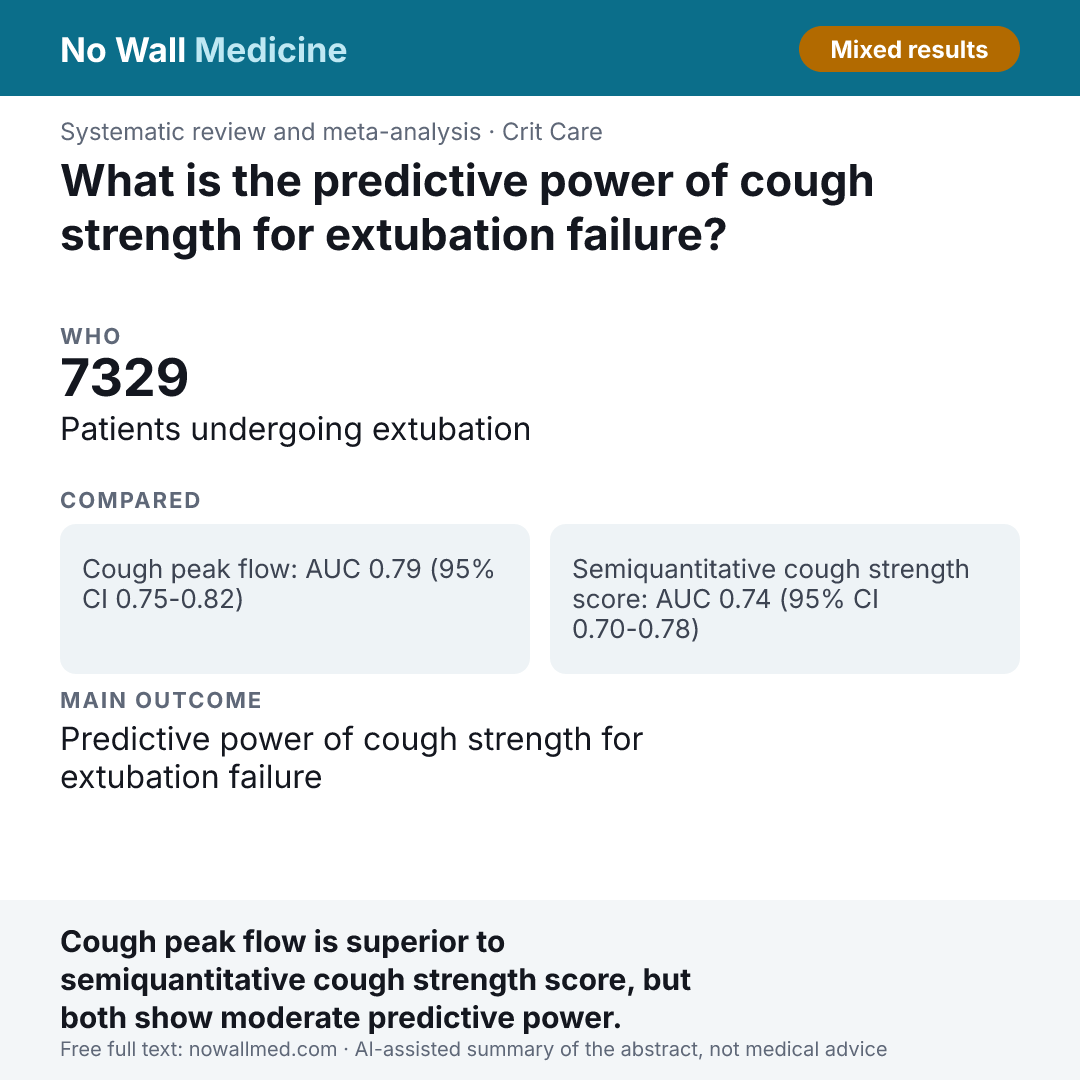
What is the predictive power of cough strength for extubation failure?
Who
7329
Patients undergoing extubation
Compared
Cough peak flow: AUC 0.79 (95% CI 0.75-0.82)
Semiquantitative cough strength score: AUC 0.74 (95% CI 0.70-0.78)
Main outcome
Predictive power of cough strength for extubation failure
Bottom line: Cough peak flow is superior to semiquantitative cough strength score, but both show moderate predictive power.
Crit Care · 2021-10-12 · Save PNG
Key points
- Researchers analyzed 34 studies involving 7329 patients to evaluate how cough strength predicts extubation failure, which is the inability to breathe independently after a breathing tube is removed.
- Cough peak flow, a measure of maximum air speed during a cough, had a sensitivity of 0.76 and a specificity of 0.75.
- The semiquantitative cough strength score, a scale-based assessment, had a lower sensitivity of 0.53 and a specificity of 0.83.
Why it matters: The predictive power of using cough strength to identify patients at risk of extubation failure varies across different studies.
Discussion prompts
- Would these patients look like yours? Who was left out?
- Is the main outcome one that matters to patients?
- Is the difference large enough to change what you do?
Cite: Duan J, Zhang X, Song J. Predictive power of extubation failure diagnosed by cough strength: a systematic review and meta-analysis. Crit Care. 2021;25(1):357. doi:10.1186/s13054-021-03781-5
Free full text: PubMed Central · Summary and visual abstract: nowallmed.com/a/predictive-power-of-extubation-failure-diagnosed-by-cough-strength-a-vf9bj7/ (AI-assisted from the abstract; check the paper before relying on it).