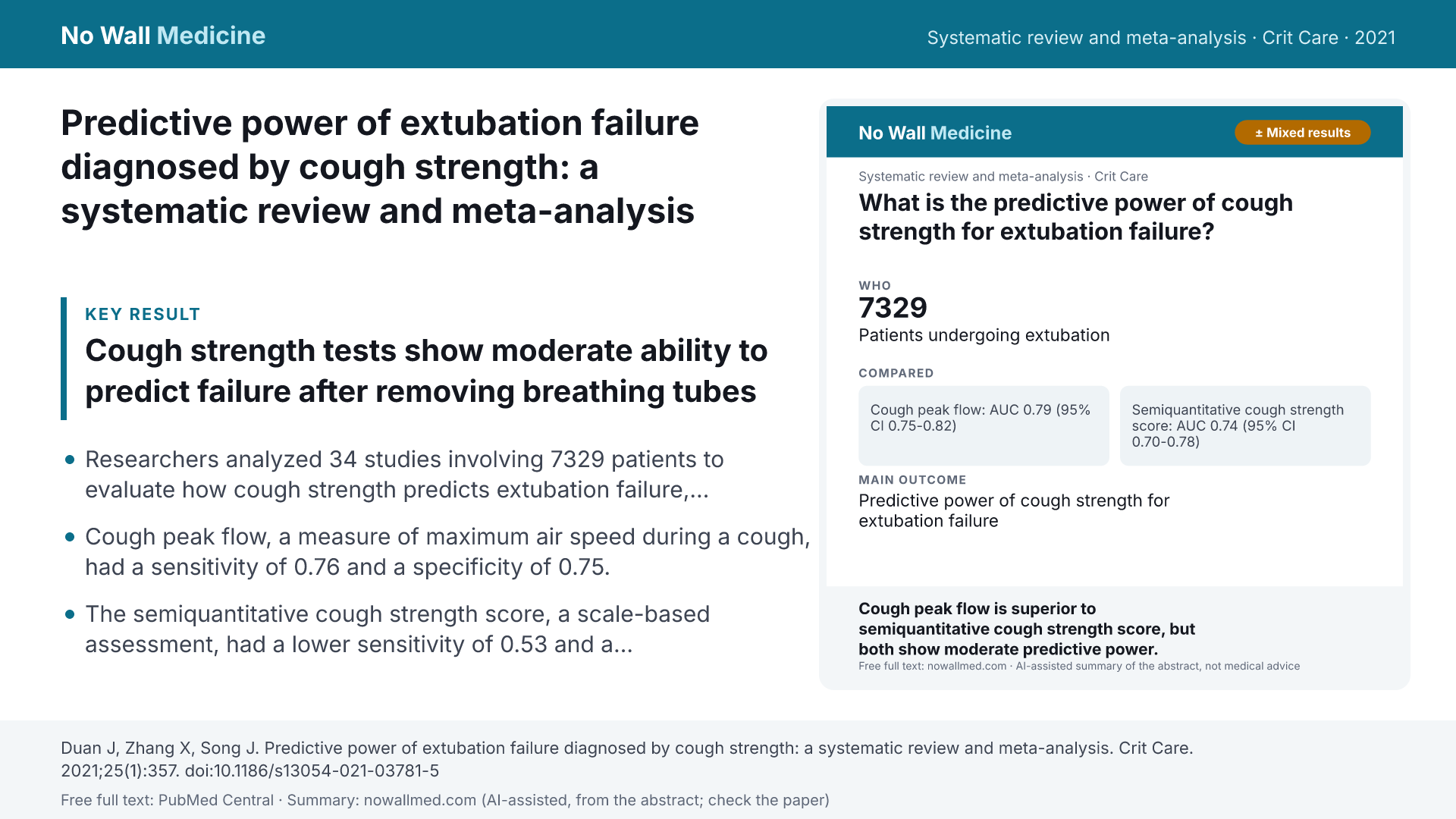
Cough strength tests show moderate ability to predict failure after removing breathing tubes
Predictive power of extubation failure diagnosed by cough strength: a systematic review and meta-analysis
Systematic review and meta-analysisMixed results
What is the predictive power of cough strength for extubation failure?
Who
7329
Patients undergoing extubation
Compared
Cough peak flow: AUC 0.79 (95% CI 0.75-0.82)
Semiquantitative cough strength score: AUC 0.74 (95% CI 0.70-0.78)
Main outcome
Predictive power of cough strength for extubation failure
Bottom line: Cough peak flow is superior to semiquantitative cough strength score, but both show moderate predictive power.
Crit Care · 2021-10-12Download image

Clinical question: What is the predictive power of cough strength for extubation failure?
Why it matters: The predictive power of using cough strength to identify patients at risk of extubation failure varies across different studies.
Key points
- Researchers analyzed 34 studies involving 7329 patients to evaluate how cough strength predicts extubation failure, which is the inability to breathe independently after a breathing tube is removed.
- Cough peak flow, a measure of maximum air speed during a cough, had a sensitivity of 0.76 and a specificity of 0.75.
- The semiquantitative cough strength score, a scale-based assessment, had a lower sensitivity of 0.53 and a specificity of 0.83.
Headline and key points written with AI from the paper’s abstract, with every number checked against it. Read the paper before relying on them.
Was this summary helpful?
Abstract
Background
The predictive power of extubation failure diagnosed by cough strength varies by study. Here we summarise the diagnostic power of extubation failure tested by cough strength. Methods
A comprehensive online search was performed to select potentially eligible studies that evaluated the predictive power of extubation failure tested by cough strength. A manual search was also performed to identify additional studies. Data were extracted to calculate the pooled sensitivity, specificity, positive likelihood ratio (LR), negative LR, diagnostic odds ratio (DOR), and area under the receiver operating characteristic curve (AUC) to evaluate the predictive power of extubation failure. Results
A total of 34 studies involving 45 study arms were enrolled, and 7329 patients involving 8684 tests were analysed. In all, 23 study arms involving 3018 tests measured cough peak flow before extubation. The pooled extubation failure was 36.2% and 6.3% in patients with weak and strong cough assessed by cough peak flow, respectively. The pooled sensitivity, specificity, positive LR, negative LR, DOR, and AUC were 0.76 (95% confidence interval [CI]: 0.72-0.80), 0.75 (0.69-0.81), 2.89 (2.36-3.54), 0.37 (0.30-0.45), 8.91 (5.96-13.32), and 0.79 (0.75-0.82), respectively. Moreover, 22 study arms involving 5666 tests measured the semiquantitative cough strength score (SCSS) before extubation. The pooled extubation failure was 37.1% and 11.3%, respectively, in patients with weak and strong cough assessed by the SCSS. The pooled sensitivity, specificity, positive LR, negative LR, DOR, and AUC were 0.53 (95% CI: 0.41-0.64), 0.83 (0.74-0.89), 2.50 (1.93-3.25), 0.65 (0.56-0.76), 4.61 (3.03-7.01), and 0.74 (0.70-0.78), respectively. Conclusions
Weak cough is associated with increased extubation failure. Cough peak flow is superior to the SCSS for predicting extubation failure. However, both show moderate power for predicting extubation failure.
Abstract reproduced under the article’s CC BY licence.
Subject terms
Headline, design, result, key points, caveat and citation as plain text.
Cite this article
Duan J, Zhang X, Song J. Predictive power of extubation failure diagnosed by cough strength: a systematic review and meta-analysis. Crit Care. 2021. doi:10.1186/s13054-021-03781-5
Spotted a mistake? Suggest a correction