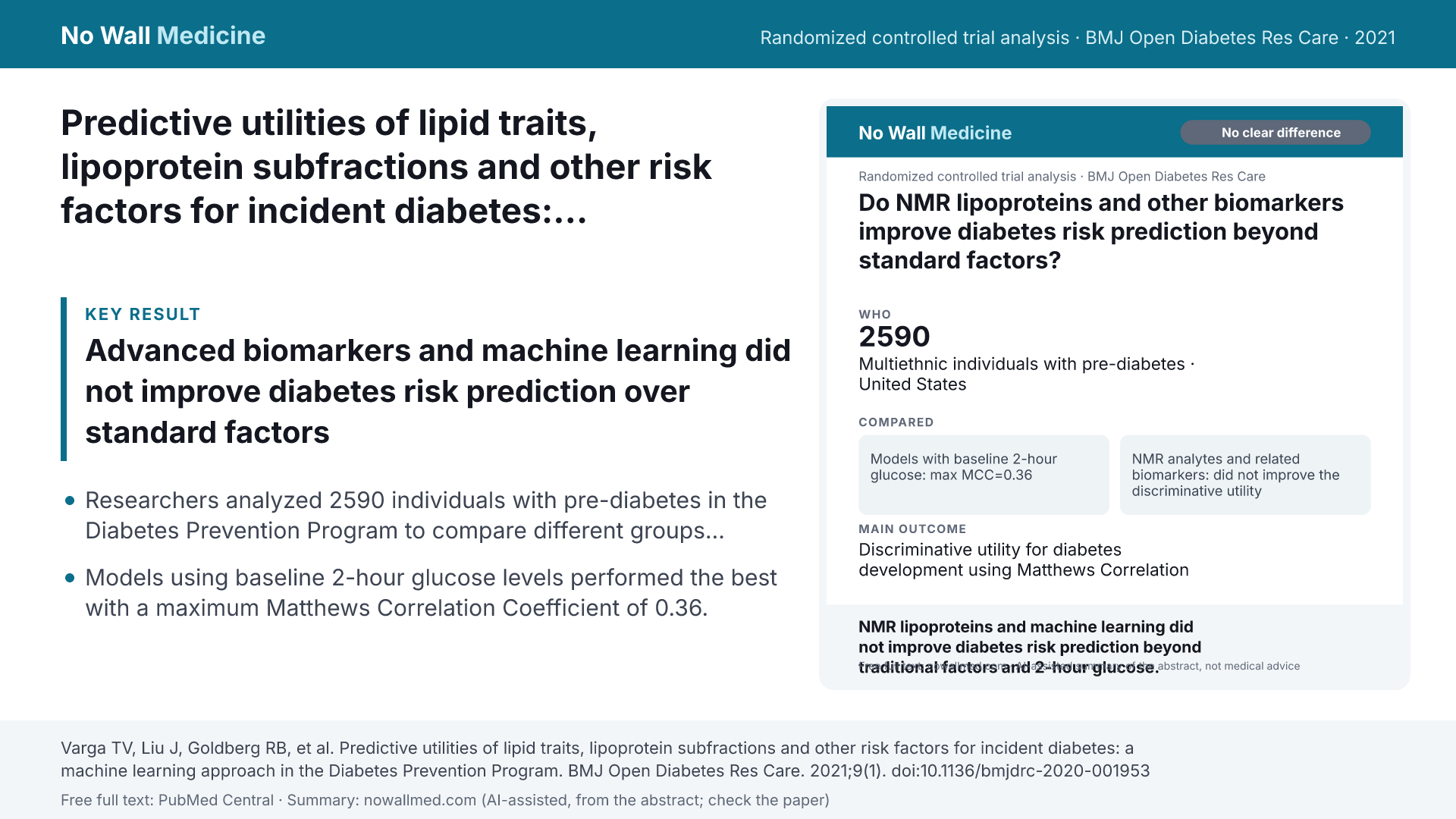
Advanced biomarkers and machine learning did not improve diabetes risk prediction over standard factors
Predictive utilities of lipid traits, lipoprotein subfractions and other risk factors for incident diabetes: a machine learning approach in the Diabetes Prevention Program
Randomized controlled trial analysisNo clear difference
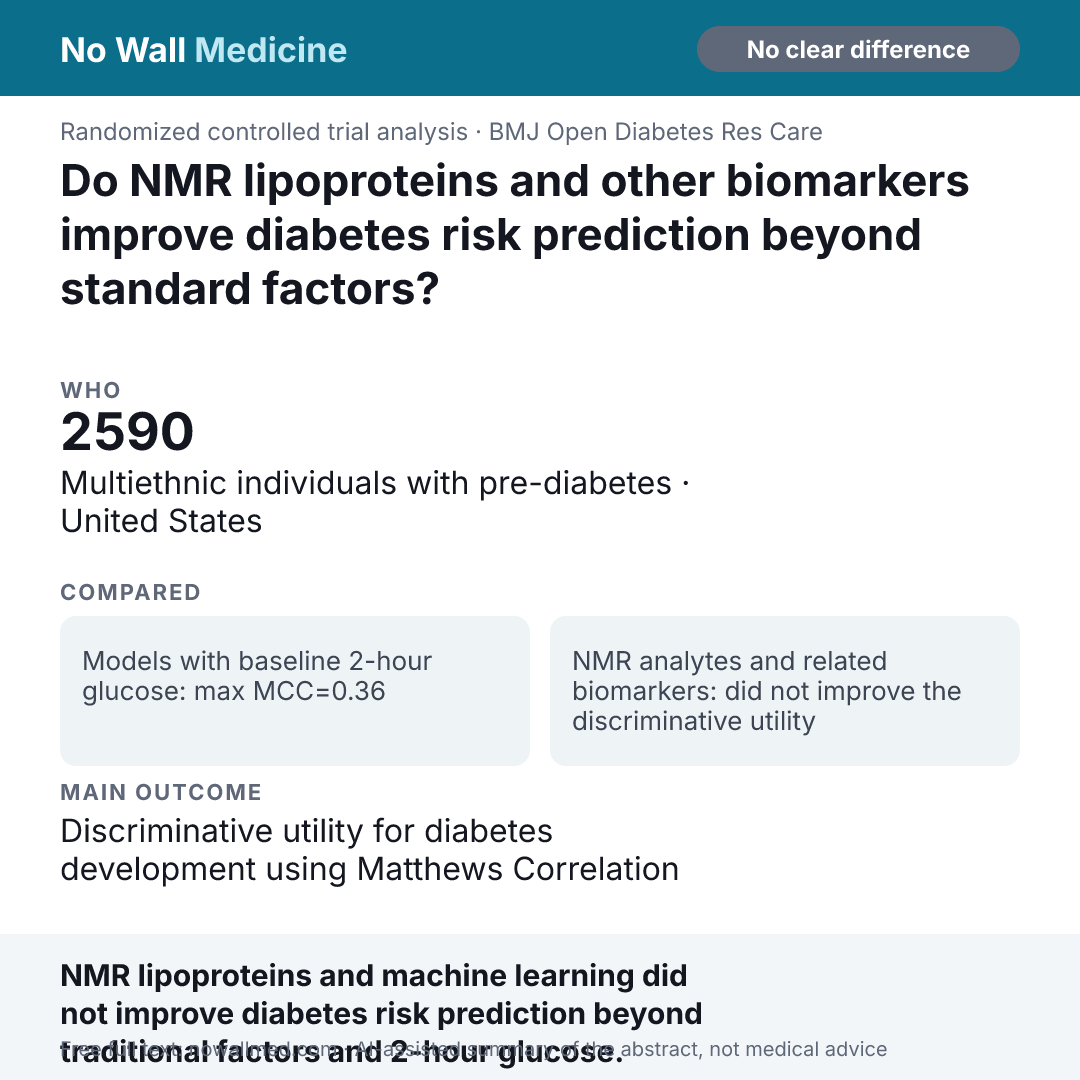
Do NMR lipoproteins and other biomarkers improve diabetes risk prediction beyond standard factors?
Who
2590
Multiethnic individuals with pre-diabetes · United States
Compared
Models with baseline 2-hour glucose: max MCC=0.36
NMR analytes and related biomarkers: did not improve the discriminative utility
Main outcome
Discriminative utility for diabetes development using Matthews Correlation Coefficient
Bottom line: NMR lipoproteins and machine learning did not improve diabetes risk prediction beyond traditional factors and 2-hour glucose.
BMJ Open Diabetes Res Care · 2021-04-01 · Save PNG
Same trial (NCT00004992, NCT00038727)
Papers we list that report this registered trial, oldest first. Read a secondary analysis alongside the main results.
- Related analysis Benefit found
Intensive lifestyle intervention was associated with lower frailty risk compared to metformin or placebo J Gerontol A 2021-01 - Secondary analysis No clear difference
This paper BMJ Open Diabetes Res Care 2021-04 - Related analysis No clear difference
Metformin and lifestyle interventions were not linked to fewer major cardiovascular events over 21 years Circulation 2022-05 - Related analysis Mixed results
High coronary artery calcium was associated with greater verbal memory decline in women J Am Heart Assoc 2023-11 - Main results Benefit found
Lifestyle changes and metformin maintained lower type 2 diabetes incidence over 21 years Lancet Diabetes Endocrinol 2025-04 - Related analysis Benefit found
Improving lifestyle recommendation scores was associated with lower risk of lifestyle-related cancers Am J Clin Nutr 2025-07 - Related report
Associations of Perfluoroalkyl and Polyfluoroalkyl Substances With Cardiovascular Disease Incidence in Adults With Prediabetes: Findings From the Diabetes Prevention Program J Am Heart Assoc 2025-12
Clinical question: Do NMR lipoproteins and other biomarkers improve diabetes risk prediction beyond standard factors?
Key points
- Researchers analyzed 2590 individuals with pre-diabetes in the Diabetes Prevention Program to compare different groups of biomarkers for predicting diabetes development.
- Models using baseline 2-hour glucose levels performed the best with a maximum Matthews Correlation Coefficient of 0.36.
- Adding nuclear magnetic resonance spectroscopy-derived biomarkers did not improve the ability to predict diabetes risk compared to using standard lipids or demographic and glycemic traits.
Headline and key points written with AI from the paper’s abstract, with every number checked against it. Read the paper before relying on them.
Was this summary helpful?
Abstract
Introduction
Although various lipid and non-lipid analytes measured by nuclear magnetic resonance (NMR) spectroscopy have been associated with type 2 diabetes, a structured comparison of the ability of NMR-derived biomarkers and standard lipids to predict individual diabetes risk has not been undertaken in larger studies nor among individuals at high risk of diabetes. Research design and methods
Cumulative discriminative utilities of various groups of biomarkers including NMR lipoproteins, related non-lipid biomarkers, standard lipids, and demographic and glycemic traits were compared for short-term (3.2 years) and long-term (15 years) diabetes development in the Diabetes Prevention Program, a multiethnic, placebo-controlled, randomized controlled trial of individuals with pre-diabetes in the USA (N=2590). Logistic regression, Cox proportional hazards model and six different hyperparameter-tuned machine learning algorithms were compared. The Matthews Correlation Coefficient (MCC) was used as the primary measure of discriminative utility. Results
Models with baseline NMR analytes and their changes did not improve the discriminative utility of simpler models including standard lipids or demographic and glycemic traits. Across all algorithms, models with baseline 2-hour glucose performed the best (max MCC=0.36). Sophisticated machine learning algorithms performed similarly to logistic regression in this study. Conclusions
NMR lipoproteins and related non-lipid biomarkers were associated but did not augment discrimination of diabetes risk beyond traditional diabetes risk factors except for 2-hour glucose. Machine learning algorithms provided no meaningful improvement for discrimination compared with logistic regression, which suggests a lack of influential latent interactions among the analytes assessed in this study. Trial registration number
Diabetes Prevention Program: NCT00004992; Diabetes Prevention Program Outcomes Study: NCT00038727.
Abstract reproduced under the article’s CC BY NC licence.
Subject terms
Headline, design, result, key points, caveat and citation as plain text.
Cite this article
Varga TV, Liu J, Goldberg RB, et al. Predictive utilities of lipid traits, lipoprotein subfractions and other risk factors for incident diabetes: a machine learning approach in the Diabetes Prevention Program. BMJ Open Diabetes Res Care. 2021. doi:10.1136/bmjdrc-2020-001953
Spotted a mistake? Suggest a correction