Predictive utilities of lipid traits, lipoprotein subfractions and other risk factors for incident diabetes: a machine learning approach in the Diabetes Prevention Program
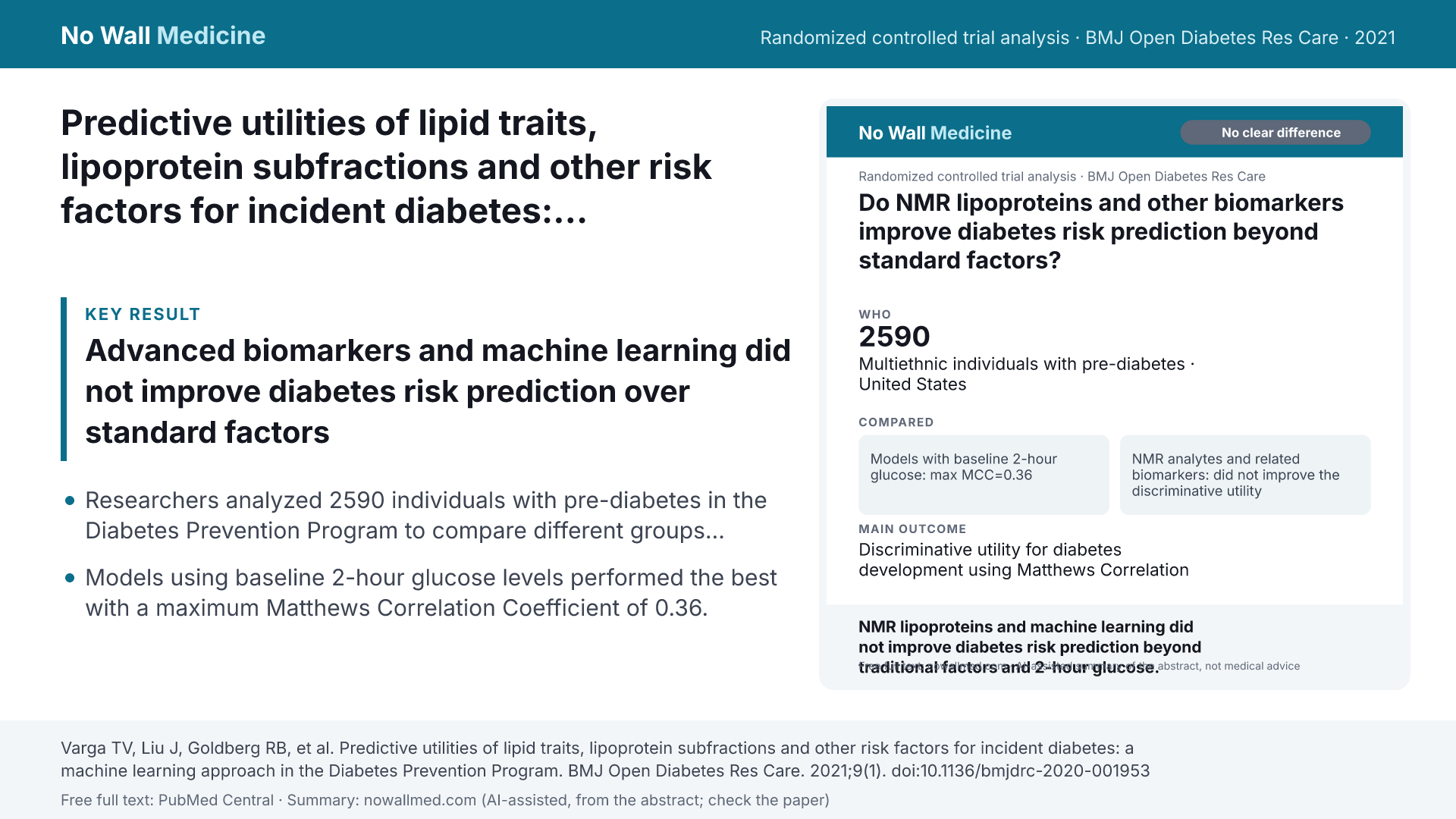
Key result: Advanced biomarkers and machine learning did not improve diabetes risk prediction over standard factors
Randomized controlled trial analysisNo clear difference
Do NMR lipoproteins and other biomarkers improve diabetes risk prediction beyond standard factors?
Who
2590
Multiethnic individuals with pre-diabetes · United States
Compared
Models with baseline 2-hour glucose: max MCC=0.36
NMR analytes and related biomarkers: did not improve the discriminative utility
Main outcome
Discriminative utility for diabetes development using Matthews Correlation Coefficient
Bottom line: NMR lipoproteins and machine learning did not improve diabetes risk prediction beyond traditional factors and 2-hour glucose.
BMJ Open Diabetes Res Care · 2021-04-01
Key points
- Researchers analyzed 2590 individuals with pre-diabetes in the Diabetes Prevention Program to compare different groups of biomarkers for predicting diabetes development.
- Models using baseline 2-hour glucose levels performed the best with a maximum Matthews Correlation Coefficient of 0.36.
- Adding nuclear magnetic resonance spectroscopy-derived biomarkers did not improve the ability to predict diabetes risk compared to using standard lipids or demographic and glycemic traits.
Discussion prompts
- Would these patients look like yours? Who was left out?
- Is the main outcome one that matters to patients?
- Is the difference large enough to change what you do?
Cite: Varga TV, Liu J, Goldberg RB, et al. Predictive utilities of lipid traits, lipoprotein subfractions and other risk factors for incident diabetes: a machine learning approach in the Diabetes Prevention Program. BMJ Open Diabetes Res Care. 2021;9(1). doi:10.1136/bmjdrc-2020-001953
Free full text: PubMed Central · Summary and visual abstract: nowallmed.com/a/predictive-utilities-of-lipid-traits-lipoprotein-subfractions-and-hruzbm/ (AI-assisted from the abstract; check the paper before relying on it).