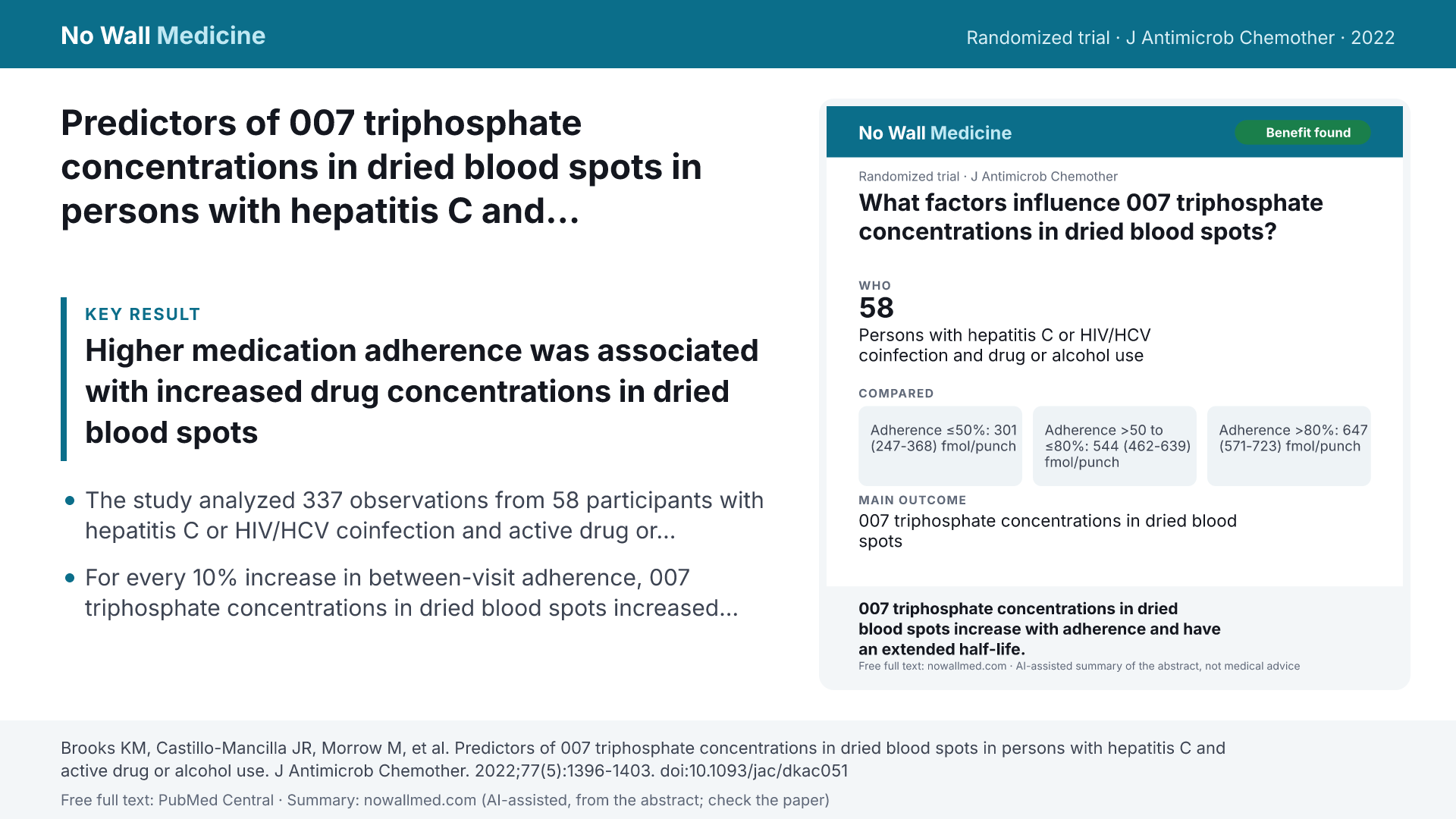
Higher medication adherence was associated with increased drug concentrations in dried blood spots
Predictors of 007 triphosphate concentrations in dried blood spots in persons with hepatitis C and active drug or alcohol use
Randomized trialBenefit found
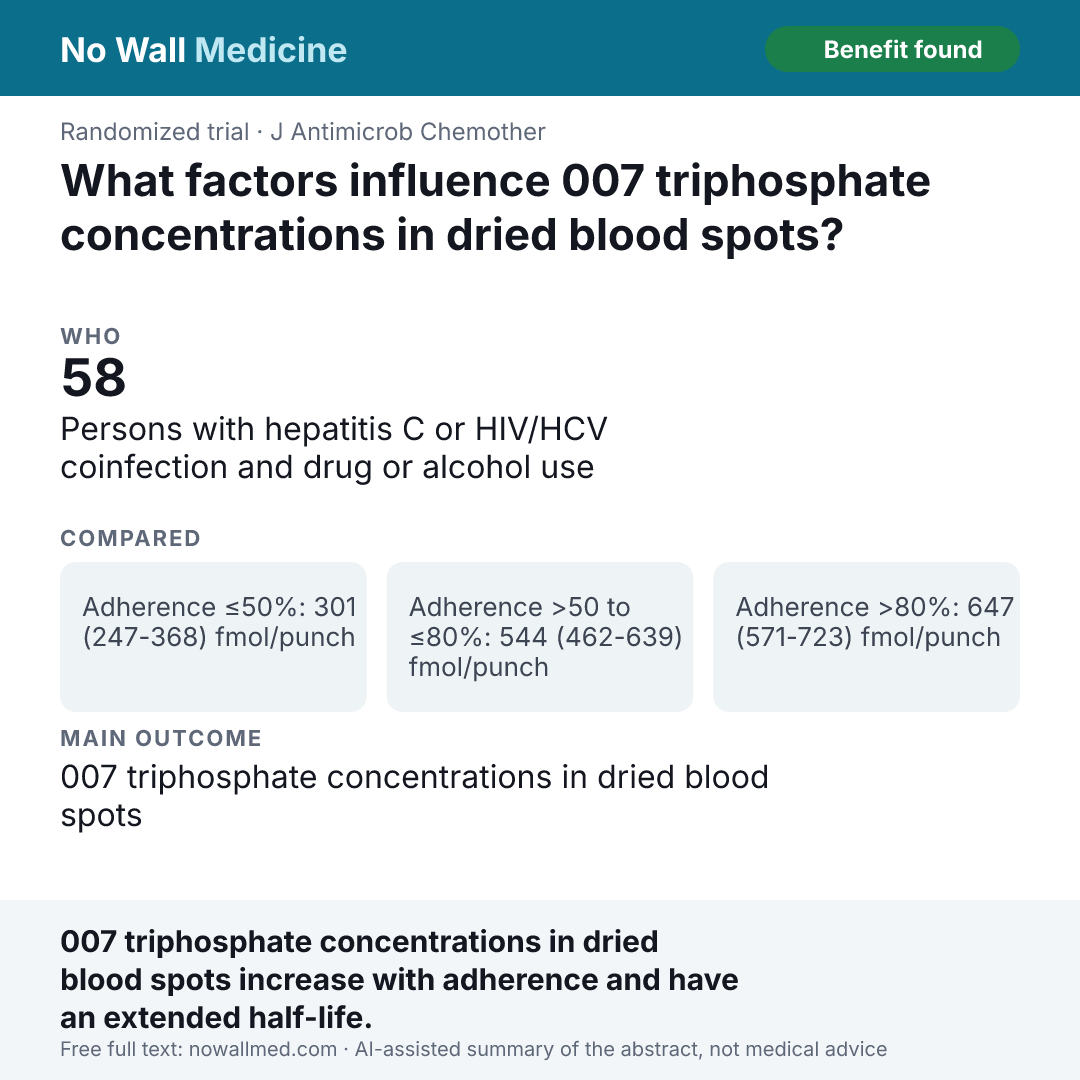
What factors influence 007 triphosphate concentrations in dried blood spots?
Who
58
Persons with hepatitis C or HIV/HCV coinfection and drug or alcohol use
Compared
Adherence ≤50%: 301 (247-368) fmol/punch
Adherence >50 to ≤80%: 544 (462-639) fmol/punch
Adherence >80%: 647 (571-723) fmol/punch
Main outcome
007 triphosphate concentrations in dried blood spots
Result: concentrations increased by 7.3% (95% CI 2.2-12.6) for every 10% increase in adherence
Bottom line: 007 triphosphate concentrations in dried blood spots increase with adherence and have an extended half-life.
J Antimicrob Chemother · 2022-02-24 · Save PNG
Clinical question: What factors influence 007 triphosphate concentrations in dried blood spots?
Key points
- The study analyzed 337 observations from 58 participants with hepatitis C or HIV/HCV coinfection and active drug or alcohol use.
- For every 10% increase in between-visit adherence, 007 triphosphate concentrations in dried blood spots increased by 7.3%.
- Higher concentrations were associated with adherence, time on therapy, increasing age, and decreased estimated glomerular filtration rate, which is a measure of kidney function.
Headline and key points written with AI from the paper’s abstract, with every number checked against it. Read the paper before relying on them.
Was this summary helpful?
Subject terms
Headline, design, result, key points, caveat and citation as plain text.
Cite this article
Brooks KM, Castillo-Mancilla JR, Morrow M, et al. Predictors of 007 triphosphate concentrations in dried blood spots in persons with hepatitis C and active drug or alcohol use. J Antimicrob Chemother. 2022;77(5):1396-1403. doi:10.1093/jac/dkac051
Spotted a mistake? Suggest a correction