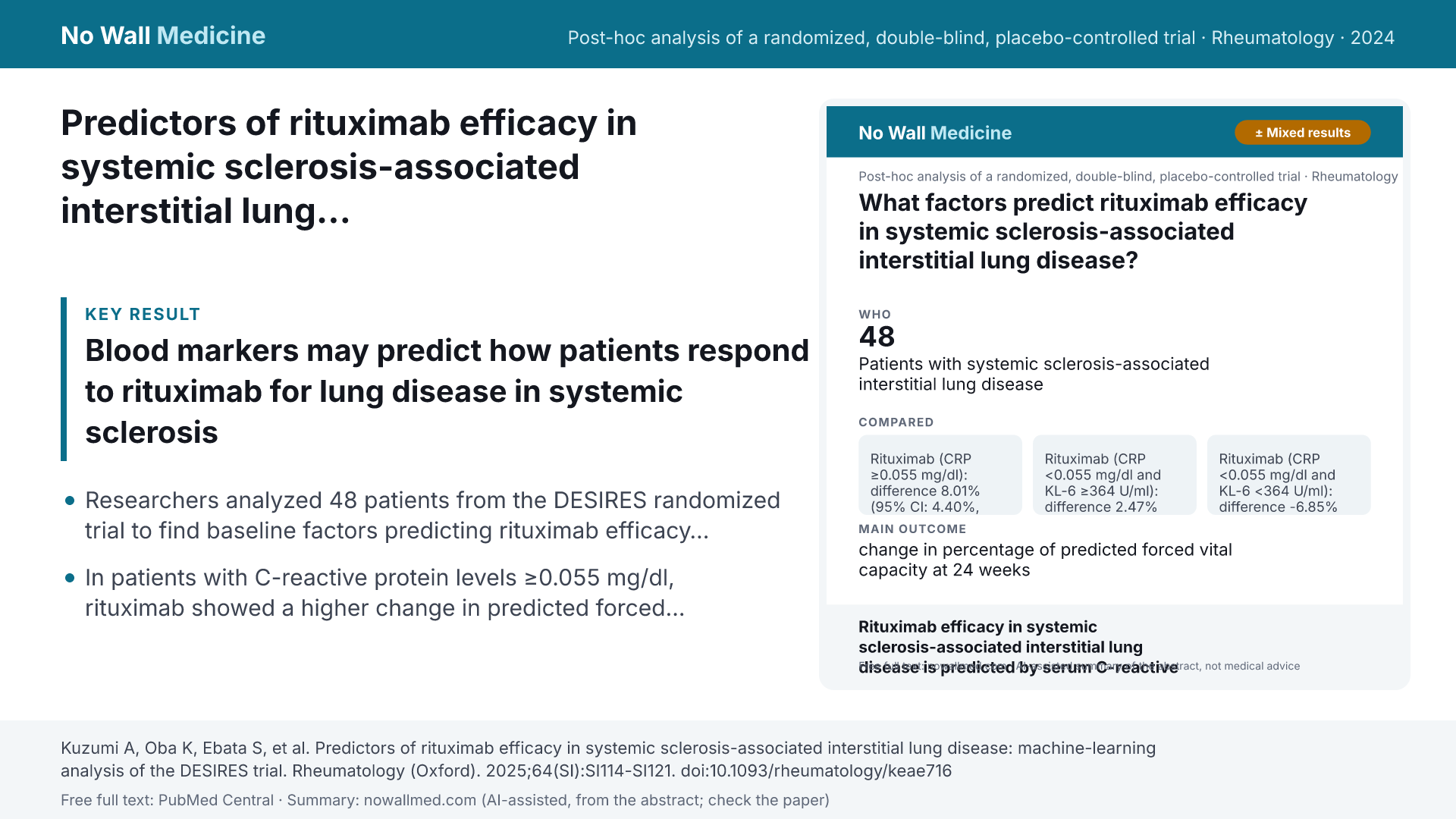
Predictors of rituximab efficacy in systemic sclerosis-associated interstitial lung disease: machine-learning analysis of the DESIRES trial
Key result: Blood markers may predict how patients respond to rituximab for lung disease in systemic sclerosis
Post-hoc analysis of a randomized, double-blind, placebo-controlled trialMixed results
What factors predict rituximab efficacy in systemic sclerosis-associated interstitial lung disease?
Who
48
Patients with systemic sclerosis-associated interstitial lung disease
Compared
Rituximab (CRP ≥0.055 mg/dl): difference 8.01% (95% CI: 4.40%, 11.62%)
Rituximab (CRP <0.055 mg/dl and KL-6 ≥364 U/ml): difference 2.47% (95% CI: -1.99%, 6.92%)
Rituximab (CRP <0.055 mg/dl and KL-6 <364 U/ml): difference -6.85% (95% CI: -10.80%, -2.91%)
Main outcome
change in percentage of predicted forced vital capacity at 24 weeks
Bottom line: Rituximab efficacy in systemic sclerosis-associated interstitial lung disease is predicted by serum C-reactive protein and Krebs von den Lungen-6 levels.
Limitation: This was a post-hoc analysis of prospective data from a single trial.
Rheumatology · 2024-12-24
Key points
- Researchers analyzed 48 patients from the DESIRES randomized trial to find baseline factors predicting rituximab efficacy on lung function at 24 weeks.
- In patients with C-reactive protein levels ≥0.055 mg/dl, rituximab showed a higher change in predicted forced vital capacity than placebo by 8.01%.
- Rituximab showed a lower change in predicted forced vital capacity compared to placebo in patients with C-reactive protein <0.055 mg/dl and Krebs von den Lungen-6 <364 U/ml.
Discussion prompts
- Would these patients look like yours? Who was left out?
- Is the main outcome one that matters to patients?
- Is the difference large enough to change what you do?
Cite: Kuzumi A, Oba K, Ebata S, et al. Predictors of rituximab efficacy in systemic sclerosis-associated interstitial lung disease: machine-learning analysis of the DESIRES trial. Rheumatology (Oxford). 2025;64(SI):SI114-SI121. doi:10.1093/rheumatology/keae716
Free full text: PubMed Central · Summary and visual abstract: nowallmed.com/a/predictors-of-rituximab-efficacy-in-systemic-sclerosis-associated-hi4l61/ (AI-assisted from the abstract; check the paper before relying on it).