Preeclampsia prevention by risk-stratified timed birth: a post-hoc Bayesian analysis of the PREVENT-PE randomised trial
Obstetrics & GynecologyAdult and pediatric
Randomized trial analysisBenefit found
Does risk-stratified timed birth prevent preeclampsia?
Who
4734
Women with singleton pregnancy · London, UK
Compared
4.1%Intervention (117/2871)
5.7%Control (106/1863)
Main outcome
Birth with preeclampsia
Result: incidence ratio 0.72 (95% CrI 0.56-0.93)
Bottom line: Timed birth reduces preeclampsia
Funded by: Fetal Medicine Foundation
eClinicalMedicine · 2026-11-05Download image
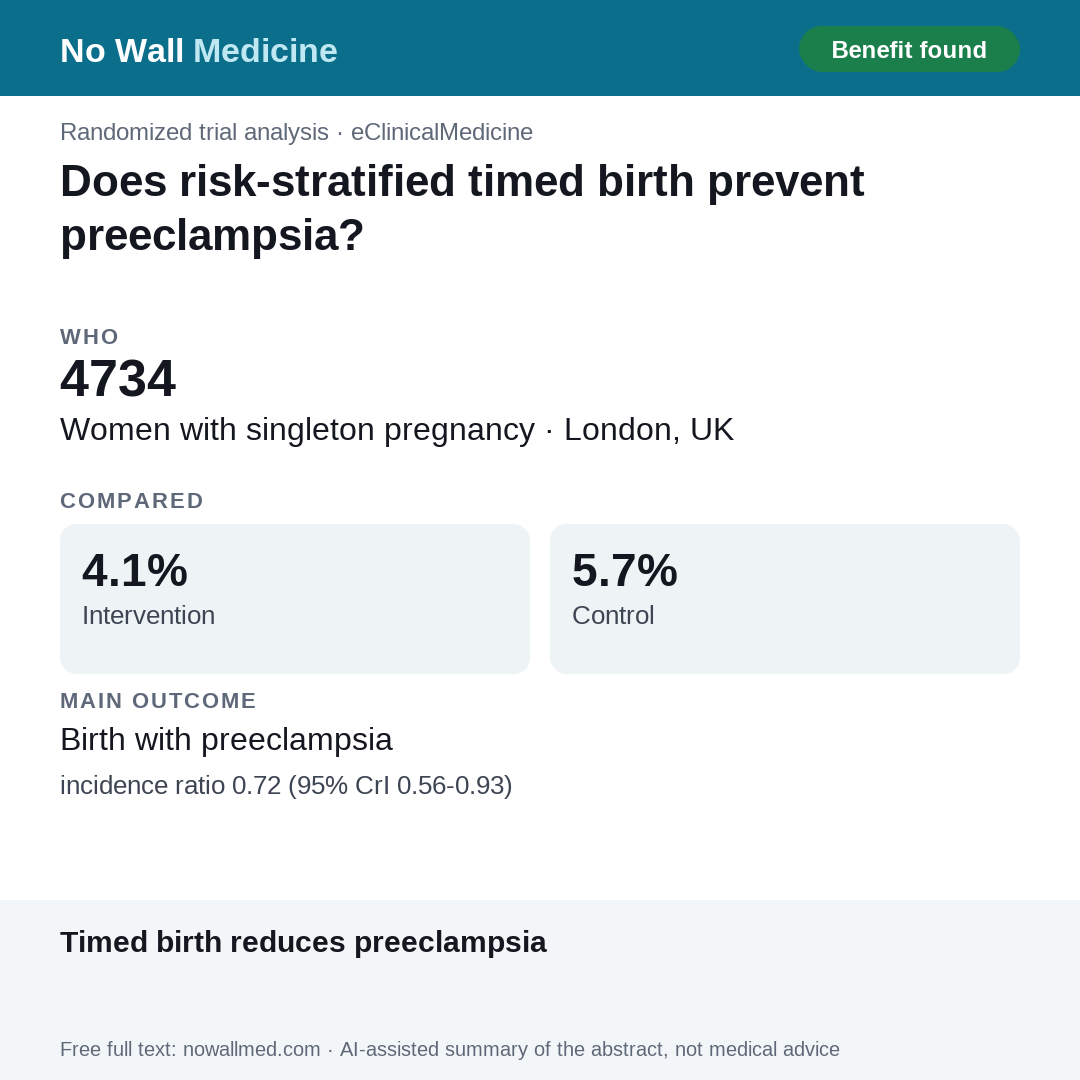
Clinical question: Does risk-stratified timed birth prevent preeclampsia?
In absolute numbers
Intervention: 4.1% · Control: 5.7% → a difference of 1.6 percentage points, so about 63 people would need the treatment for 1 more to benefit (number needed to treat) over the trial’s follow-up.
Worked out by us from the two group results above, not reported by the authors. Check the paper for the exact outcome and timing.
Abstract
Background
PREVENT-PE showed that screening for preeclampsia risk at 35-36 weeks followed by risk-stratified timed birth reduced birth with preeclampsia overall. We aimed to assess possible benefit and harm within each risk stratum. Methods
This post hoc Bayesian analysis included 4734 participants recruited at King's College Hospital, London, UK, in PREVENT-PE. The parent trial included women aged 16 years or older with a live singleton pregnancy, no major fetal abnormality or preeclampsia, and no conflicting trial participation. We included all 2871 intervention participants and 1863 control participants with stored serum and haemodynamic measurements that allowed retrospective calculation of 35-36-week preeclampsia risk. We estimated incidence proportions, ratios, and differences using independent Beta(1, 1) priors and binomial likelihoods. PREVENT-PE is registered with ISRCTN, ISRCTN41632964. Findings
PREVENT-PE recruited between May 9, 2023, and June 7, 2024. Birth with preeclampsia occurred in 117/2871 (4.1%; 95% credible interval [CrI] 3.4-4.9) intervention participants and 106/1863 (5.7%; 4.7-6.8) controls; the posterior median incidence ratio was 0.72 (95% CrI 0.56-0.93), with probability of benefit 0.995. Estimates at 39 and 40 weeks favoured intervention and were more precise; estimates at 37 and 38 weeks were much less precise. Heterogeneity of treatment effect was not established. Overall incidence ratios were 1.03 (0.92-1.15) for emergency caesarean and 0.97 (0.76-1.25) for neonatal unit admission for at least 48 h. Interpretation
The overall PREVENT-PE strategy is supported by randomised evidence, but these post hoc data do not establish different treatment effects across risk strata. The balance of benefit and harm of routine planned birth at 37-38 weeks remains uncertain and needs further evaluation. Funding
Fetal Medicine Foundation.
Cite this article
Wright D, Singh L, Syngelaki A, Magee LA, von Dadelszen P, Wright A. Preeclampsia prevention by risk-stratified timed birth: a post-hoc Bayesian analysis of the PREVENT-PE randomised trial. eClinicalMedicine. 2026. doi:10.1016/j.eclinm.2026.104309
Spotted a mistake? Suggest a correction