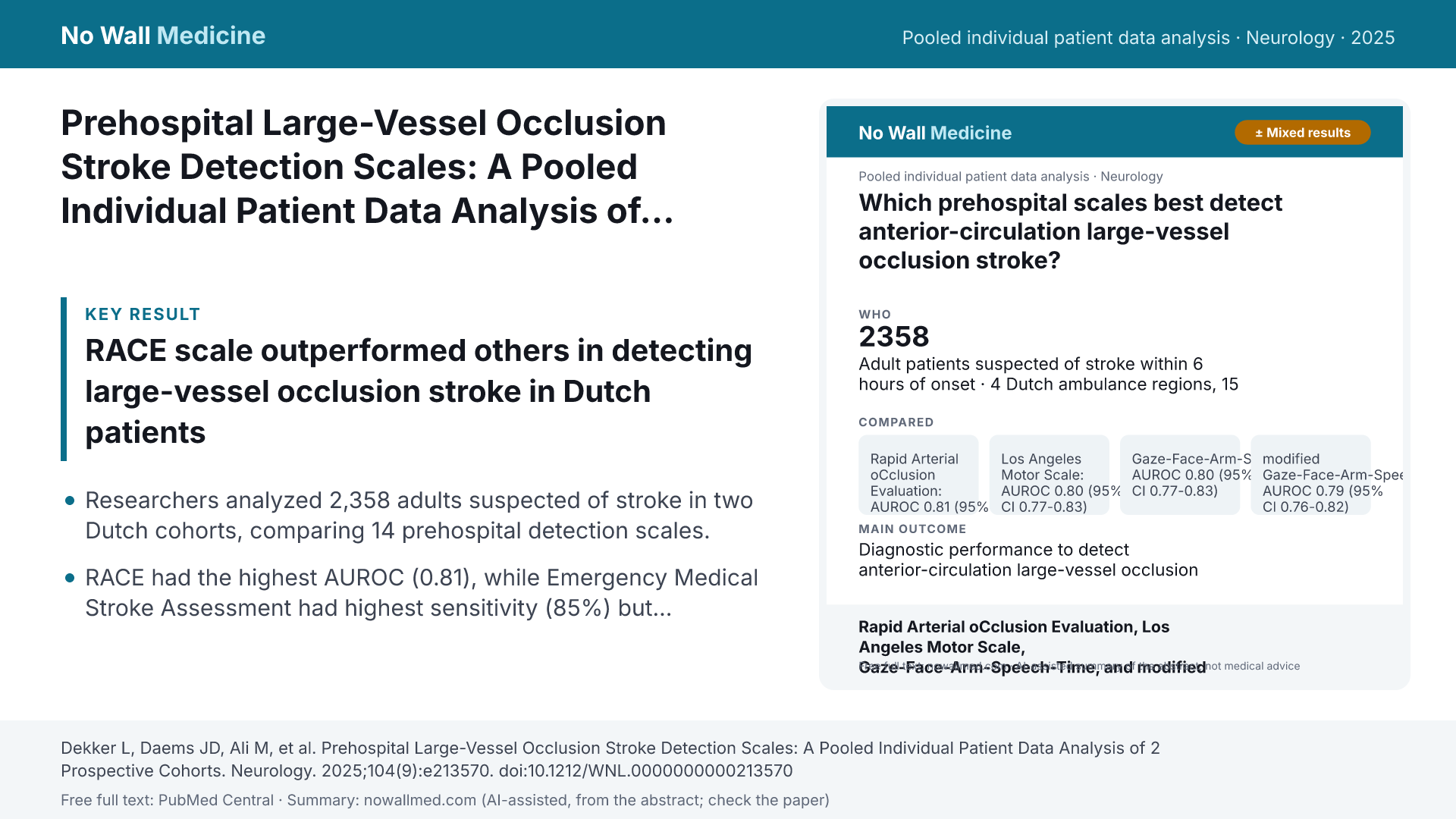
RACE scale outperformed others in detecting large-vessel occlusion stroke in Dutch patients
Prehospital Large-Vessel Occlusion Stroke Detection Scales: A Pooled Individual Patient Data Analysis of 2 Prospective Cohorts
Pooled individual patient data analysisMixed results
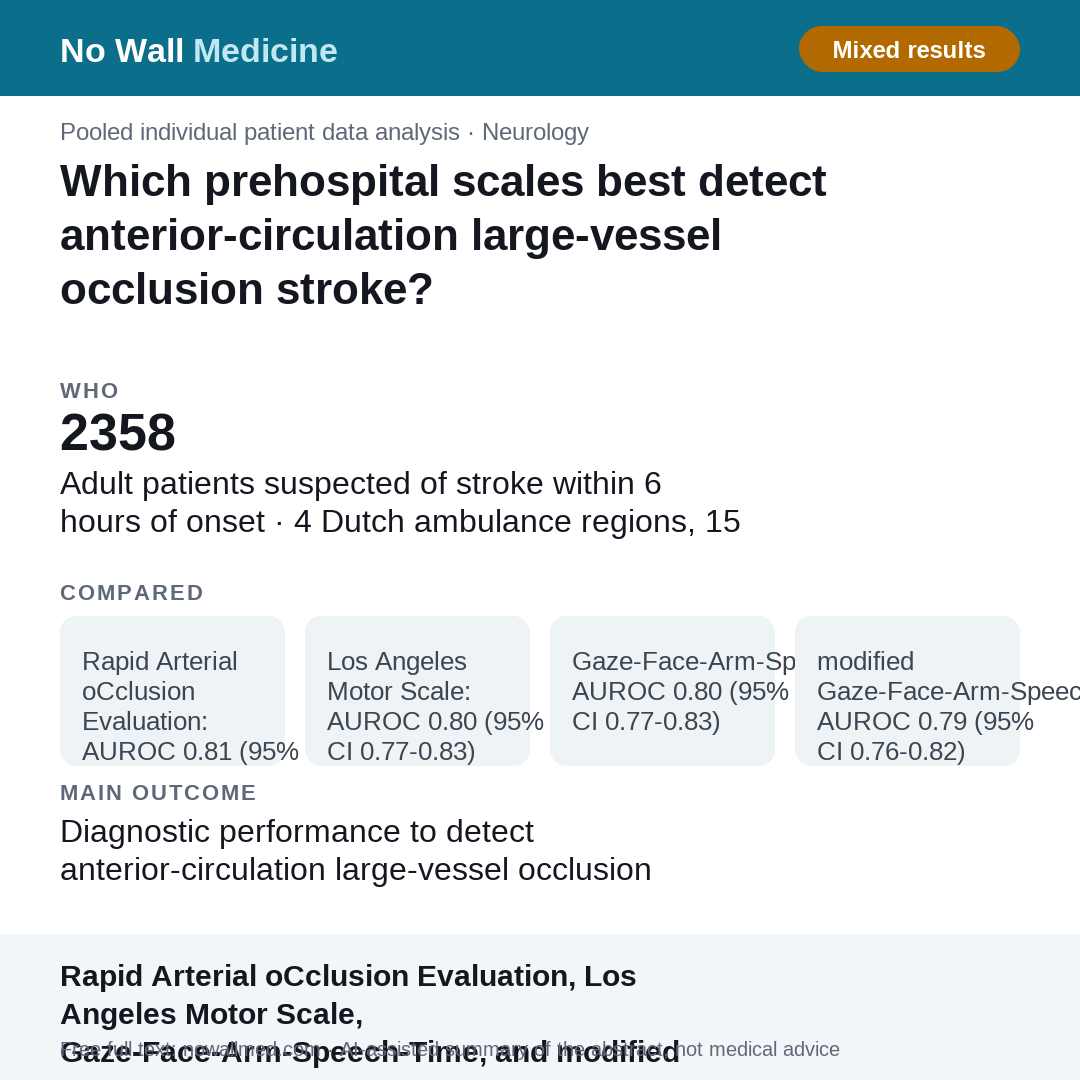
Which prehospital scales best detect anterior-circulation large-vessel occlusion stroke?
Who
2358
Adult patients suspected of stroke within 6 hours of onset · 4 Dutch ambulance regions, 15 stroke centers
Compared
Rapid Arterial oCclusion Evaluation: AUROC 0.81 (95% CI 0.78-0.84)
Los Angeles Motor Scale: AUROC 0.80 (95% CI 0.77-0.83)
Gaze-Face-Arm-Speech-Time: AUROC 0.80 (95% CI 0.77-0.83)
modified Gaze-Face-Arm-Speech-Time: AUROC 0.79 (95% CI 0.76-0.82)
Main outcome
Diagnostic performance to detect anterior-circulation large-vessel occlusion stroke
Bottom line: Rapid Arterial oCclusion Evaluation, Los Angeles Motor Scale, Gaze-Face-Arm-Speech-Time, and modified Gaze-Face-Arm-Speech-Time are the best-performing scales.
Neurology · 2025-04-08Download image
Clinical question: Which prehospital scales best detect anterior-circulation large-vessel occlusion stroke?
Why it matters: A head-to-head comparison of prehospital scales was needed to determine which is most useful for triage in different regional contexts.
Key points
- Researchers analyzed 2,358 adults suspected of stroke in two Dutch cohorts, comparing 14 prehospital detection scales.
- RACE had the highest AUROC (0.81), while Emergency Medical Stroke Assessment had highest sensitivity (85%) but lowest specificity (58%).
- Decision curve analysis showed RACE offered the highest benefit across a clinically reasonable range of harm-benefit trade-offs.
Limitation the authors note: The study used data from only two prospective observational cohorts conducted between 2018 and 2019 in the Netherlands.
Headline and key points written with AI from the paper’s abstract, with every number checked against it. Read the paper before relying on them.
Was this summary helpful?
Subject terms
Cite this article
Dekker L, Daems JD, Ali M, et al. Prehospital Large-Vessel Occlusion Stroke Detection Scales: A Pooled Individual Patient Data Analysis of 2 Prospective Cohorts. Neurology. 2025. doi:10.1212/WNL.0000000000213570
Spotted a mistake? Suggest a correction