Prenatal hormone injections showed no significant impact on child development or mortality at 14 years
Prenatal 17-Alpha-Hydroxyprogesterone Caproate Exposure in Twins and Childhood Outcomes: 14-Year Follow-Up of a Randomised Trial
Follow-up of a randomized controlled trialNo clear difference
What are the long-term child outcomes after intra-uterine exposure to 17-alpha-hydroxyprogesterone caproate?
Who
1296
Children born in the AMPHIA study from multiple pregnancies · Multicentre
Compared
23.3%17-alpha-hydroxyprogesterone caproate
20.1%placebo
Main outcome
Composite of abnormal development
Result: OR 1.31 (95% CI 0.66-2.56)
Bottom line: Prenatal 17-alpha-hydroxyprogesterone caproate exposure is unlikely to affect child mortality, education, cognition, or behavior.
Limitation: Detailed developmental outcomes were collected for only 23% of surviving children.
BJOG · 2026-03-23Download image
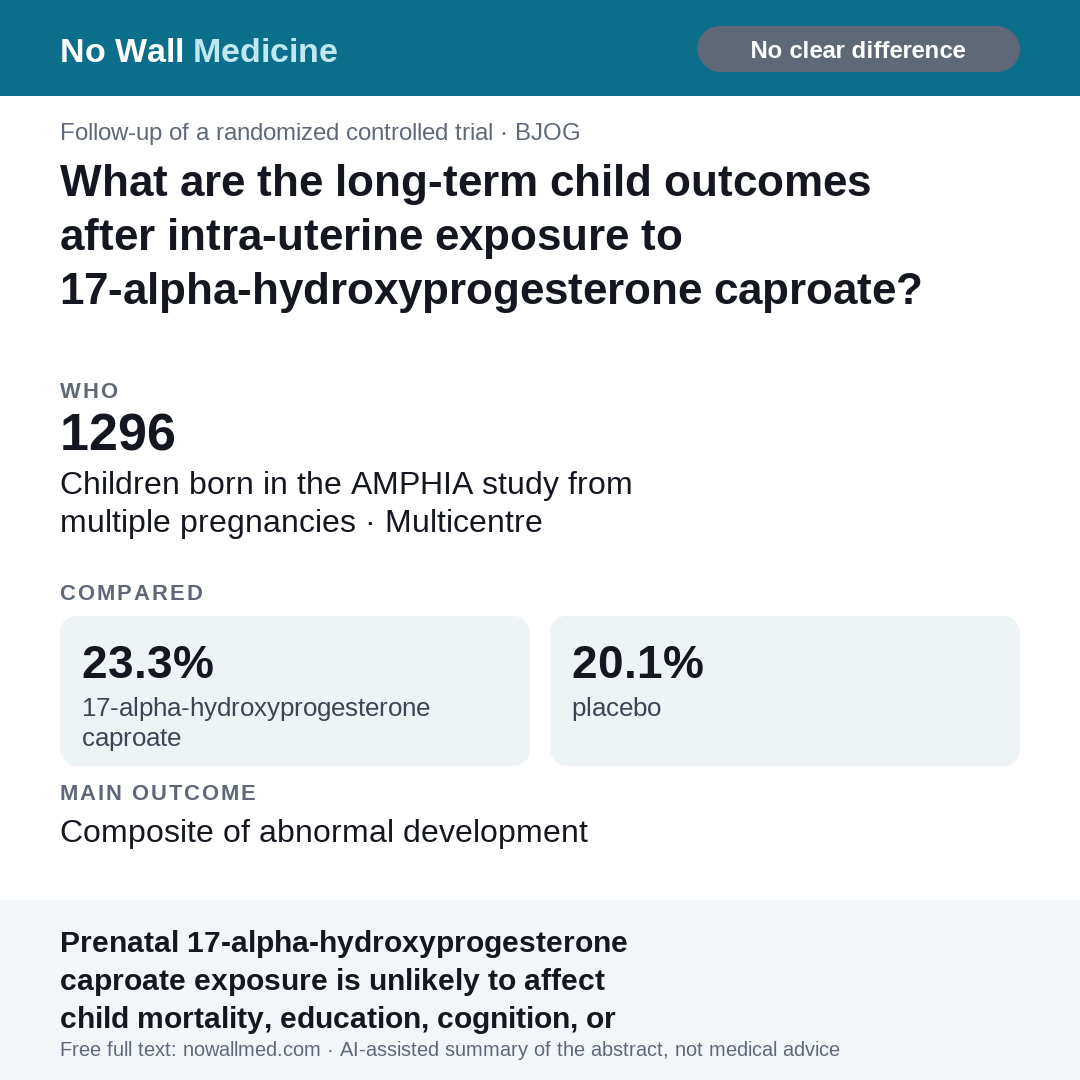
Clinical question: What are the long-term child outcomes after intra-uterine exposure to 17-alpha-hydroxyprogesterone caproate?
Why it matters: It was unknown how prenatal exposure to 17-alpha-hydroxyprogesterone caproate in multiple pregnancies affects long-term child outcomes.
Key points
- Researchers followed children from the AMPHIA randomized controlled trial to compare outcomes between those exposed to 17-alpha-hydroxyprogesterone caproate and those given a placebo.
- No significant differences were found in educational attainment, cognition, behavior, gender identity, general health, or the composite of abnormal development between the two groups.
- Up to 14 years, 60/1356 children had died, consisting of 24 in the hormone group and 36 in the placebo group.
Limitation the authors note: Detailed developmental outcomes through questionnaires were collected for only 303/1296 (23%) surviving children.
Headline and key points written with AI from the paper’s abstract, with every number checked against it. Read the paper before relying on them.
Topics
Spotted a mistake? Suggest a correction